Wedding Memorial Ideas to Honor Someone Who Died
Gentle wedding memorial ideas to honor a parent or loved one who has passed, from memorial tables and program wording to toasts and keepsakes you can carry.
Planning a Wedding When Someone You Love Is Missing
Picture the morning of the wedding. The dress or suit is finally on, someone is fussing with the last detail, and for one unguarded second you reach for your phone to send a photo to a person who is no longer there to see it. Then you remember. That instinct, quick and involuntary, is why so many couples start searching for wedding memorial ideas in the weeks before the ceremony. Not because they want the day to feel sad, but because it cannot feel complete without making room for the person who is missing.
Grief has a way of resurfacing around milestones, even joyful ones. It can catch you in a fitting room, during a toast rehearsal, or while lining up chairs for the ceremony. The Hospice Foundation of America's advice for grieving through meaningful occasions centers on three ideas that fit a wedding well: choose deliberately how you want to mark the day, communicate those choices with the people around you, and leave room for compromise within your family.
This guide walks through the questions couples ask most: how to honor a late father or mother, how to set up a memorial table or an empty chair, what to say during the ceremony, what to write in the program, who walks you down the aisle, whether to mention them in a toast, and how to carry something of theirs with you. If you want ideas that reach beyond the wedding day, our guide to meaningful ways to honor a loved one who has passed away is a good place to start. None of what follows needs to be a grand gesture. Most of these ideas take a few minutes to plan and last far longer than the day itself.
Key Takeaways
Small tributes carry big meaning. A quiet gesture often means more than a large public one, and you get to decide how visible your tribute is.
Choose one focal point. A memorial table, an empty chair, or a single program line can honor someone without taking over the day.
Anyone can walk you down the aisle. A sibling, grandparent, your partner, or walking on your own are all meaningful choices.
Loop in your speakers early. Agree ahead of time on who will mention your loved one in a toast so it stays short and never catches the room off guard.
Check in with family first. Talk with a surviving parent or close relatives before planning a public tribute, especially in blended families.
How to Honor a Deceased Father at a Wedding
Couples most often honor a late father through something small and personal, the kind of detail that means everything to the people who knew him and needs no explanation for anyone who did not. A few of the most loved ideas:
- A photo charm wrapped around the bouquet stem or pinned to a boutonniere
- A piece of his shirt, tie, or jacket sewn into the dress lining or a suit jacket
- His watch, cufflinks, or ring worn for the day
- His favorite song played during the processional, or in place of a father-daughter or father-son dance
- A reserved seat in the front row, marked with a flower or a small photo
If the traditional father dance feels like too much to sit through, there are gentler ways to mark the moment. Some couples dance with a grandfather, an uncle, or the surviving parent. Others simply stand still for the length of his favorite song and let the room hold the quiet with them. Neither choice is more meaningful than the other. What matters is picking whatever feels honest for your family, not whatever you have seen at someone else's wedding.
One thing most wedding guides skip: you do not need to replace every "father moment" on the timeline, from the first look to the last dance. It usually works better to choose one or two moments to mark deliberately and let the rest of the day unfold as it would have anyway. A tribute in every transition can make the absence feel bigger than it needs to, while a single, well-placed moment often says just as much.
How to Honor a Deceased Mother at a Wedding
For a late mother, many of the most treasured tributes are ones you can wear, hold, or even taste. Some couples cook one of her recipes for the reception or the late-night menu, so every guest shares a little piece of her that day. Other ideas to consider:
- Wearing her wedding dress, or reworking part of it, such as the lace, buttons, or veil, into your own look
- Tucking her favorite flower somewhere in the bouquet or centerpieces
- Wearing her jewelry or a touch of her perfume
- Her handwriting from an old card, engraved or printed onto a ring, cufflink, or bouquet wrap
- One of her recipes served at the reception or as a late-night snack
For many people, it is the getting-ready stretch of the morning, not the ceremony, where a mother's absence is felt most. It is a quiet, unhurried time she might have filled: fixing a hem, pouring coffee, reminding you to breathe. Asking an aunt, a grandmother, or a close friend to step into that role for the morning, even informally, can soften the gap without pretending to replace her.
It helps to name who will stand in for a role ahead of time, so nobody is caught off guard on the day, whether that role is fixing your veil or simply sitting beside you while you get dressed. It also helps to remember that the wedding does not have to hold everything. A quieter moment on the anniversary of her passing, or another date that matters to your family, can carry some of the weight. Our guide to anniversary ideas and remembrance messages has ideas for those days.
Memorial Table and Empty Chair Ideas for a Wedding
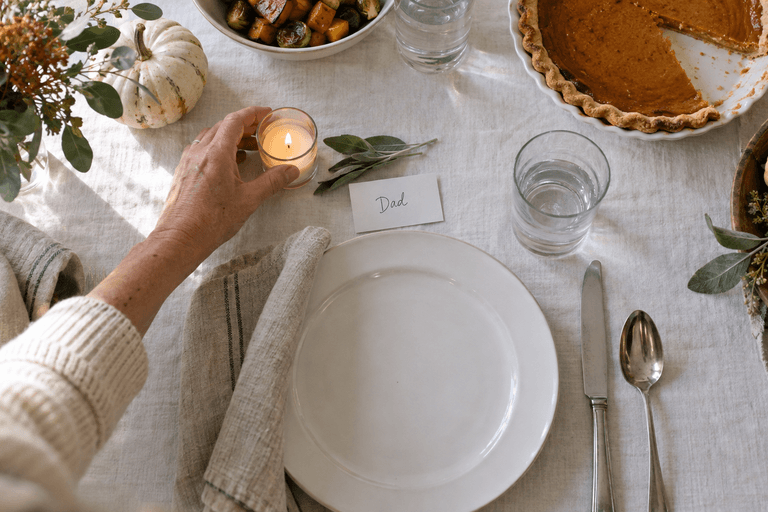
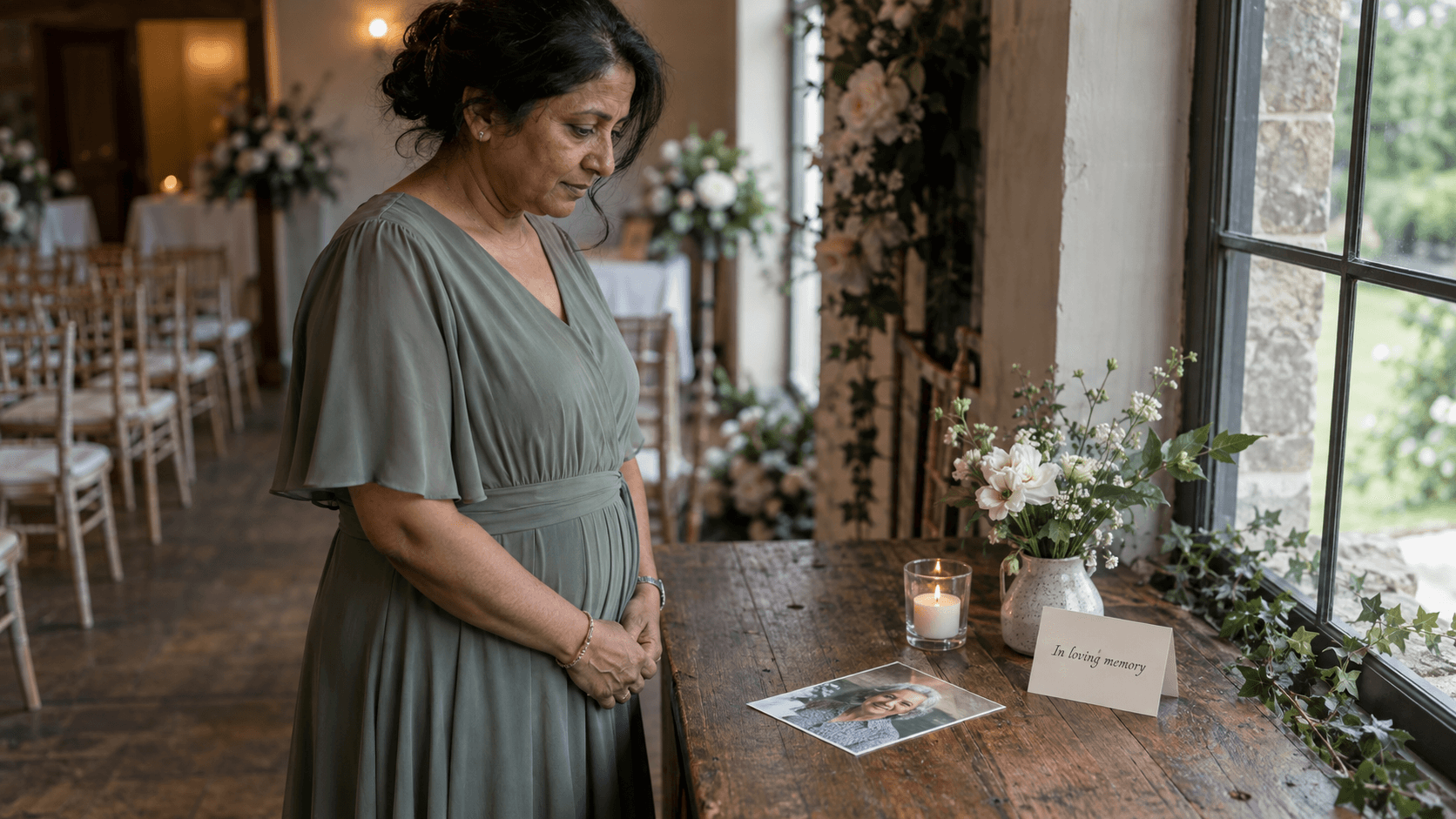
Many couples want a tribute that guests can notice without anyone explaining it from the microphone. A memorial table near the entrance, or a single marked seat up front, does exactly that. It gives anyone who knew the person a moment to pause, and it quietly answers the question for anyone who did not.
If you want the table to do more than hold a photo, you can create a free online memorial ahead of time and point guests to it with a QR code. It gives them a place to read the person's full story during the reception and to add their own photos from the wedding afterward.
Six Ways to Set a Memorial Table or Empty Chair
A Framed Photo Table
Set a favorite photo near the guestbook or entrance, where guests pass on their way in rather than inside the receiving line.
A Reserved Chair Up Front
Leave one seat in the front row with a flower, their hat, or a small handwritten sign, so their place at the ceremony is visible without a word being said.
A Remembrance Candle Table
A single candle beside their photo is a quiet, traditional touch, though it is worth checking your venue's rules and considering a flameless candle instead.
A Sign With a Short Verse
A small standing sign with their name and a line or two of verse gives guests a simple, dignified way to notice the tribute on their own.
A Memory Jar for Guests
Set out cards and a jar labeled with their name, and invite guests to write down a favorite memory or a piece of advice for the newlyweds.
A QR Code to Their Memorial Page
Print a QR code on the table linking to an online memorial page, so guests can read their story and keep adding photos long after the wedding ends.
Where you place the table matters as much as what is on it. Set it somewhere guests naturally pass, such as beside the guestbook, rather than in the flow of the receiving line. Then ask a bridesmaid, usher, or family friend to check on it during the reception, since photos get knocked over and candles need watching.
If you do include a candle, treat it the way you would at home. The National Fire Protection Association's candle safety tips advise keeping any lit candle at least one foot away from anything that can burn and never leaving it unattended, which is easy to forget on a table crowded with frames, ribbon, and a guestbook. Some venues restrict open flame entirely, so check before you plan around one. A flameless candle, which the NFPA also suggests considering, sidesteps the question altogether.
Whatever you choose, the feeling behind it is one families know from the holidays too: the quiet ache of an empty seat at a family table. We write more about that in our guide to the first Thanksgiving without them, if you are looking for ways to carry that tradition beyond the wedding day.
How to Mention Family That Has Passed at a Wedding
The most common spoken acknowledgments are simple: a line in the officiant's welcome, a brief moment of silence, lighting a candle during the ceremony, or naming the person in a reading or prayer. Officiants are used to weaving this in, and a few words are usually enough. Couples often borrow something close to: 'As we celebrate today, we hold in our hearts those who could not be here, especially [name], who is loved and remembered.' Or more simply: 'Let us pause for a moment of silence in memory of those we wish could be with us today.' A third option folds it into the welcome itself: '[Names] are here in spirit, and we feel their love as we begin this celebration.'
Couples marrying in the Catholic Church have a built-in place for this. The Universal Prayer, also called the Prayer of the Faithful, is part of the Order of Celebrating Matrimony, and the USCCB's guidance on the Universal Prayer notes that in a particular celebration such as a wedding, the intentions can focus more closely on the occasion itself. One of the Order's model intercessions asks the assembly to pray for all members of our families who have passed from this world, and for all the departed, language couples can use as written or adapt with their priest or deacon.
Jewish tradition holds its own version of this, and it begins before the wedding day. A bride or groom who has lost a parent often visits the grave in the days before the wedding, sometimes leaving an invitation there as a way of inviting the parent to the celebration, according to Chabad.org's reflection on this wedding invitation custom. Many communities also include a memorial prayer during the procession itself, which we cover in the aisle section below.
Hearing a loved one's name said out loud, in a room full of people who knew them, can be one of the moments that stays with you longest, more than the flowers or the food. If your family situation is layered, such as a blended family or a complicated relationship, talk with a surviving parent and siblings before naming anyone publicly, so the moment lands the way you intend for everyone in the room. Saying a name out loud together is a small ritual we also explore in our guide on getting through a first birthday without them, and it translates easily to a wedding day.
How to Word a Memorial Line in the Wedding Program
Keep it simple: one or two lines, placed at the bottom of the order of ceremony or on the back page, using the person's full name and their relationship to the couple. That is really the whole formula. Everything else is a matter of tone, and a few sample wordings tend to help more than any rule:
- 'In loving memory of the bride's father, James Carter, who is with us in every moment today.'
- 'In loving memory of the groom's mother, Linda Ruiz, watching over this day with love.'
- 'In loving memory of our grandparents, Robert and Helen Sinclair, whose love made this day possible.'
- 'Remembering with love: James Carter, Linda Ruiz, and Michael Carter, forever in our hearts.'
- 'In memory of our dear friend, David Kim, who we wish could be here to celebrate with us.'
- 'In loving memory of the groom's brother, Daniel Carter, always by our side.'
- 'For James Carter, who taught the bride to dance in the kitchen and would have loved this one most of all.'
A few practical details make this easier. Confirm name spellings with family before the program goes to print, since this is one detail nobody wants to see wrong later. Most couples leave out birth and passing dates, because the line is meant as a tribute rather than an obituary, though there is no rule against including them if that feels right to your family. Match the tone to the rest of the program: a formal program calls for formal wording, while a more casual one can carry something closer to that last example.
If you would rather let someone else's words carry the moment, many couples borrow a line from Thomas Campbell's poem Hallowed Ground, printed at the bottom of the program or on a memorial table sign when they want something timeless.
“To live in hearts we leave behind is not to die.”
Who Walks You Down the Aisle When Your Father Has Died?
Anyone you choose can walk you down the aisle, or you can walk it alone. There is genuinely no rule here, only what feels right for your family. Some common choices:
- A surviving parent, or a mother and stepfather together
- A sibling, grandparent, uncle, or close family friend who has been steady for you
- Your own child, if you have one old enough to walk beside you
- Your partner, meeting you halfway down the aisle or walking with you from the very start
- Walking alone, which many people describe as a way of carrying their father with them rather than going without him
Some faiths already build in a different format. In a Jewish wedding, the escorts are usually both parents rather than one, with the groom traditionally walking with his parents and the bride with hers, according to Chabad.org's guide to the wedding procession. When a parent has passed, many communities chant El Malei Rachamim, a memorial prayer for the soul of the departed, a moment considered especially fitting because the souls of departed parents are believed to join their children on the wedding day.
Catholic weddings leave similar room for families to decide. The USCCB's Committee on Divine Worship has noted that the Order of Celebrating Matrimony simply calls for the procession to take place in the customary manner, which gives families latitude rather than a fixed script. If you are unsure what is customary in your own faith or community, ask your officiant directly.
You can also include him in smaller ways during the walk itself: a locket with his photo, a charm tied to the bouquet, or leaving a space beside you for the first few steps before someone else joins you. None of these need an announcement. They are for you, and for anyone in the room who knows what they mean. Whether you walk with a stepfather, a brother, on your own two feet, or all three in some order that only makes sense to you, the right answer is the one that feels true to your family.
Should You Mention Them in the Toast or the Speeches?
Yes, if the couple wants it, and the best version is short and planned ahead. A mention works best when it shares a warm, specific memory rather than dwelling on the loss, because that keeps the room smiling while still making space for the person who is missing. Something like: 'Dad would have told the worst joke in this room tonight, and he would have been so proud of you both.' One sentence like that can say more than a full paragraph of grief.
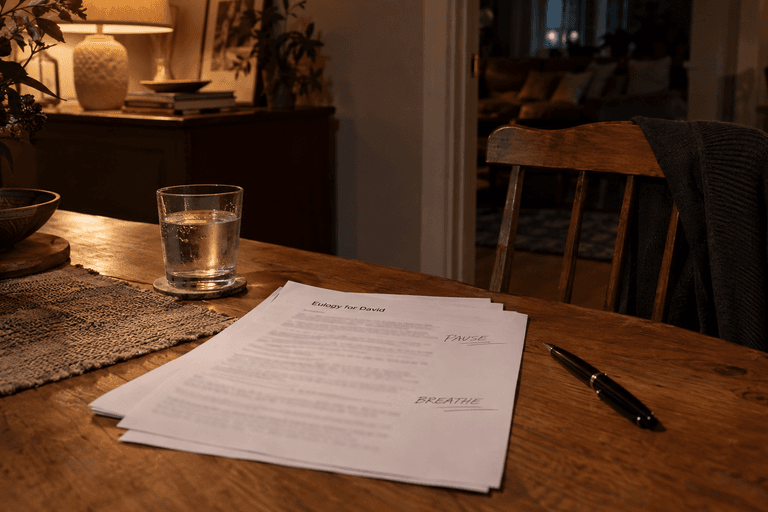
It usually works best to have one speaker carry the mention rather than every speaker, so it does not repeat through the evening and lose its weight. If whoever is toasting wants a few lines to work from, our collection of eulogy examples has warm, adaptable phrases that translate easily into a short wedding tribute.
Before the Speeches Begin
Tell every speaker ahead of time whether a mention is planned and who will give it, so nobody is caught off guard mid-toast. Keep the mention to one or two sentences built around a happy memory. Place it early or in the middle of the speech, never as the closing line, so the toast still ends on an upbeat note.
How to Carry Something of Theirs on the Day
Some tributes are never spoken or displayed at all. They are simply carried. Having something of theirs close to you can be a private comfort through the whole day, and the ideas break down naturally by who is holding them:
- For the couple: a photo locket or bouquet charm, a piece of their clothing stitched into a garment, their ring worn on a chain, or their handwriting engraved inside a wedding band.
- For the wedding party: a boutonniere or bouquet wrapped in fabric cut from their tie or scarf.
- For the ceremony: their Bible, prayer book, or a reading they loved, used in place of or alongside a new selection.
- For guests: seed packets or small tree seedlings as favors, a living tribute that keeps growing long after the wedding, much like the trees we help families plant in someone's honor.
One practical note on heirlooms: watches, jewelry, and handwritten notes are easy to set down and forget in the happy chaos of a wedding day. Assign one trusted person, often the maid of honor or best man, to hold anything irreplaceable and make sure it makes its way home.
What starts as something carried for a single afternoon often becomes something that keeps going. A seedling handed out at the reception can grow into a tree in a garden planted in their memory. A recipe cooked for the late-night menu becomes a holiday tradition. Our complete guide to memorial tree planting and other living memorials has more ideas if you want the tribute to keep growing well past the wedding day, carrying their love into the life you are just beginning together.
Give Them a Place Beyond the Wedding Day
A wedding is one day, but an online memorial page gives the person you are honoring a lasting home, somewhere guests can read their story, add photos from your wedding, and leave a message long after the celebration ends. Set it behind the QR code on your memorial table.
Create a Free MemorialIs it appropriate to have a memorial table at a wedding?
Yes. A memorial table is a gentle, widely embraced way to include someone who has passed. The key is thoughtful placement, somewhere guests can pause for a moment without disrupting the ceremony or the receiving line, and a friend assigned to keep an eye on it during the reception.
What if my surviving parent does not want a public tribute?
Talk with them early, before you finalize any plans, since this is their loss too and their comfort matters. If a public tribute does not feel right for your family, a private gesture, such as carrying something of the person's or wearing a small keepsake, can honor them just as meaningfully without a public moment.
Should the memorial be at the ceremony or the reception?
Either works, and many couples do a little of both. The ceremony is a natural place for a spoken mention, a moment of silence, or a reserved seat, while the reception is where a photo table, memory jar, or QR code to an online memorial tends to fit best.
How do we honor someone without making the day sad?
Focus on joy and specific memories rather than the loss itself, and keep any tribute brief and planned in advance. A single sentence about a favorite joke, or a photo that makes people smile, does more than a long, emotional speech, and it keeps the day feeling like the celebration it is meant to be.
Can we honor a grandparent, sibling, or friend the same way?
Yes. Every idea in this guide, from a memorial table to a program line to a piece of their jewelry, adapts easily to any relationship. The program wording examples above include versions for grandparents, siblings, and friends, so you can adjust the relationship and keep the rest of the format.
Is it okay to get married soon after a loss, or to keep the original date?
There is no set rule, and the right choice is the one that feels right for your family rather than what you think others expect. The Hospice Foundation of America's guidance on coping with grief around meaningful dates points out that people grieving a loss have real choices about which traditions to keep, change, or let go of, and that leaving room for compromise within a family matters. Whether you keep your date or move it, you can still build in the tributes that feel right.
Sources
- Hospice Foundation of America, Three Cs for Coping with Grief
- National Fire Protection Association, Candle Safety
- United States Conference of Catholic Bishops, Universal Prayer (Prayer of the Faithful)
- Liturgy Office, Catholic Bishops' Conference of England and Wales, Order of Celebrating Matrimony: Examples of the Universal Prayer
- Chabad.org (Sichos in English, by Moshe Bogomilsky), A Wedding Invitation
- Project Gutenberg, The Poetical Works of Thomas Campbell
- Chabad.org, The Procession
- United States Conference of Catholic Bishops, Committee on Divine Worship, Committee on Divine Worship Newsletter, August 2016: 10 Questions on Implementing the Order of Celebrating Matrimony
Lovekept's guides are drafted with AI against briefs written by the Lovekept team. Abdullah Nabeel, the founder, is the blog's editor. Read how we produce and correct content at /editorial-standards.