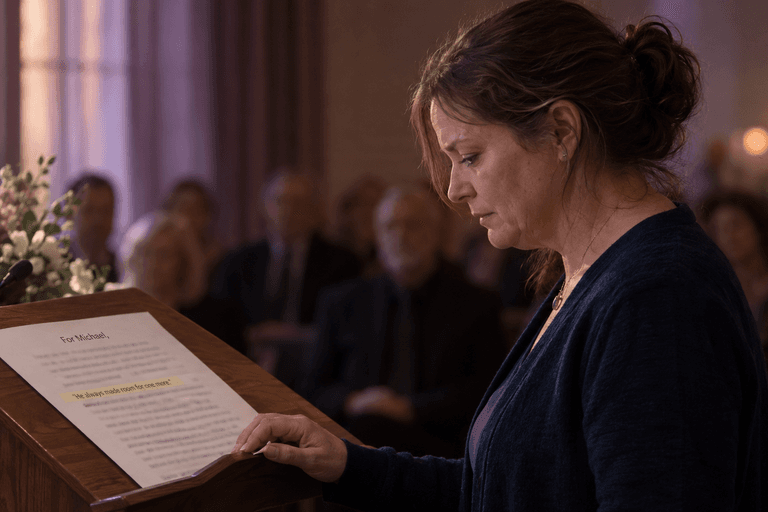
How to Write and Deliver a Eulogy
Learn how to write a eulogy with a clear structure, heartfelt examples, thoughtful revision advice, and calm guidance for delivering your tribute.
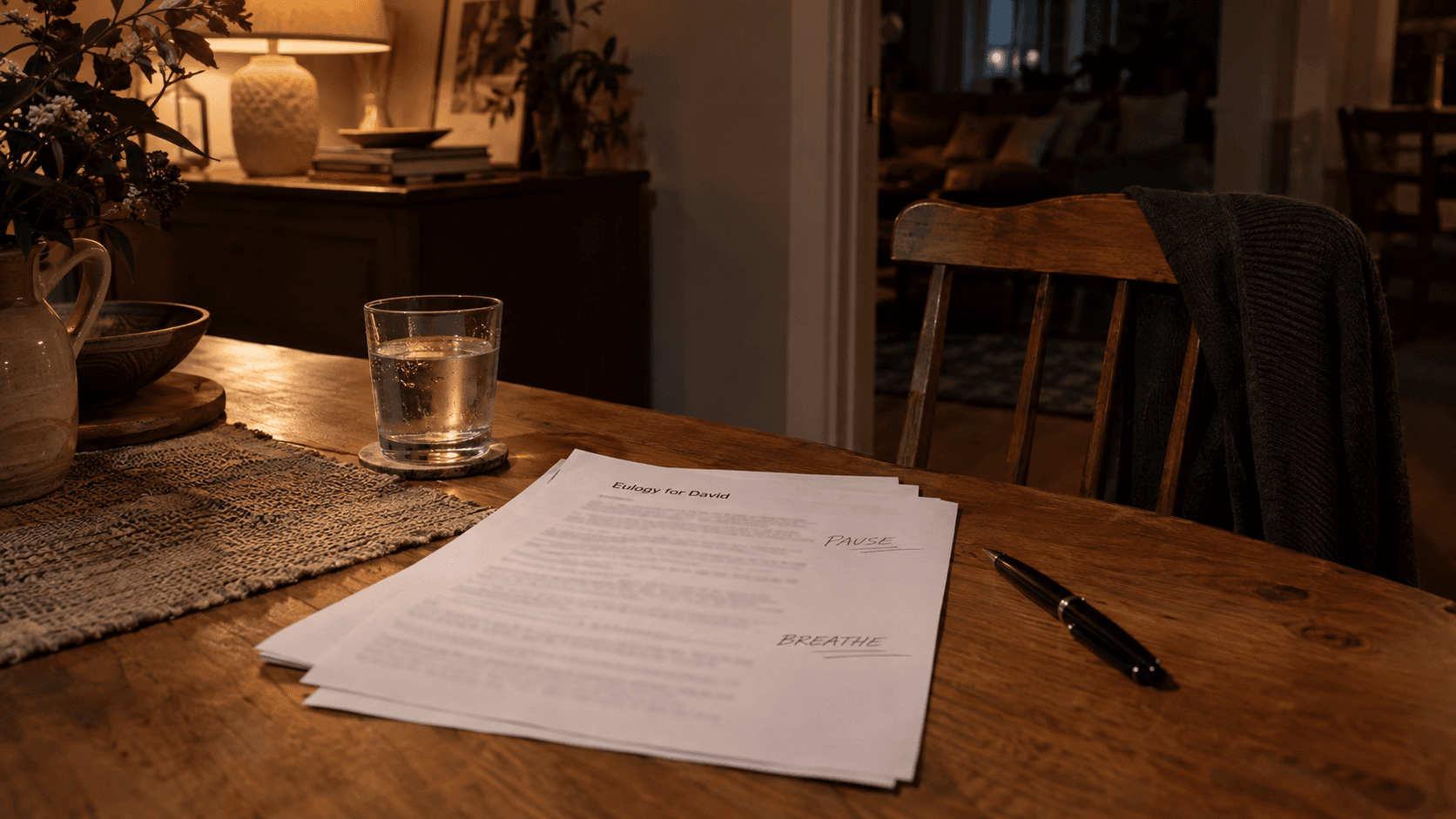
How to Write a Eulogy When the Words Feel Hard to Find
Learning how to write a eulogy can feel overwhelming when grief has made even ordinary decisions difficult. You may wonder how a few pages could possibly represent a whole life, or whether you can speak without emotion taking over. A meaningful eulogy does not need to include everything. It only needs to offer an honest, recognizable picture of the person and what their life meant to others.
The most moving tributes often begin with one specific story rather than a polished summary. It might be the way your father called every Sunday, the garden your neighbor shared with the block, or the phrase your friend used whenever someone needed courage. A concrete memory gives you somewhere manageable to begin.
This guide will take you from gathering memories through revising and delivering your words. You will find a flexible structure, a fill-in template, original examples, practical speaking advice, and options for handling difficult emotions. You can work through it in order or move directly to the part you need today.
Give yourself permission to write imperfectly at first. A rough sentence that sounds like you is more useful than a formal paragraph that sounds distant. The purpose is not to perform grief correctly. It is to help a room of people recognize, remember, and honor someone who mattered.
Key Takeaways
Choose one central theme. Decide what you most want listeners to remember about the person, then let that idea guide what you include.
Use two or three specific memories. Small, concrete moments reveal character more clearly than a long list of qualities or achievements.
Create a clear beginning and ending. Introduce your relationship and purpose, then close with gratitude, a lasting lesson, or a direct farewell.
Rehearse aloud. Reading aloud helps you improve the wording, estimate the length, practice pauses, and prepare emotionally.
Plan for support. You may pause, use notes, ask someone to stand beside you, or arrange for a backup speaker to continue.
What Is a Eulogy, and Who Can Give One?
A eulogy is a speech delivered at a funeral or memorial service to commemorate a person's life. It may remember their character, values, relationships, achievements, interests, familiar habits, and influence. Humanists UK's explanation of a eulogy notes that a family member, friend, or funeral celebrant may deliver it.
A eulogy differs from an obituary because it is written to be heard by people gathered together. An obituary is generally a written notice or life summary. A religious reading, prayer, poem, or passage may support a service, but it does not necessarily provide the personal portrait and memories found in a eulogy. The National Museum of Funeral History distinguishes a spoken eulogy from an obituary in the same practical way.
The speaker might be a child, partner, sibling, friend, colleague, community member, clergy member, or secular celebrant. Several people may contribute shorter tributes instead of asking one person to represent every part of a life. This can be especially fitting when the person belonged to several communities or had relationships that revealed different sides of them.
Before accepting the role, ask the organizer how much time is available, who else will speak, and whether the service has religious or cultural expectations. Funeral Consumers Alliance explains that religious practice and protocol may shape the program in a place of worship. The best speaker is not necessarily the person who appears most confident. It is someone willing to prepare carefully and speak with respect.
How to Prepare a Eulogy Before You Start Writing
Prepare for a eulogy by gathering a small set of reliable facts and meaningful memories before trying to draft complete paragraphs. Start with the person's preferred name, your relationship to them, important relationships in their life, defining qualities, interests, familiar routines, and moments that show how they treated people. Also confirm the service date, speaking order, time available, and any guidance from the family or officiant.
Do not turn this into an exhausting research project. Speak with one or two trusted people who knew the person in different settings. Ask focused questions: What did they do that always made you feel welcome? What saying do you still hear in their voice? When did you see them at their most generous or determined? Humanists UK's preparation guidance likewise recommends collecting relationships, qualities, habits, interests, milestones, and specific stories before drafting.
Use a simple memory page with three headings: what they cared about, how they showed it, and one moment that proves it. If you write “generous” in the first column, the proof might be that they quietly delivered groceries to an elderly neighbor every Friday. This process is similar to gathering memories when you do not feel like a writer: clear questions make an intimidating task smaller.
Finally, choose a stopping point. Once you have enough material to identify a central message and two or three supporting memories, begin drafting. More memories can always be preserved elsewhere. Your eulogy needs a thoughtful focus, not a complete archive.
What to Say in a Eulogy
A strong eulogy says who the person was, what made them recognizable, how they affected other people, and what listeners may carry forward. You do not need to recite every stage of their life. Choose the details that support the central quality or message you want the room to remember.
Concrete details do this work better than praise alone. Instead of saying, “She was thoughtful,” describe how she kept a drawer of birthday cards and mailed each one early. Instead of saying, “He loved his family,” recall the Saturday pancakes he made while everyone crowded into the kitchen. Specific examples communicate personality, kindness, humor, and achievement more clearly than general descriptions.
Useful material may include a familiar expression, weekly ritual, treasured interest, act of service, moment of courage, lesson they taught, or way they made people feel. Achievements can belong in the eulogy, but explain why they mattered. A job title becomes meaningful when listeners understand the patience, curiosity, or commitment behind it.
A story works best when people who were not present can still understand its meaning. Give one line of context, tell the essential moment, and connect it to the person's character. An unexplained inside joke may exclude the room, while a briefly framed story can invite everyone in.
You may also acknowledge that the person was human. Warmth does not require perfection. A gentle reference to their stubborn devotion to a sports team or habit of arriving early can make the portrait feel true, provided it is affectionate and appropriate for the family, setting, and audience.
A Simple Structure for Writing a Eulogy
- Choose the central message: Complete this sentence: Above all, I want people to remember that this person was someone who ___. Let that idea guide every choice.
- Introduce your relationship: Say your name if needed, explain how you knew the person, and offer one sentence that establishes the tribute's focus.
- Name defining qualities: Choose two or three connected qualities rather than listing every admirable trait. Use words that sound natural in your voice.
- Tell one or two stories: Share concise memories with enough context for every listener to understand what happened and why the moment matters.
- Recognize important relationships: Acknowledge the people, communities, or causes that shaped the person's life without turning the speech into a list of names.
- Describe their influence: Explain how they changed a family, workplace, friendship, neighborhood, or community through their presence and choices.
- Reflect on their legacy: Name a value, tradition, lesson, or way of caring that others can continue in the years ahead.
- Close with direct words: Offer gratitude, love, a final lesson, or a simple farewell. Keep the last lines clear enough to deliver through emotion.
- Adapt the order: Adjust the structure to fit cultural, spiritual, family, and service preferences. A thematic or chronological order can both work.
A Eulogy Template You Can Adapt
Use this eulogy template as a framework, not a script. Fill in the blanks quickly first, then revise the language until it sounds like something you would genuinely say.
Fill-in Eulogy Framework
- Opening: Thank you for being here to remember [name]. When I think of [name], I first think of [central quality or image].
- Relationship: I knew [name] as [relationship], and one of the things I valued most was [specific quality].
- Memory: I saw that quality clearly when [brief story with setting, action, and outcome].
- Broader influence: That was not an isolated moment. [Name] brought the same [quality] to [people, work, community, or cause].
- Legacy: We can continue [name]'s influence when we [specific action, value, or tradition].
- Closing: [Name], thank you for [gift or lesson]. We will remember you whenever [specific image or action].
Replace broad phrases with sensory or behavioral details. “She lit up every room” becomes “She greeted each person by name and moved her chair so no one sat alone.” “He would do anything for his family” becomes “He drove three hours to repair a leaking sink and stayed to make dinner.” Specificity makes the tribute personal without making it complicated.
If filling a blank page still feels impossible, you can begin drafting with Lovekept's free eulogy writer. Treat the result as a starting point. Add your memories, remove language you would not use, and read every line aloud before deciding it belongs.
Eulogy Examples
These original eulogy examples show how different relationships and tones can fit the same basic structure. Use them to notice technique, not to replace your own voice. For more, see eulogy examples for every relationship, our guide to writing a eulogy for your father, or our guide to writing a eulogy for your mother.
For a Parent
“My mother rarely announced that she was helping. You noticed it later, when a meal appeared in your refrigerator or a handwritten note arrived before a difficult day. She taught us that love could be quiet and still change the shape of a week. We will honor her by noticing what people need and acting before they have to ask.”
Why it works: The opening names a central quality, the examples make it visible, and the closing turns that quality into a practical legacy.
For a Partner
“Daniel made an ordinary Tuesday feel worth celebrating. He played music while we cooked, sampled the sauce too early, and insisted the dog deserved a seat nearby. Life with him was built from thousands of small joys. Thank you, Daniel, for showing me that a good life is not only measured by milestones, but by how fully we inhabit the days between them.”
Why it works: A familiar domestic scene carries the emotion. The final thought widens one couple's memory into an idea everyone can understand.
For a Sibling or Friend
“Maya was the person you called when your plan had fallen apart. She would listen, ask one honest question, and somehow help you see the next step. She did that for me after countless disappointments, always without pretending the problem was smaller than it was. I will miss her candor, her ridiculous road-trip playlists, and the steady courage she lent so freely.”
Why it works: Affectionate humor sits beside a serious quality. The details feel personal, but listeners do not need private background to follow them.
For a Colleague or Community Member
“Mr. Alvarez knew that belonging begins when someone remembers your name. At every neighborhood meeting, he welcomed newcomers before discussing the agenda. He made public service feel personal. Our community is kinder and more connected because he showed us that leadership often starts with pulling out an extra chair.”
Why it works: One repeated action represents a larger contribution. The closing image is simple enough to remain with listeners after the service.
Make the Eulogy Personal Without Oversharing
Honesty does not require sharing every private fact or resolving a complicated relationship in public. Choose stories that reveal character without embarrassing the person, exposing confidential information, reviving unresolved conflict, or relying on an inside joke that excludes most listeners. If a detail makes the tribute truthful but may cause harm, keep the underlying truth and remove the private evidence. You might say, “Our relationship had difficult chapters, but I remain grateful for what he taught me about persistence.” Respectful boundaries can make a eulogy more honest, not less.
How to Revise a Eulogy So It Sounds Like You
Revise a eulogy by reading it aloud and listening for anything you would not naturally say. Spoken language needs shorter sentences, familiar words, and clear transitions. If you run out of breath, lose the meaning halfway through a sentence, or repeatedly stumble over a phrase, simplify it.
Complete three revision passes. First, check the structure: does the opening establish the main idea, does each story support it, and does the closing feel complete? Second, check the language: replace formal phrases such as “possessed a generous disposition” with words you would use in conversation. Third, check for repetition. Keep the strongest version of each idea and remove the rest.
Mark transitions directly in the draft. Simple phrases such as “That same patience appeared at work” or “One memory captures this best” help listeners follow you. The recommended practices of using plain English, short sentences, a rough outline, and an aloud reading are also included in Humanists UK's eulogy guidance.
Then verify every name, relationship, pronunciation, date, and story that could reasonably be checked. Ask one appropriate family contact to review for factual errors, privacy concerns, and service expectations. One trusted reviewer is often more useful than an open invitation for edits, which can turn a personal speech into a committee document.
Finally, protect the lines that sound distinctly like you. A reviewer may prefer a different adjective or sentence rhythm, but preference is not the same as correction. Your voice is part of the tribute because your relationship is part of the story.
How to Review the Eulogy With Family
Review the eulogy with family by choosing one decision-maker, setting a clear deadline, and defining what feedback you need. Ask reviewers to check names, relationships, facts, pronunciations, privacy concerns, and anything that may conflict with the service. Do not ask an unlimited group whether they “like it,” because that invites incompatible style preferences.
Separate factual corrections from personal taste. A misspelled name must be corrected. A request to remove confidential information deserves serious attention. A suggestion to replace your natural wording with someone else's preferred phrase is optional unless the family has agreed that the speaker represents everyone collectively.
If two people remember an event differently, decide whether the disputed detail is essential. Often you can preserve the meaning without claiming certainty: “I remember those afternoons as the time she taught us patience,” rather than specifying a date or sequence no one can confirm. When a disagreement touches a painful family history, neutral wording may be kinder than using the eulogy to settle the record.
The same practical habits used for reaching agreement on a family tribute can prevent rounds of conflicting edits. Assign responsibility, limit the review window, and keep the shared purpose visible.
Before printing, use a practical fact-checking process for the names and life details that also appear in the eulogy. Then freeze the approved version. Last-minute rewriting can introduce mistakes and make rehearsal less useful.
How to Deliver a Eulogy
Deliver a eulogy by preparing the page, your voice, and a support plan. Print a complete copy in a large, easy-to-read font with generous spacing. Number the pages, avoid printing a sentence across two pages, and bring a second copy for your backup speaker. Mark names, planned pauses, and any words you find difficult to pronounce.
Rehearse aloud several times and time the complete speech. Toastmasters recommends frequent rehearsal, logical organization, and timed practice. Practice the middle and ending separately instead of always restarting at the first line. This makes the whole speech familiar and helps you recover if emotion interrupts you.
Ask the organizer how long you have. As of 2026, Funeral Consumers Alliance advises keeping a eulogy under 15 minutes and notes that five minutes are often enough. The organizer's direction should govern your final length. When estimating from a draft, Humanists UK suggests 130 to 140 spoken words per minute as of 2026, but an aloud rehearsal is more reliable because pauses affect your pace.
Arrive early enough to see the lectern, microphone, stairs, and route to your seat. Ask how close to stand to the microphone, place your pages in order, and keep water within reach. Speak more slowly than you think necessary. Look up at a natural break when comfortable, but do not force eye contact if it makes the words harder to deliver.
Your delivery does not need to be polished. A trembling voice, a pause, or tears can coexist with a clear and loving tribute. Arrange for someone to stand nearby or take over if needed. Knowing that support exists often makes it easier to begin.
What to Do If Emotion Takes Over While You Are Speaking
Stop at the end of the sentence, breathe slowly, take a sip of water, and find your next marked line. Continue only when you are ready. Silence and tears do not diminish the tribute, and you do not need to apologize. Before the service, give a copy to a backup speaker and agree on a simple signal. You may hand over the text or end early if continuing feels impossible.
What to Say at a Funeral Service
What you say at a funeral service depends on your role. A full eulogy develops a portrait through qualities and stories. A welcome helps people settle into the gathering. A reading presents someone else's words. Brief remarks may share one memory, while a prayer follows the beliefs and customs of the service.
Short Wording Patterns
- Opening: “Thank you for gathering to remember Rosa and the care, humor, and determination she shared with us.”
- Introducing a reading: “This poem reflects the attention Elena gave to ordinary beauty, so I would like to share it in her memory.”
- Sharing one memory: “I will always remember Marcus arriving early to set out chairs, then staying late so no one cleaned up alone.”
- Thanking attendees: “Your presence and the memories you have shared show how widely Priya's life reached.”
- Inclusive closing: “May each of us carry forward something we received from Thomas, in whatever way feels meaningful to us.”
Confirm the order and purpose of your contribution with the officiant or organizer. Ask whether someone will introduce you, whether a reading requires attribution, and whether particular language, prayers, or customs are expected. Do not assume that a practice is universal simply because it is familiar to you.
If spontaneous sharing is invited, keep your contribution to one memory and one sentence about what it reveals. A concise story gives other people room to participate and reduces the pressure to improvise a complete life summary.
Memorial Tribute Ideas
A eulogy can become the beginning of an enduring memorial tribute. With the family's permission, preserve the written speech and invite others to add the memories it brings forward. This allows the public words shared at the service to open a broader, continuing conversation.
- Shared memory collection: Ask relatives, friends, and colleagues to contribute one story connected to the eulogy's central theme.
- Digital memorial: Preserve the eulogy beside photographs, videos, milestones, and guestbook messages so distant loved ones can participate.
- Audio or video: Save a recording when the speaker, family, venue, and attendees whose voices or images may appear have given permission.
- Printed keepsake: Pair an excerpt with a photograph, recipe, letter, or piece of artwork that reflects the person's life.
- Continuing ritual: Cook a familiar meal, visit a meaningful place, support a cherished cause, or gather annually to exchange stories.
For more possibilities, explore these meaningful ways to honor a loved one. Choose an idea that fits the person rather than selecting the most elaborate option.
Families who want one shared home for stories and media can create a collaborative online memorial and invite others to contribute.
Get Help Drafting Your Eulogy
If you have memories but cannot yet shape them into a speech, Lovekept's free eulogy writer can organize a compassionate first draft. Use it as a supportive starting point, then add your own stories, judgment, and voice.
Draft a EulogyHow long should a eulogy be?
Ask the officiant or organizer for the permitted speaking time. As of 2026, Funeral Consumers Alliance says a eulogy should be no longer than 15 minutes and that five minutes are often enough. The service plan and number of speakers should determine your final length.
Who should give the eulogy?
A relative, friend, colleague, community member, clergy member, or secular celebrant may give a eulogy. Choose someone who knew the person, can prepare carefully, and is comfortable with the family's wishes and the service format.
Can two people give a eulogy?
Yes. Two or more speakers can divide the tribute by relationship, period of life, or theme. Coordinate the opening and closing, remove repeated stories, and confirm the combined time with the organizer.
Is it acceptable to read a eulogy from paper?
Yes. Reading a complete printed copy, using an outline, or referring to cue cards are all acceptable. Notes protect important wording and give you a clear place to return after a pause.
How do you begin a eulogy?
Begin with the person's name, your relationship if it is not obvious, and one sentence that expresses the central quality or image you want listeners to remember. A direct opening is easier to deliver and immediately gives the tribute direction.
How do you end a eulogy?
Return to your main theme and close with gratitude, a lesson, a continuing tradition, or a direct farewell. Keep the final lines brief and mark them clearly so you can find them if emotion makes it difficult to continue.
Can a eulogy include humor?
Yes, when the humor reflects the person's character and suits the family, audience, and setting. Humanists UK notes that a eulogy does not have to be entirely solemn. Choose affectionate humor, not a joke that embarrasses someone or requires private context.
What happens if I cannot finish speaking?
Pause, breathe, take a sip of water, and continue only if you are ready. You may give the pages to a backup speaker or end early. The National Museum of Funeral History recommends arranging for a backup speaker in advance and making sure that person has read the eulogy before the service.
A Meaningful Eulogy Begins With One Honest Memory
A meaningful eulogy does not need to capture every chapter of a life or sound professionally written. It needs a clear purpose, a few true details, and words chosen with care. If the whole task still feels too large, return to one honest memory.
Write down where you were, what the person did, and what that action revealed. Perhaps they waited with you in a hospital hallway, taught a child to plant tomatoes, remembered a new colleague's name, or made tea before difficult conversations. Connect that moment to the quality you want others to remember.
Then build outward only as far as needed. Introduce your relationship, tell the story, show how the same quality appeared elsewhere, and close with what you will carry forward. That is already the foundation of a complete tribute.
Your voice may shake. You may read every word from the page. You may need someone beside you. None of those things make the eulogy less worthy. Sincere words, spoken or shared with care, are enough to help people remember a life with love.
Sources
- Humanists UK, What is a eulogy and how do I write one?
- National Museum of Funeral History, HOW DO I WRITE A EULOGY?
- Funeral Consumers Alliance, How to Plan a Memorial Service
- Humanists UK, How to Write a Funeral Speech (Eulogy): A Step-by-Step Guide
- Toastmasters International, Preparing a Speech
Lovekept's guides are drafted with AI against briefs written by the Lovekept team. Abdullah Nabeel, the founder, is the blog's editor. Read how we produce and correct content at /editorial-standards.