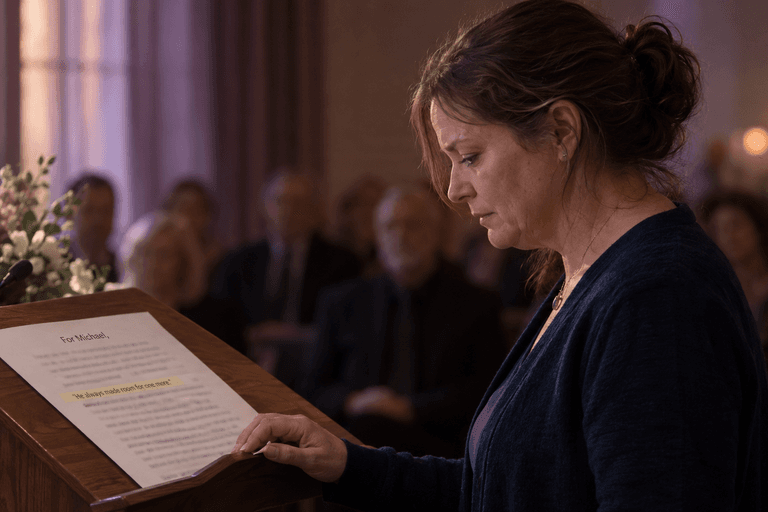
How to Write a Eulogy for a Mother
Write a heartfelt eulogy for a mother with guidance on choosing stories, honoring complex bonds, and finding words for a loving farewell that feels true.
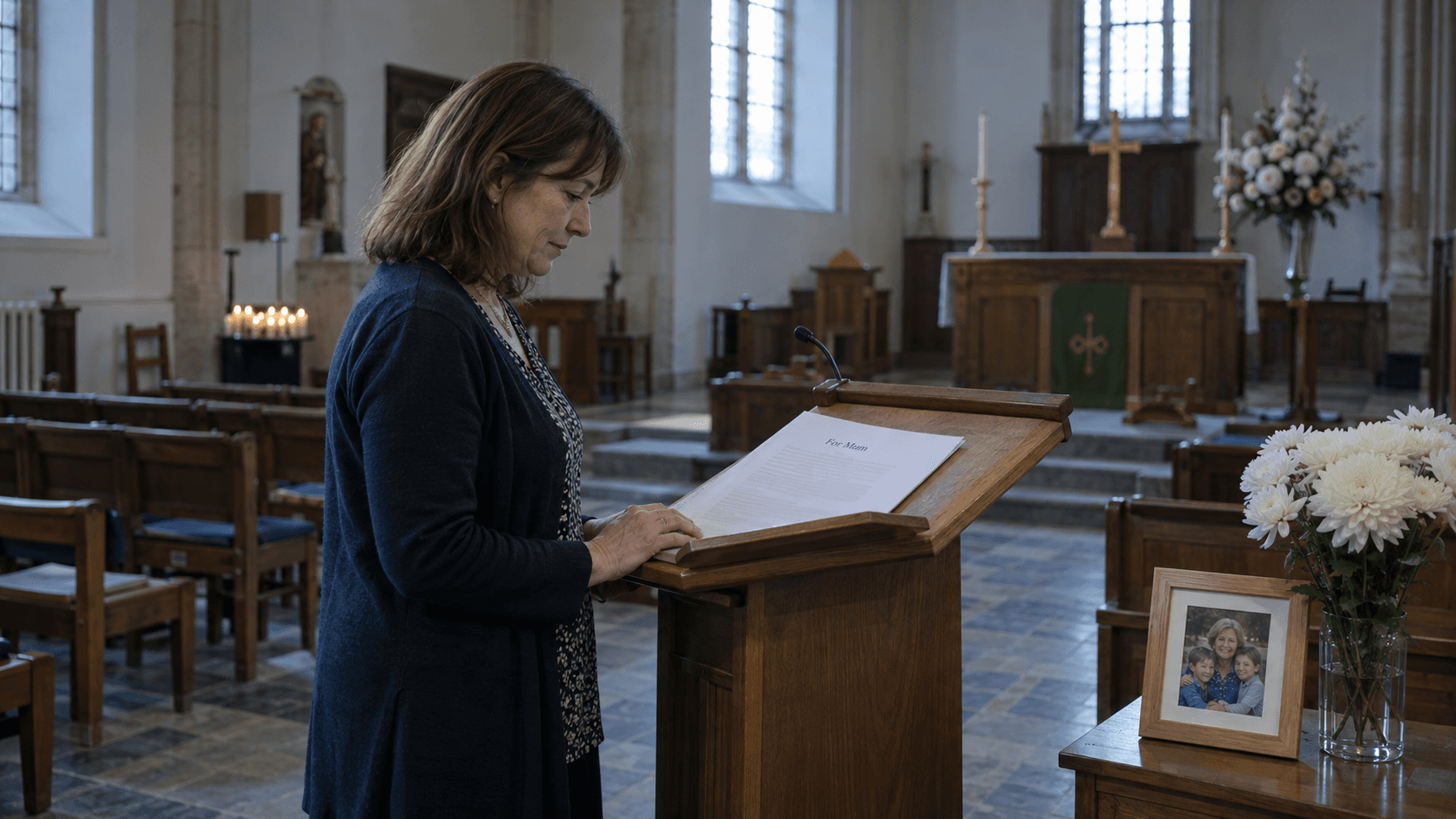
Writing a Eulogy for a Mother That Sounds Like Her
The page is blank, but your mind is not. You may see your mother standing at the kitchen counter, hear a phrase she repeated whenever you were worried, or remember the exact expression she wore when she was trying not to laugh. At the same time, years of memories may be competing for space, each one seeming too important to leave out.
A meaningful eulogy for a mother does not have to summarize her entire life. It only needs to help listeners recognize her. A focused tribute can reveal more through one familiar gesture or carefully chosen story than a complete list of dates, accomplishments, and family roles ever could.
Begin by asking what you most want the room to understand about her. Perhaps she made people feel welcome, protected those she loved, found humor in hard seasons, or showed care through practical acts. That quality can become the thread connecting your memories, opening, and final goodbye.
The guidance ahead will help you choose that thread and shape it into words you can speak. If you want to compare approaches for other family members and loved ones, these eulogy examples for different relationships and our guide to writing a eulogy for a father offer a helpful place to begin. For now, you can stay with the person only you knew as Mom.
Key Takeaways
Choose one defining quality. Let a central trait, such as generosity, steadiness, curiosity, or humor, guide the tribute.
Support it with two specific memories. A pair of developed stories usually creates a clearer portrait than a rapid list of moments.
Write in your natural voice. Use the words and sentence rhythms you would use when telling someone about your mother.
Honor complexity with care. You can acknowledge distance or difficulty without pretending, assigning blame, or settling old conflicts.
Prepare one simple final sentence. A direct goodbye gives you a dependable place to land if emotion makes the ending difficult.
What to Say About a Mother When Everyone in the Room Knew Her
When everyone in the room knew your mother, you do not need to tell them facts they already know. Offer the private perspective that only a daughter, son, or close loved one can provide. Show what she did when nobody was watching, which advice appeared in every important conversation, or how her presence changed an ordinary afternoon.
Details that feel almost too ordinary are often the ones listeners recognize most deeply. Saying that she was generous is sincere. Remembering how she always sent visitors home with leftovers, even when they insisted they had enough, allows everyone to feel that generosity again.
You might describe the song she hummed while folding laundry, the pause she took before giving serious advice, or the chair from which she welcomed every grandchild. These details do more than decorate a speech. They show how love appeared in daily life.
This also relieves you of the pressure to include everything. Decide what can be heard and felt within the time available, then let the rest remain part of the family's larger collection of stories. Our guide to choosing the right eulogy length can help you set a comfortable boundary before you begin drafting.
Which Stories About Mom Are Worth the Two Minutes?
Choose a story that reveals something essential about your mother and can be understood without a long explanation. A strong memory has a clear moment, a meaningful choice or gesture, and a connection to the quality guiding your tribute.
Test each possible story by telling it aloud in a few sentences. If the memory helps listeners picture her and understand why the moment mattered, keep it. If it requires several names, dates, or side stories before reaching the point, save it for another time.
A Quick Test for Choosing a Story
It reveals her character
Choose a moment that shows how she loved, decided, helped, persisted, welcomed, or found joy.
It needs little backstory
A listener outside the immediate family should understand why the moment matters without a long explanation.
It contains a concrete moment
Specific words, gestures, places, and objects help listeners picture your mother as she truly was.
It supports the central idea
Each story should deepen the defining quality at the heart of your eulogy instead of opening a new theme.
How to Include Her Faith, Her Cooking, and Her Habits
Include faith, cooking, traditions, and familiar habits when they reveal meaning, not simply because they belong on an inventory of her life. Instead of saying that faith mattered to her, name the prayer she returned to when someone was afraid. Instead of listing favorite recipes, describe the dish that gathered people around her table.
Small habits can carry the same emotional weight. Perhaps she checked that everyone arrived home safely, saved the prettiest garden flowers for the kitchen, or kept a handwritten birthday list beside the telephone. Explain what the habit gave your family: reassurance, continuity, belonging, or laughter.
George Eliot captured the power of one intimate image in Chapter 20 of Daniel Deronda. The line below does not attempt to explain an entire relationship. It lets a single remembered face hold the beginning of a life and the bond between mother and child.
“I think my life began with waking up and loving my mother's face.”
Sample Eulogy for a Mother From a Daughter
An Original Sample
My mother had a gift for making people feel expected. When you arrived at her home, she did not greet you as though you had interrupted her day. Somehow, the kettle was already on, a chair had been cleared, and there was room for whatever you needed to say.
I remember coming home after my first difficult week at college. I tried to act as though everything was fine, but she placed a mug in front of me and said, “You can be brave tomorrow. Tonight, you can just be home.” She did not solve the problem. She gave me a safe place from which I could face it.
Years later, I watched her offer that same welcome to my daughter. Every Saturday, they sat at the kitchen table sorting buttons from an old tin, inventing stories about the coats and dresses those buttons might once have fastened. Mom made an ordinary hour feel like a world created just for the two of them.
Her welcome continues in us. It is there when we make room at the table, listen before offering advice, and tell someone they do not have to be brave every minute. Mom, thank you for making us feel expected, wanted, and at home. I love you, and I will carry your welcome with me.
How to Make the Sample Your Own
Replace “making people feel expected” with the quality that best describes your mother. Then substitute one memory from your own relationship and one that shows her influence reaching another person or generation. Keep only language you would genuinely say aloud.
A son can use the same structure without changing its emotional honesty. He might begin, “My mom taught me that strength could be quiet,” then share a childhood memory and a later moment when he recognized her influence in his own choices. For help turning your memories into a starting draft, Lovekept's guided eulogy writer can help you organize the tribute in your own voice.
For more help with revising and speaking the finished tribute, see our complete eulogy writing and delivery guidance.
How to Write About a Mother You Had a Complicated Relationship With
Respect does not require you to pretend that your relationship was simple or ideal. A eulogy is neither a courtroom nor a place where you must perform an affection you did not feel. It can be a carefully bounded statement about what was true, what was given, and what you choose to carry forward.
The American Psychological Association's guidance on grief notes that people respond to loss differently and that a difficult relationship can add another dimension to grief. Give yourself permission to write from your own experience rather than forcing your feelings into someone else's idea of what a child should say.
You might say, “My mother and I did not always understand each other, but I recognize the determination she passed on to me.” You could acknowledge distance by saying, “Our relationship had seasons of closeness and seasons of silence.” If loving language feels untrue, neutral words such as “I remember,” “I recognize,” “I am grateful for,” and “I hope she is at peace” can offer dignity without distortion.
There is a difference between honesty and disclosure. Honesty means not claiming a closeness that was absent. Disclosure means revealing private grievances, and you are not required to do that in a public tribute. Choose the truth the room needs, while preserving the more painful truth for a private conversation, journal, counselor, or trusted friend.
What to Say About Her Final Months Without Dwelling on Them
Give listeners only the context they need, then return their attention to the whole person. You can acknowledge that your mother's final months were difficult without allowing illness, caregiving, or suffering to become the last and largest definition of her life.
A gentle structure is to name the season, recognize care or courage without romanticizing pain, and then move to an earlier memory. For example: “Her final months asked much of her and of everyone who cared for her. We are grateful for the tenderness that surrounded her. When I think of Mom, though, I return to summer mornings when she opened every window and sang with the radio.”
The National Institute on Aging's end-of-life guidance recognizes emotional needs, caregiver strain, and the comfort that sharing good memories can bring. Your eulogy can follow that same humane movement, acknowledging what was hard while gently restoring the fuller landscape of her life.
Use a Three-Part Transition
Acknowledge the difficult season in one or two sentences, recognize the care or courage present without idealizing suffering, then return to a vivid memory from before the illness.
How to Open a Eulogy for a Mother
Open a eulogy for your mother with a small scene, the quality people felt in her presence, or a direct statement about what made her unmistakably herself. Each approach gives listeners an immediate point of connection and gives you a steady first sentence to practice.
- Begin with a scene: “On Sunday mornings, Mom was always the first person awake, filling the house with the smell of coffee and cinnamon.”
- Name her defining quality: “My mother made courage look quiet, practical, and possible.”
- Speak directly to the room: “Everyone here knew Mom had a way of noticing who needed a seat, a meal, or a little more time.”
Avoid beginning with an apology about your writing or speaking ability. A dictionary definition of “mother” will sound distant, while a long biography delays the personal connection people are waiting to hear. You do not have to earn the room's attention. Your relationship with her has already given your words their place.
The eulogy may appear alongside music, readings, prayers, reflections, or a committal, depending on the family's plans and cultural or religious practices. This guide to where the eulogy fits in the funeral service can help you understand the surrounding moments and prepare for your turn to speak.
How to End a Eulogy for a Mom
End by returning to your opening image, naming what your mother's influence leaves behind, and offering one sentence directly to her. This creates a feeling of completion without requiring a grand conclusion. If emotion rises, that final prepared sentence can carry you safely to the end.
Original Closing Lines for Different Relationships
- Warm: “Mom, thank you for making home a feeling we can still give one another. I love you, and I will miss you every day.”
- Restrained: “Her steadiness shaped this family, and we will continue to recognize it in one another. Goodbye, Mom.”
- Spiritual: “We entrust Mom to the peace she believed in, grateful that her love remains present in the lives she touched.”
- Complicated: “Our story was not simple, but it mattered, and I will carry its lessons with care. I hope you are at peace, Mom.”
A simple goodbye is enough. You can pause, look at the page, and say only, “Thank you, Mom. I love you. Goodbye.” The value of the eulogy rests in the truth of what came before it, not in the flourish of its final words.
After the service, your finished words can become part of your family's larger collection of photographs, memories, and familiar stories. The eulogy does not need to hold everything. It can be one loving contribution to the many ways people will continue to remember her.
Get Help Drafting the Words
Turn the memories you already carry into a thoughtful first draft. Personalize every detail, shorten it for the service, or use it as a gentle starting point.
Draft Her EulogyHow long should a eulogy for a mother be?
Aim for a length that lets you develop one central idea and two memories without rushing. As of 2026, the Funeral Consumers Alliance's memorial service guidance says five minutes are often enough and recommends keeping a eulogy within 15 minutes. The service leader may also give you a specific time limit.
Can two siblings share the eulogy?
Yes. Divide the tribute by theme or life period so each speaker has a clear part, then agree on one opening and one ending. Practice the handoff aloud and avoid repeating the same biographical details.
What if I cry while speaking?
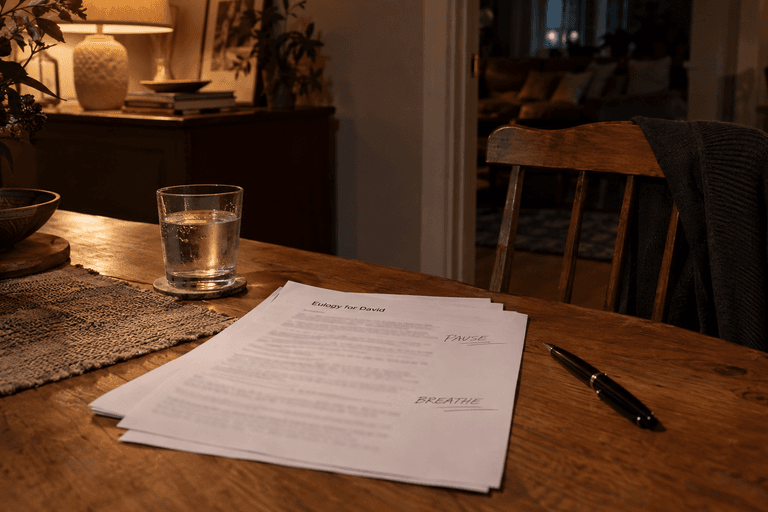
Pause, breathe, take a sip of water, and begin again when you are ready. Mark natural stopping places in your printed copy and ask a trusted person to stand nearby with a second copy. Tears do not diminish your tribute, and you do not need to apologize for them.
Should I mention family conflict?
Mention complexity only when leaving it out would make your words feel false. Use brief, neutral language and speak from your own experience. A public eulogy is not the place to reveal private details, assign blame, or ask listeners to take sides.
How can a son personalize a eulogy for his mom?
Choose a lesson, ritual, phrase, or moment that belonged specifically to your relationship. Describe how her influence appears in the way you care for others, make decisions, raise a family, practice a craft, or respond to hardship. Personalization comes from concrete detail, not from using a separate formula for sons.
Can someone else read what I wrote?
Yes. Your words remain your tribute even when another relative, friend, clergy member, or celebrant reads them. Give the reader a clean printed copy, mark any names that need pronunciation guidance, and tell them where you would like a pause. You may also decide at the last moment whether to speak or hand the reading to them.
Sources
- Wikisource, Daniel Deronda (First Edition)/Volume 2/Chapter 20
- American Psychological Association, Grief: Coping with the loss of your loved one
- National Institute on Aging, Providing Care and Comfort at the End of Life
- Funeral Consumers Alliance, How to Plan a Memorial Service
Lovekept's guides are drafted with AI against briefs written by the Lovekept team. Abdullah Nabeel, the founder, is the blog's editor. Read how we produce and correct content at /editorial-standards.