Eulogy Examples for Every Relationship
Find heartfelt eulogy examples for parents, partners, friends, relatives, coworkers, and mentors, plus guidance for short speeches and thoughtful humor.
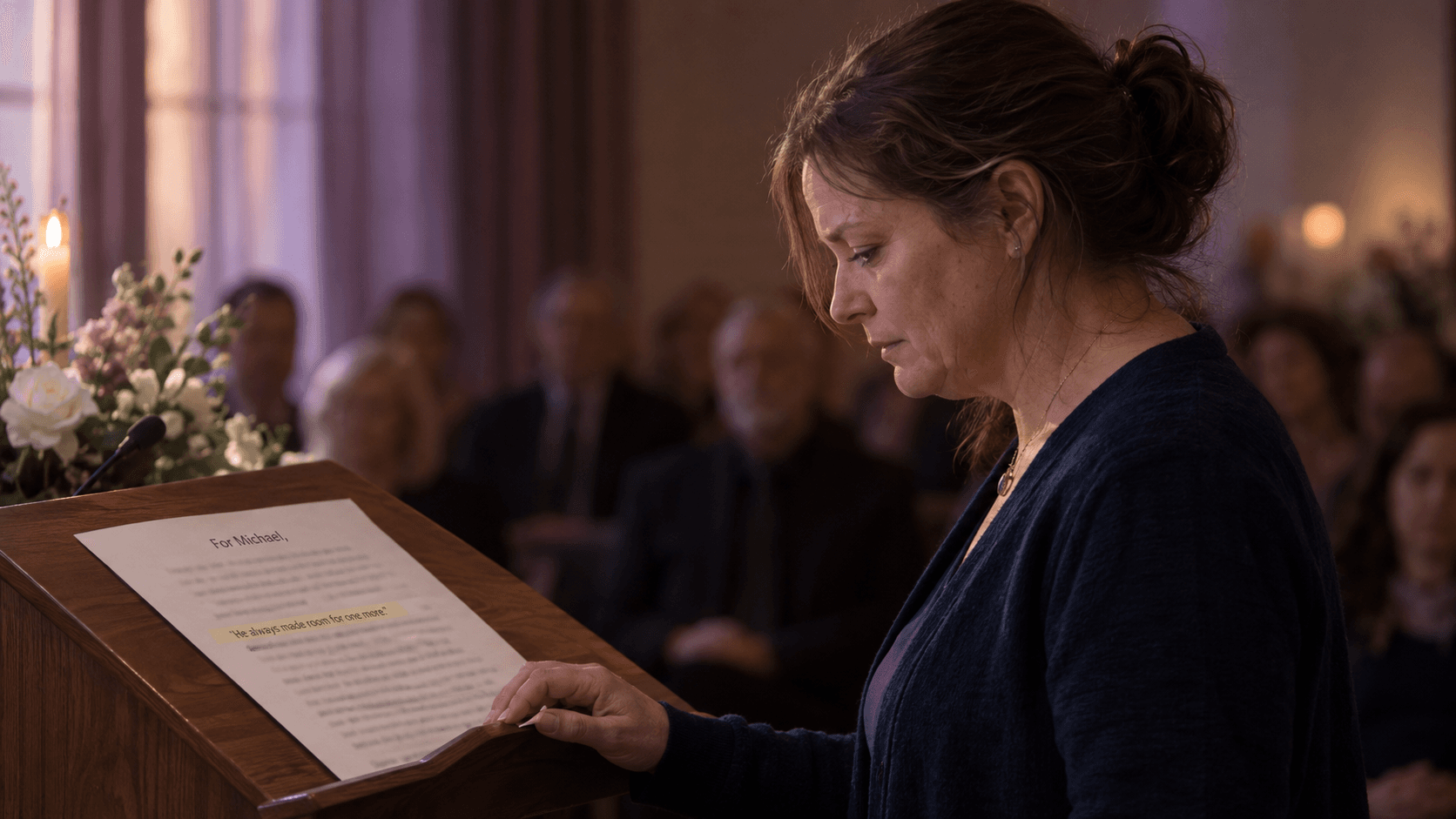
How to Use These Eulogy Examples
The page is blank, yet your mind is anything but empty. A familiar laugh arrives first, then a kitchen-table conversation, a favorite saying, and a dozen moments that seem too important to leave out. Finding the words can feel especially difficult when memories are arriving faster than you can organize them.
These eulogy examples are starting points, not scripts. Borrow a structure, a transition, or the shape of a closing, then replace general language with details that could belong only to the person you are remembering. Humanists UK recommends plain English, short sentences, and reading a draft aloud, useful principles whether the gathering is religious, secular, formal, or intimate.
A small, truthful detail often carries more emotional weight than a long list of virtues. Choose one central quality, show it through one recognizable story, and close with what you will remember or carry forward. The result does not need to sound literary. It needs to sound like you, speaking honestly about them.
Key Takeaways
Begin with the relationship Choose the example closest to how you knew the person, then adjust it for the relationship you actually shared.
Choose one central quality Let kindness, curiosity, loyalty, courage, humor, or another defining trait give the speech a clear thread.
Tell one specific story A familiar phrase, ordinary ritual, or small act of care can make the tribute feel vivid and true.
Write for the ear Use natural language, short sentences, and pauses that will help you speak at a comfortable pace.
Match the person and gathering Adapt the warmth, formality, faith language, and humor to the person being honored and the people listening.
Eulogy for a Father
A eulogy for a father often feels most personal when it begins with the ordinary ways his influence appeared. Perhaps he checked the tires before every long drive, repeated the same piece of advice, taught you how to mend something, or quietly arrived whenever help was needed.
Sample eulogy: My father rarely announced that he was teaching us. His lessons arrived while we held a flashlight beside him, waited for him to finish helping a neighbor, or heard him say, once again, that a promise mattered most when keeping it was inconvenient. He showed his love through attention and dependability. I will miss his voice, his steady hands, and the feeling that there was always someone in my corner. I hope to honor him by offering others the same quiet reliability he gave us.
Adapt the tone to the father you knew. A warm or humorous father may be best captured through dialogue. A reserved father may be honored through actions rather than emotional declarations. For a stepfather, grandfather, coach, foster parent, or chosen father, name the relationship he built instead of treating biology as the only source of belonging. If the relationship was complicated, honest affection can sit beside carefully chosen language about what was difficult.
One useful test is to include a sentence that only someone who knew him could have written. That detail will usually reveal more than a résumé of accomplishments. If you also need to prepare a written life notice, these obituary templates and examples for a father can help you organize names, milestones, and biographical details separately.
Eulogy for a Mother
A eulogy for a mother becomes vivid through a gesture people can see in their minds. It might be the way she tucked handwritten notes into lunches, welcomed unexpected guests, sang while cooking, remembered everyone's favorite dessert, or asked the question that made you feel truly heard.
Sample eulogy: My mother had a way of making care feel practical. She called before storms, sent everyone home with food, and noticed when someone at the table had grown quiet. Her phrase was, “There is always room,” and she meant more than room at dinner. She made room for questions, mistakes, new beginnings, and people who needed somewhere to belong. I will miss her familiar gestures, but the welcome she created remains with us. Each time we make room for another person, part of her kindness continues.
Not every maternal relationship looks the same. You may be honoring a biological mother, adoptive mother, stepmother, foster parent, grandmother, aunt, family friend, or chosen mother. Describe what she did and what the relationship meant rather than relying on assumptions about who cooked, cared for children, managed a home, or expressed affection.
If many memories compete for space, choose a repeated gesture and let it guide the tribute. Details that belong in a formal notice can be organized with these obituary templates and examples for a mother, leaving the eulogy free to dwell on her character, presence, and influence.
Eulogy for a Friend
A eulogy for a friend can reveal the person who existed beyond family titles and public roles. Begin with how you met, what drew you together, or the private language of your friendship. Then choose a small moment that lets everyone recognize your friend's way of moving through the world.
Sample eulogy: I met Jordan because we both reached for the last chair at a crowded community meeting. Jordan gave it to me, sat on the floor, and spent the next hour making whispered observations that nearly made me laugh at the wrong moments. That was Jordan: generous first, funny immediately after. Our friendship grew through long walks, late calls, and an understanding that neither of us had to pretend. I will miss the shorthand we shared, but I will keep the courage Jordan gave me to be fully known.
Friendship stories can be wonderfully revealing, but consider who else will hear them. If a memory involves private struggles, an old romance, family conflict, or information the person did not share openly, check with close relatives when appropriate. An affectionate story should help listeners feel closer to the person, not leave someone feeling exposed.
Your perspective does not need to represent every friendship they had. Speak honestly from your own place in their life. For help separating a spoken tribute from a biographical notice, see our guide to writing an obituary for a friend.
Eulogy for a Grandmother
A eulogy for a grandmother can follow a thread of continuity: a recipe made without measurements, a holiday ritual, a family saying, a song, a prayer, a craft, or a lesson now carried by another generation. The familiar object or practice gives listeners something tangible to hold while you describe what she passed forward.
Sample eulogy: Every winter, Grandma Elena called us into the kitchen to make the bread her own grandmother had taught her to make. She never used a written recipe. She showed us how the dough should feel and told the same family stories while we waited for it to rise. Only later did I understand that she was teaching us more than cooking. She was showing us how memory travels through hands, voices, and time spent together. We will keep making her bread, and we will keep telling her stories.
Show who she was beyond the role of grandmother. She may also have been an organizer, artist, immigrant, gardener, business owner, advocate, musician, traveler, or quiet observer. Ask what interested her when nobody needed anything from her. That question often uncovers a fuller and more surprising portrait.
Family continuity may be expressed through faith, cultural customs, shared meals, language, music, service, or something entirely personal. Name the tradition that belonged to her without presenting any one practice as universal. A strong closing can then show how you intend to keep that inheritance alive in your own way.
Eulogy for a Grandfather
A eulogy for a grandfather can pair one recognizable detail with the value it carried. Think of how he arranged tools in a workshop, greeted every visitor, tended a garden, told a favorite story, folded a newspaper, or took the long route home. The routine is the doorway. The meaning behind it is the tribute.
Sample eulogy: Grandpa Sam began every morning in the garden, even when there was little to do. As a child, I thought he was checking the tomatoes. As an adult, I realized he was practicing patience. He taught me that attention is a form of love, whether you give it to a plant, a difficult task, or a person trying to find the right words. He took pride in his work, but he was proudest when one of us became kinder or braver. I will carry that patient attention with me.
Work, military service, leadership, and accomplishments may belong in the speech, but they should not crowd out tenderness. Include the expression on his face when someone surprised him, what made him worry, the apology he learned to offer, or how he softened over time. Vulnerability helps listeners meet the whole person rather than a polished résumé.
If your grandfather spoke little, resist filling the silence with traits you cannot support. Describe what you observed. A repaired toy, an early arrival, or a hand resting briefly on your shoulder may say exactly what needs to be said.
Eulogy for a Brother or Sister
A eulogy for a brother or sister may begin in childhood, but it should leave room for the person your sibling became. Shared bedrooms, road trips, rivalries, invented games, and family routines can lead naturally into the adult relationship you built, renewed, or hoped to understand better.
Sample eulogy: My sister Maya and I could describe the same childhood afternoon and make it sound like two different events. She remembered who said what. I remembered where we hid the evidence. That difference stayed with us: Maya noticed people, motives, and the details everyone else missed. As adults, she became the person I called when I needed the truth delivered with love. We did not agree about everything, but we never stopped learning how to be siblings. I will miss being known by someone who remembered where our story began.
Siblings can grow up under the same roof and experience that home very differently. Speak from your memory without declaring it to be the family's only truth. Phrases such as “what I remember” or “the sibling I knew” make room for other perspectives while preserving the honesty of your own.
Private jokes need a little translation. Give the audience enough context to understand why the story matters, and leave unresolved conflicts out unless they can be acknowledged with care and without assigning blame. The aim is not to edit your sibling into perfection. It is to honor their humanity in a room full of people who knew different parts of them.
Eulogy for a Husband or Wife
A eulogy for a husband, wife, or partner can be intimate without asking the audience to enter every private room of the relationship. Build it around shared daily life, a value that shaped your partnership, and something you will continue carrying forward.
Sample eulogy: Life with Alex was built from ordinary mornings. Coffee appeared beside me before I asked. The dog was walked in every kind of weather. A hand found mine whenever a room felt uncertain. Our marriage was not one grand story but thousands of small choices to turn toward each other. Alex taught me that partnership is attention practiced over time. I do not yet know how the mornings will feel without that familiar presence, but I know the care we built will continue shaping how I love.
This structure can honor a spouse, long-term partner, fiancé, separated partner, former partner, or relationship that others did not fully understand. Use the name and relationship language that feels true. You do not need to defend the bond or explain its legitimacy to make its importance clear.
Loving relationships can also be complex. Honest affection does not require you to erase separation, illness, disagreement, or seasons of distance. You can choose a sentence such as, “Our life together held joy and difficulty, and I remain grateful for what we shared.” That measured truth may feel more respectful than either idealizing the relationship or revisiting private pain before a gathered audience.
Eulogy for a Child
A eulogy for a child does not need to explain the loss, find a lesson in it, or give suffering a larger meaning. It can simply say who this child was, what delighted them, how they related to others, and how completely they were loved. Gentle specificity is enough.
Sample eulogy: Leo loved bright yellow rain boots, strawberries cut into stars, and asking questions just as everyone else was ready for bed. He greeted dogs before people and saved his biggest smiles for his sister. His life cannot be measured by its length. It lives in the love he gave and received, in the routines that became precious because he was part of them, and in every person changed by knowing him. We will speak his name, remember his joy, and love him always.
If siblings may attend or participate, explain what will happen in language they can understand and offer genuine choices. Child Bereavement UK advises age-appropriate preparation and genuine choice, including the freedom for older children to change their minds. Participation can also be small and voluntary, such as choosing a song or poem, making a card, or creating a drawing, even when a child does not attend.
No child should feel responsible for comforting adults or completing a public role. Invite participation only in ways the child understands and wants. If the family prefers silence, a recording, a shared reading, or no spoken eulogy at all, that choice can also honor the child with tenderness.
Eulogy for an Aunt or Uncle
A eulogy for an aunt or uncle can honor a role that was both familial and wonderfully distinct. They may have been a confidant, storyteller, caregiver, family historian, travel companion, source of mischief, or chosen parent. Begin with one memory that shows where they stood within the larger family.
Sample eulogy: Aunt Rosa remembered the stories everyone else forgot. At family gatherings, she could tell us who first made a certain dish, why an old photograph mattered, and which version of a childhood adventure had improved over the years. Yet she was never trapped in the past. She asked about our new work, new friends, and changing dreams with real curiosity. To me, she was both a keeper of family history and a person who made the future feel welcome. I will miss her stories and the place she made for mine.
As a niece or nephew, you can speak personally without claiming to represent every relative. Say “this is what she gave me” or “this is how I knew him.” That framing welcomes other memories rather than competing with them. It is especially helpful when an aunt or uncle held different roles for different branches of the family.
If you are also gathering formal family information, our guide to writing an obituary for an aunt or uncle can help with survivor wording and biographical details while your eulogy preserves the relationship in your own voice.
Eulogy for a Coworker
A eulogy for a coworker should connect professional contributions with the human qualities people witnessed during ordinary days. Patience with a new employee, integrity during a difficult decision, or kindness during a stressful week may reveal more than a list of positions and awards.
Sample eulogy: Priya made our workplace more thoughtful. She asked the question everyone else had rushed past, gave credit freely, and never made a new colleague feel foolish for needing help. Her work mattered, but so did the way she worked. She showed us that excellence and generosity do not compete with each other. Many of us became better at our jobs because of her guidance, and better colleagues because of her example. We will miss her clear judgment, her dry wit, and the calm she brought into a busy room.
Leave out confidential projects, personnel matters, private health information, and stories that depend on office politics. Translate workplace jargon so family and friends can understand why the person's contribution mattered. Instead of saying someone “optimized cross-functional processes,” describe how they brought people together and helped them solve hard problems.
Avoid exaggerated praise that relatives may not recognize. A balanced workplace tribute can acknowledge dedication while also remembering lunchtime walks, a favorite mug, a reassuring phrase, or the person who always noticed a birthday. Those ordinary details show that a workplace is also a community of human relationships.
Eulogy for a Teacher or Mentor
A eulogy for a teacher or mentor is strongest when it follows one lesson beyond the place where it was first given. Show how a sentence spoken in a classroom, studio, workshop, office, or community space became a choice, practice, or habit that stayed with you.
Sample eulogy: Mr. Bennett taught us to pause before saying that something was impossible. He would ask, “What have you tried, and what could you try next?” Years after leaving his classroom, I still hear that question when a problem seems fixed in place. It changed the work I chose, the risks I was willing to take, and the patience I offer others who are still learning. I know I am not alone. His influence continues in former students who now ask better questions, make braver attempts, and extend the same patience to someone else.
Influence is easier to understand when you show its consequences. Rather than saying a mentor was inspiring, describe the application you submitted, the instrument you kept practicing, the difficult conversation you handled differently, or the person you later chose to mentor. A changed action makes gratitude visible.
Then widen the view. Name the students, apprentices, colleagues, artists, athletes, neighbors, or community members who also carry that person's teaching. The most fitting measure of a mentor may not be what they completed themselves, but what other people became willing and able to do because they were encouraged.
A Line About Lasting Influence
A short speech cannot contain an entire life, but it can reveal how one life continues through others. That is especially clear when honoring someone who taught, guided, or encouraged people over many years. Henry Adams captured that lasting reach in The Education of Henry Adams. His words also offer a useful bridge to every kind of eulogy: influence often travels farther than any speaker can trace.
“A teacher affects eternity; he can never tell where his influence stops.”
Short Eulogy Examples
Short eulogies work best when they have a deliberate shape, not when a longer speech is simply compressed. Choose the form that matches what you know, how many people are speaking, and what the gathering needs. The University of Kansas guidance on ceremonial speaking notes that expected speaking time varies by situation, so confirm any service-specific expectations with the organizer.
One Vivid Memory With a Closing Line
Best situation: Several people are speaking, or one memory expresses the relationship clearly. Suggested structure: Name the moment, explain what it revealed, and end with what you will remember. Personalize: Use the real setting, gesture, and words spoken.
One Defining Quality Supported by Two Moments
Best situation: You knew the person across different stages or settings. Suggested structure: Name the quality, show it once in an ordinary moment and once during a challenge, then connect it to the person's legacy. Personalize: Replace broad praise with two contrasting examples.
A Brief Shared Tribute From a Family or Group
Best situation: One speaker is representing relatives, friends, classmates, or colleagues. Suggested structure: Open with the group's connection, include two or three brief contributions, and close in a shared voice. Personalize: Attribute memories when appropriate and avoid claiming that every person feels exactly the same.
Funny Eulogy: When Humor Lands and When It Does Not
Gentle humor can belong in a eulogy when it sounds like the person and gives listeners the relief of recognition. Cruse Bereavement Support recognizes that humor, gratitude, love, and sadness can coexist at a funeral. A laugh does not cancel grief. Sometimes it expresses how vividly the person remains present in a shared memory.
The safest humor points toward an affectionate truth: the route they always insisted was faster, the song they sang with complete confidence and uncertain pitch, or the familiar story everyone knew was about to grow in the retelling. Let the person remain the hero of the moment. If the laugh depends on humiliation, private knowledge, or someone else's discomfort, choose another story.
A useful question is not simply, “Is this funny?” Ask, “Will the people closest to them feel recognized and cared for when they hear it?” Humor that passes that test can bring warmth into a difficult room without asking anyone to set grief aside.
Use humor as recognition, not exposure
Choose affectionate humor that reflects the person's familiar character and can be appreciated by the wider gathering. Avoid jokes about private pain, unresolved conflict, identity, the circumstances of the loss, or any story that embarrasses the person being honored or someone listening.
How long should a eulogy be?
There is no universal length that fits every eulogy or gathering. The appropriate speaking time depends on the service, the number of participants, and the organizer's plans. Ask the officiant or service coordinator about expectations, then rehearse aloud so you know how the speech feels at a calm, natural pace.
Do I need to tell the person's whole life story?
No. A eulogy is not required to cover every year, relationship, and achievement. One central quality supported by a few well-chosen memories often creates a more vivid tribute. A printed program, obituary, or memorial page can preserve additional biographical details.
Can I read directly from a written copy?
Yes. Reading from a manuscript can provide steadiness when emotions are close to the surface. Use large, clear type, mark natural pauses, number the pages, and practice looking up at comfortable moments. Bring a second printed copy and ask someone you trust to hold it.
Can more than one person give a eulogy?
Yes. Family members, friends, colleagues, and community members may offer separate tributes when the service format allows it. Coordinate with the organizer so speakers understand the order and any time expectations. Different speakers can focus on different parts of the person's life, which reduces repetition and creates a fuller portrait.
Does a eulogy need to be religious?
No. A eulogy may include faith, spiritual beliefs, cultural traditions, humanist values, or no religious language at all. Match the words to the person being honored and the gathering they would recognize. If you are unsure about a prayer, reading, or belief statement, consult the family or officiant.
What can I do if I become too emotional to finish?
Pause, breathe, take a sip of water, and continue only if you want to. Arrange beforehand for a trusted person to stand nearby or finish reading if needed. You can mark a sentence where that person should begin. Becoming emotional is not a failure, and the care behind your words remains clear even if someone else reads the final lines.
How can I preserve and share the eulogy after the service?
Keep the final manuscript with the service program, or share it with relatives and friends who could not attend. You can also create a collaborative online memorial where loved ones can preserve the speech alongside photographs, videos, stories, and messages.
If you are comparing storage, collaboration, or customization options, review Lovekept's current memorial plan details before deciding how you would like the tribute to be shared.
Let Your Own Voice Lead
The most meaningful eulogy will not be the most polished one. It will be the one that helps listeners recognize the person through a detail, a story, or a familiar turn of phrase. Use these examples to find a shape for your thoughts, then let your own memories supply the heart of the tribute.
If organizing those memories still feels difficult, Lovekept's guided eulogy writer can help you create a starting draft. Revise it freely, read it aloud, and keep only the words that feel honest to the relationship you shared.
Need Help Drafting the Words?
If you have gathered meaningful memories but still feel unsure how to shape them into a speech, draft a starting version with Lovekept's free eulogy writer. You can revise every line until the tribute sounds like your own voice.
Draft a EulogySources
- Humanists UK, What is a eulogy and how do I write one?
- Child Bereavement UK, How do I explain a funeral to a young child?
- Project Gutenberg, The Education of Henry Adams
- University of Kansas Libraries, Ceremonial Speaking
- Cruse Bereavement Support, Feelings at a funeral
Lovekept's guides are drafted with AI against briefs written by the Lovekept team. Abdullah Nabeel, the founder, is the blog's editor. Read how we produce and correct content at /editorial-standards.