Eulogy for a Father
Write a heartfelt eulogy for a father with story prompts, guidance for complex bonds, sibling tips, a daughter's sample, and meaningful closing words.

Writing a Eulogy for a Father When the Words Feel Far Away
The page is open, the room is quiet, and every sentence seems too small for the person you are trying to describe. Writing a eulogy for a father can feel especially difficult because you are being asked to turn a lifetime, or perhaps a complicated part of one, into a few minutes of spoken remembrance.
A meaningful tribute does not need to explain everything about your father. It can be specific, honest, and imperfect. One familiar habit, one revealing story, and one clear expression of what remains with you may say more than a polished summary of his entire life.
The most recognizable portraits often grow from ordinary details: the mug he always chose, the route he took home, the joke everyone heard before, or the quiet way he showed up when help was needed. These details keep a tribute from sounding like a list of dates and achievements.
This guide will help you choose those details, speak honestly about a complex bond, coordinate with siblings, and find an opening and closing that feel natural. If you need models for another family member or relationship, Lovekept's eulogy examples for every relationship can help you find the right starting point. For now, begin with the father you actually knew.
Key Takeaways
Choose revealing stories. Use brief scenes that show your father's character through something he did, chose, taught, or said.
Prefer concrete details. A familiar gesture, tool, recipe, route, or phrase will make the tribute feel personal.
Leave room for complexity. You can acknowledge distance or difficulty without settling old arguments in front of the room.
Give siblings distinct ground. Choose separate memories or themes so every contribution adds something new.
End with a direct farewell. Return to your central memory or lesson, then say goodbye in language that sounds like you.
Adapt, do not imitate. Use the daughter's sample and suggested openings as structures, then replace their details with your own.
Which Stories About Dad Land in a Room Full of People?
The strongest stories are brief scenes that reveal a recognizable quality through an action, choice, habit, or exchange. Instead of saying, “Dad was generous,” recall the winter morning when he quietly cleared three neighbors' driveways before anyone else woke up. The action gives the room something it can see.
Test each possible memory with four questions. Can listeners understand the setting quickly? Is there one concrete detail they will remember? Does the scene reveal something meaningful about him? Will it feel appropriate to the people gathered? A story does not have to be dramatic. Teaching you to check the oil, leaving the porch light on, or calling every Sunday may carry the emotional center of the tribute.
The National Institute on Aging notes that sharing memories and stories can help grieving people support one another. That is part of what a eulogy can do. Your story may return a version of your father to the room that another person had forgotten, or reveal a side of him that someone had never seen.
If a memory requires several minutes of family history before it makes sense, trim the background. Begin as close as possible to the meaningful action. Then explain, in one sentence, why that moment stays with you. The meaning is the bridge between a private memory and everyone listening.
What to Say About a Father Who Was Hard to Know
If your father was hard to know, describe the relationship honestly without trying to diagnose why he kept his distance. You do not have to turn silence into secret tenderness or emotional reserve into wisdom. Speak about what you observed and what it meant to live beside it.
You might say, “Dad rarely spoke about his feelings, but he was always waiting in the car when someone needed a ride.” Another honest line could be, “We did not share everything easily, yet I understood the importance he placed on keeping his word.” These sentences honor observable reliability, routines, sacrifices, and attempts at connection without claiming a closeness you did not experience.
It is easy to feel pressure to resolve an entire relationship while writing a memorial speech. A more useful distinction is this: telling the truth is not the same as telling every truth. A eulogy can be truthful while leaving private injuries, disputed motives, and unfinished conversations outside the ceremony.
Ask yourself which part of the relationship belongs to the shared gathering and which part belongs to a journal, counselor, trusted friend, or later conversation. This is not an instruction to hide pain. It is a way to protect your own boundaries while offering the room a portrait you can stand behind after the service is over.
How to Include His Work, His Hobbies, and His Sayings
Work, hobbies, and familiar sayings belong in a eulogy when they reveal character rather than simply fill out a biography. Connect each detail to the quality it expressed, the people it touched, or the lesson it left behind.
Three Ways to Turn Familiar Details Into Character
His Work
Move beyond his job title. Show whom he helped, what standards he kept, or how his work expressed service, persistence, craftsmanship, or responsibility.
His Hobbies
Name the activity, then reveal the quality inside it. Gardening might show patience, coaching might show encouragement, and repairing old radios might show curiosity.
His Familiar Sayings
Quote a phrase people recognize, then explain the family value it carried. A repeated reminder about doing things properly may have been his way of teaching care.
Sample Eulogy for a Father From a Daughter
This original sample begins with a small shared memory, expands into character and influence, and ends with gratitude and a direct goodbye. Its relationship is loving but not flawless, so you can see how warmth and honesty may sit together.
A Daughter's Eulogy for Her Dad
When I picture my dad, I see him at the kitchen table early on Saturday morning. His coffee was beside him, the newspaper was folded into a precise square, and he was making a list of everything he believed could be finished before lunch. His lists were ambitious. The days rarely went according to plan.
Dad taught me that care often looks ordinary. It looks like checking the tires before a long drive, carrying an extra coat because someone will forget theirs, or calling to make sure you arrived safely. He was not always comfortable with big declarations, but he paid attention. Over time, I learned to recognize attention as one of his languages of love.
We were alike in ways that sometimes brought us close and sometimes made us stubborn with each other. We both wanted the last word. We both needed time before admitting we were wrong. Our relationship was real, which means it held laughter, disagreement, pride, frustration, forgiveness, and more than a few conversations that ended better the next day.
What I will carry forward is his steadiness. Dad believed that if a person mattered to you, you showed up. You did not have to arrive with the perfect words. You brought a casserole, a toolbox, a ride home, or simply yourself. I hope I can offer that same dependable love to the people in my life.
Dad, thank you for every ordinary act of care that I understand more clearly now. Thank you for teaching me to prepare, to keep my promises, and to show up. I will miss your lists, your phone calls, and the sound of you moving around the kitchen before the rest of the house was awake. I love you. Goodbye, Dad.
To personalize this structure, replace the kitchen table with your own opening scene, identify the form his care took, name one honest tension if it belongs, and choose the lesson you want to carry. If you are preparing words for a different parent, the guide to writing a eulogy for a mother offers relationship-specific guidance.
Borrow the Shape, Not the Sentences
A polished sample should give you a structure, not a script to copy word for word. Replace each generic phrase with one detail that could belong only to your father. If a sentence could describe almost anyone, ask what he did, carried, cooked, repaired, repeated, or noticed that made the idea true.
How to Write About a Father You Were Estranged From
If you were estranged from your father, you may speak only to what you know. You can acknowledge the distance in restrained language, and you do not have to offer forgiveness, certainty, or praise that you do not feel. Your task is not to repair the entire relationship at a lectern.
Three Honest Options
A brief factual tribute may be right if contact was limited: “My father and I spent many years apart, so I cannot describe every part of his life. I can remember his love of music, his quick wit, and the pride he took in his work.” This says what you know without filling gaps with guesses.
A mixed-feelings tribute may name the unresolved bond: “Our relationship was complicated, and there are parts of it I am still learning how to hold. Today, I want to recognize the life he lived and the ways our connection shaped me.” The language does not pretend that pain has disappeared.
You may also decide not to speak. Someone else can deliver the family tribute, you can contribute one memory privately, or you can attend without taking a public role. The National Institute on Aging emphasizes that there is no single right way to mourn. Choosing a boundary is not a failure of love or duty. It may be the most honest way you can participate.
When Grief Makes the First Draft Feel Frightening
The C. S. Lewis Institute records Lewis's words about grief and fear from A Grief Observed. That comparison can feel familiar when writing asks you to approach memories you have been carefully carrying.
A frightened first draft does not need to sound ceremonial. Write the truest details first. You can shape them into a speech later, when the page feels less like a test and more like a place to remember.
“No one ever told me that grief felt so like fear.”
How to Write It With Your Siblings When You All Want to Speak
When several siblings want to speak, the goal is not to make every memory fit into one voice. It is to create a sequence in which each person adds a distinct piece of the same portrait. One shared eulogy can feel connected and communal, while several short contributions can preserve each sibling's natural tone.
Before assigning sections, ask the officiant how much speaking time is available. Humanists UK's eulogy guidance recommends confirming the available time rather than assuming every contribution will fit. Lovekept's explanation of the funeral order of service can also help your family understand where the eulogy may sit among readings, music, and other elements.
A Six-Step Plan for a Shared Eulogy
Agree on One Shared Theme
Choose a simple thread, such as his steadiness, humor, curiosity, or devotion to family, that can connect different memories.
Collect One Story Each
Ask every sibling for one brief scene that reveals something recognizable about your father through action or dialogue.
Remove Repeated Background
State family history once. Let later speakers move directly into their memories instead of repeating names, dates, and biographical details.
Assign a Clear Order
Arrange the contributions by theme, life stage, or emotional movement so the speech feels intentional rather than improvised.
Rehearse the Handoffs
Practice names, transitions, microphone changes, and pauses aloud so each speaker knows exactly when to begin.
Confirm the Service Timing
Ask the officiant where the tribute belongs and how much time is available, then shorten each contribution fairly if needed.
How to Start a Eulogy for a Father
Start a eulogy for your father with a vivid moment, a defining habit, a simple statement of relationship, or a line naming what the room will remember. The opening only needs to bring your father into focus and help you take the next breath.
A vivid moment might begin, “Every Sunday morning, Dad stood at the stove making pancakes in a pan that should have been replaced years ago.” A defining habit could open with, “My father never arrived empty-handed.” A simple statement of relationship might be, “I am proud to stand here as Robert's son, though I wish with all my heart that this moment had not come so soon.”
You can also name the room's shared memory: “Most of us knew the look Dad gave just before delivering one of his terrible jokes.” This opening creates recognition immediately and invites listeners into the tribute with you.
Avoid spending the first minute apologizing for your emotions or writing ability. Skip dictionary definitions of fatherhood and resist beginning with a long biography. Names and dates may matter, but the opening should first sound like a person remembering another person. Lovekept's complete eulogy writing and delivery guide can help you refine the full structure and prepare to speak.
Once you have gathered your central memories and themes, Lovekept's free eulogy writer can help turn those notes into a first draft that you remain free to revise in your own voice.
Need Help Turning Memories Into a Draft?
Enter a few memories, qualities, and important details to create a gentle starting point. Revise every line until the eulogy sounds like you and reflects the father you knew.
Try the Free Eulogy WriterHow to End a Eulogy for a Dad
End a eulogy for your dad by returning to its central image, lesson, saying, or promise. The conclusion should stop introducing new biography. Instead, it should gather the tribute into a final thought and give you somewhere gentle to place your goodbye.
A closing built around gratitude might say, “Dad, thank you for teaching us that love is something we practice. We will keep practicing it with one another.” A direct address can be even simpler: “I love you, Dad. I will miss you, and I will carry your voice with me.”
For a shared remembrance, try, “Whenever we hear that song, repeat that joke, or gather around the table, part of Dad's story will be present with us.” If you opened with an image, echo it: “The porch light Dad always left on is dark tonight, but the welcome it represented will remain in this family.”
You may also close with a promise that you can realistically keep: to make his recipe, care for someone he loved, continue a tradition, or tell his stories to younger relatives. Avoid promising to preserve everything exactly as it was. A living legacy changes as people carry it forward.
According to Humanists UK's guidance on concluding a eulogy, a brief ending can summarize the person's impact and offer a final expression of love, loss, or appreciation. You do not need a grand final line. Sometimes “Thank you, Dad. Goodbye” is complete.
How long should a eulogy for a father be?
Ask the officiant how much time is available, then shape your tribute to that limit. For help estimating, drafting, and trimming, see Lovekept's guide to how long a eulogy should be. A focused tribute is usually more moving than one that tries to include every memory.
Is it acceptable to cry or pause while giving the eulogy?
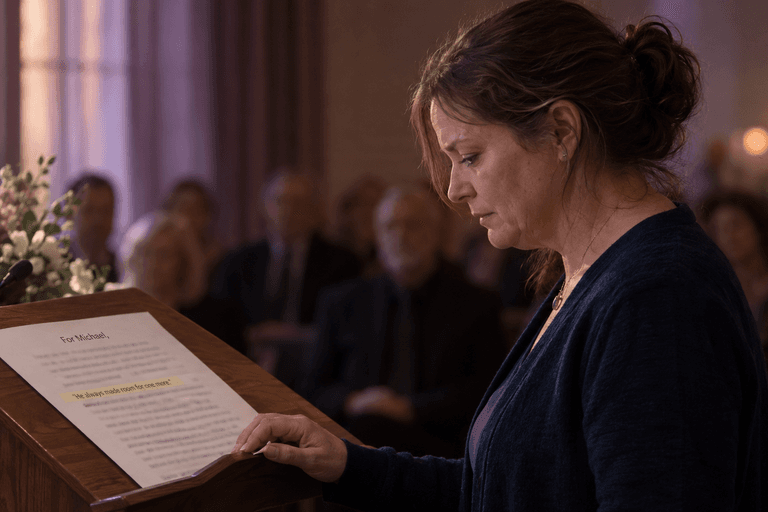
Yes. Pause, breathe, take a sip of water, and continue when you are ready. Humanists UK's delivery guidance says it is acceptable to become upset and recommends arranging a support person who can step in if needed. Your emotion does not diminish the tribute.
Can a eulogy mention a difficult relationship with a father?
Yes. You can acknowledge distance, disagreement, or emotional reserve with restrained language. Focus on what you observed and how the relationship shaped you, without using the gathering to assign motives or settle a dispute.
Should siblings give one eulogy together?
Siblings can share one connected eulogy or give separate short contributions. Choose the form that feels manageable, give each person a distinct memory or theme, and confirm the available time and speaking order with the officiant.
Can I read my father's eulogy from notes?
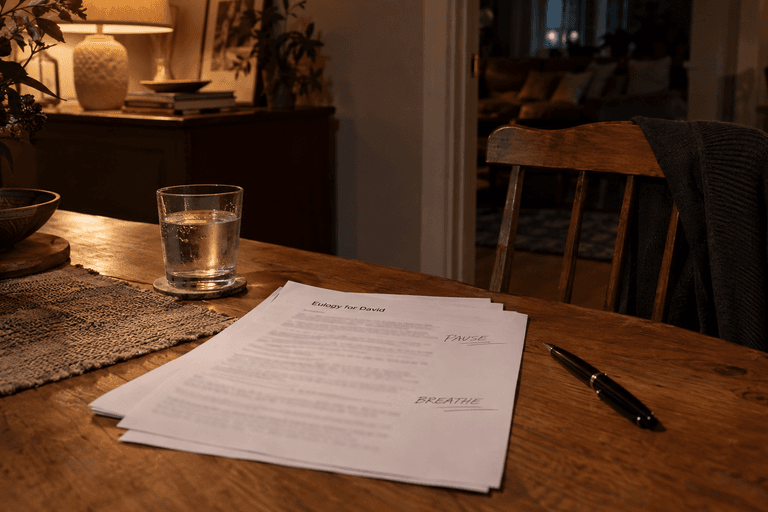
Yes. Memorization is not required. Print the speech clearly, mark natural pauses, number the pages, and practice reading it aloud. You can look up when it feels comfortable, but your notes are there to support you.
Sources
- National Institute on Aging, Coping With Grief and Loss
- C.S. Lewis Institute, C.S. Lewis on Grief
- Humanists UK, How to Write a Funeral Speech (Eulogy): A Step-by-Step Guide
- Humanists UK, How to deliver a eulogy – 9 tips from a celebrant
Lovekept's guides are drafted with AI against briefs written by the Lovekept team. Abdullah Nabeel, the founder, is the blog's editor. Read how we produce and correct content at /editorial-standards.