Funeral Order of Service Explained
A funeral order of service, explained: the typical sequence from prelude to committal, where the eulogy fits, Catholic vs Protestant, and timing for each part.
Why the Order of a Funeral Service Matters
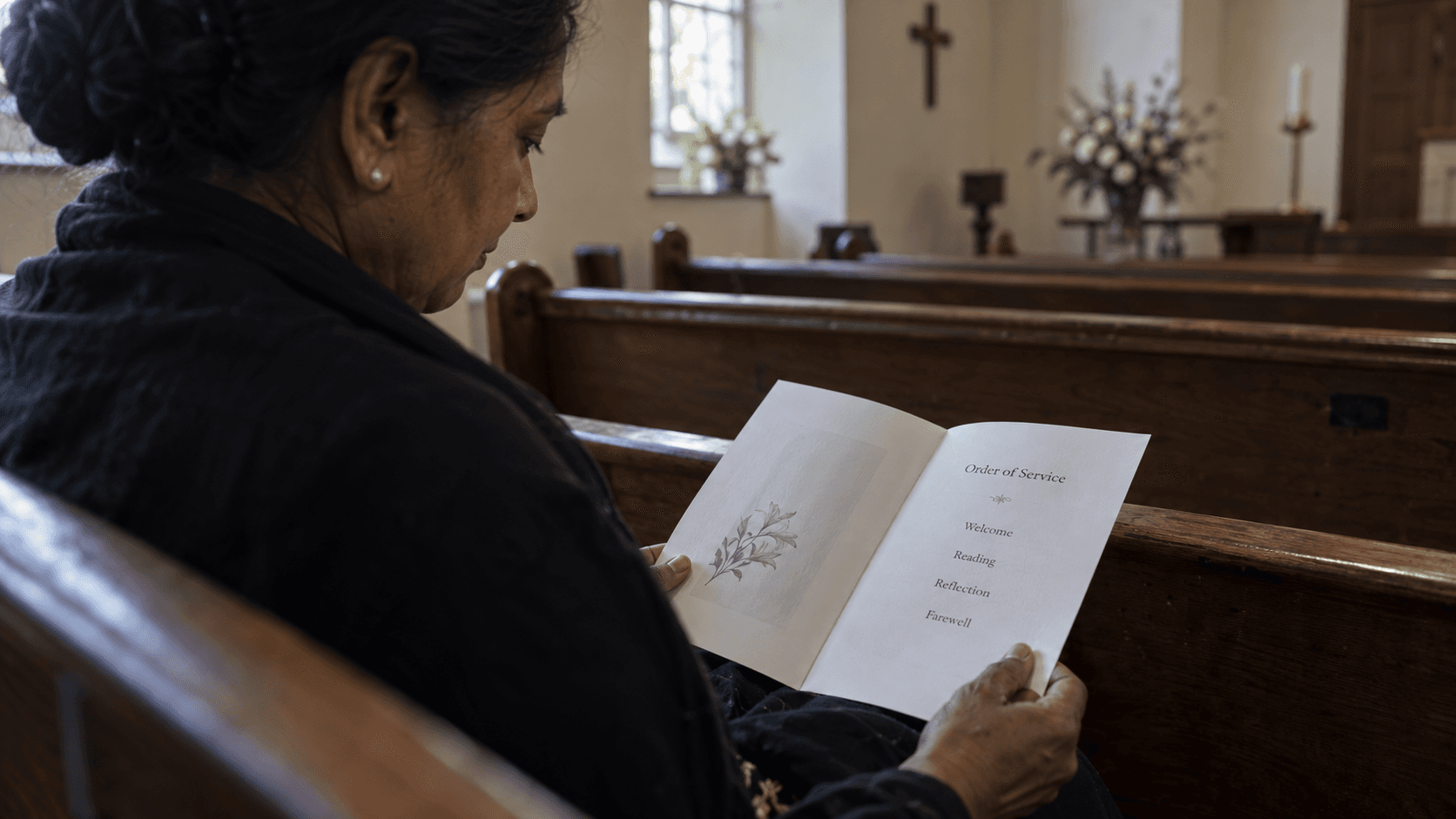
When people gather to say goodbye, they often glance down at a folded piece of paper to know when to stand, when to listen, and when it is finally their turn to speak. A funeral order of service is that quiet guide. The phrase covers two things at once: the running order the officiant follows at the podium, and the printed outline guests hold in their hands, telling everyone what is happening now and what comes next.
If you are planning a service right now, every decision can feel like it needs to happen at once. It does not. Many of the choices that shape the order, such as readings, music, and who speaks and when, can wait until a few days after the more urgent decisions covered in our guide to the first 24 hours after a loss. This guide walks through a typical funeral order of service from start to finish, where the eulogy usually fits, how Catholic and Protestant services differ, what changes at a graveside, and how long you can expect each part to take.
Key Takeaways
A familiar arc. Most funeral services move through gathering music, a welcome, readings and prayers, a eulogy or remembrance, closing words or a commendation, and a recessional.
The Catholic exception. In a Funeral Mass, a brief word of remembrance may come before the Final Commendation, but the homily itself is never a eulogy.
Graveside only is shorter. A graveside only service folds everything into a committal at the grave that often runs 15 to 30 minutes.
Family shapes it, faith frames it. The family usually decides the order together with the officiant, while the church or denomination sets the liturgical parts that cannot change.
Two different documents. The printed program shows guests the outline, while the officiant's spoken run sheet carries the cues nobody prints.
What an Order of Service Includes
An order of service lists every part of a funeral ceremony in the sequence it will happen, along with the person leading each part. At its simplest, it answers two questions for everyone in the room: what is happening right now, and what comes next. A typical order draws from these elements:
- Prelude or gathering music
- Processional
- Welcome and opening words
- Readings (scripture or poetry)
- Prayers or reflections
- Hymns or songs
- Eulogy or tributes
- A homily or message
- Committal or closing words
- Benediction
- Recessional
Beyond the sequence itself, the order of service usually names the officiant, the readers, the musicians, and the pallbearers, so guests know who is who as the ceremony moves forward. In Catholic tradition, this sequence sits inside a larger structure: the funeral rites unfold in three main parts, usually held in different places, the Vigil, the funeral Mass, and the Committal, according to the Archdiocese of New York's liturgical guidelines for funerals.
Secular and humanist services follow the same basic arc. They simply swap scripture readings and prayers for poems, music, and personal reflections chosen by the family. Whatever words fill each part, most services move the same way: from gathering, to remembering, to letting go.
The Usual Order of a Funeral Service From Start to Finish
No two services are exactly alike, but most funeral home, Protestant, and nonreligious ceremonies follow a recognizable path. Think of the steps below as a starting shape you can adapt, adding a song here or a second tribute there. A Catholic Funeral Mass follows its own set structure, which we cover a little further down.
A Typical Funeral Service, Step by Step
- Prelude music: Guests arrive to quiet instrumental or vocal music, usually starting 10 to 20 minutes before the service begins.
- Processional and seating: The casket or urn is carried in and the immediate family is seated, often to a slow hymn or piece of music.
- Welcome and opening prayer: The officiant greets everyone, offers an opening prayer or a few words of scripture or poetry, and sets the tone for what follows.
- First reading and a hymn: A reader shares a passage or poem, followed by a hymn or song the congregation may join.
- Second reading: A second reading, often chosen by another family member or friend, adds a different voice to the service.
- Eulogy and family tributes: One or more speakers share memories and tributes, usually the most personal part of the service.
- Homily, sermon, or reflection: The officiant offers a message of comfort and meaning, tied to the readings that came before.
- Closing prayer, benediction, and recessional: A closing prayer or commendation, a final blessing, and the recessional as the casket or urn is carried out and guests follow.
Where the Eulogy Goes in the Order of Service
In most Protestant and nonreligious services, the eulogy comes after the readings and before the sermon or closing prayers, just as it does in the steps above. That placement lets the service move naturally from scripture or poetry, to personal memory, and then to comfort.
Catholic funerals work differently. Within a Funeral Mass, the homily cannot be replaced by a eulogy. The homily is reserved for a priest or deacon, is based on the day's readings, and is never given in the style of a personal tribute, according to the Archdiocese of Boston's guidelines on words of remembrance in the Order of Christian Funerals. What the rite does allow is a brief word of remembrance from a family member or friend before the Final Commendation begins. Diocesan guidance like Boston's typically keeps this to one speaker for no more than about five minutes, with the remarks written out in advance.
If your family wants a longer tribute, or more than one voice, there are other places for it. A wake or vigil the night before, the reception afterward, or a separate memorial gathering can all hold the fuller stories that a five-minute slot cannot. If you're looking for a starting point, our collection of eulogy examples for every relationship shows how different tributes take shape depending on who is speaking and who is being remembered. Lovekept's eulogy writer can then help you organize your own memories into something you feel steady reading aloud.
How a Catholic and a Protestant Order of Service Differ
Catholic and Protestant funerals share the same basic arc of gathering, remembering, and letting go, but the details differ enough that it helps to see them side by side.
- Overall structure. Catholic funeral rites unfold in three parts, usually held in different places: the Vigil, the funeral Mass, and the Rite of Committal, as laid out in the Archdiocese of New York's liturgical guidelines. Protestant traditions typically hold a single service, and its name changes by denomination. The Episcopal Church's Book of Common Prayer calls it the Burial of the Dead, while the United Methodist Church's Service of Death and Resurrection and the service of witness to the resurrection described in the Presbyterian Church's Book of Order follow the same idea under their own names.
- Opening. A Catholic funeral usually opens with the reception of the body at the church door, where holy water recalls the person's baptism and the casket may be covered with a funeral pall, per the Archdiocese of New York's guidelines on the reception of the body. Protestant services often open instead with opening sentences or an anthem, as in the Episcopal Church's Burial of the Dead: Rite One.
- Readings. The Catholic Mass follows a set structure: a first reading, a responsorial psalm, an optional second reading, and a Gospel proclaimed by clergy, with family members sometimes invited to proclaim the earlier readings, according to the Archdiocese of New York's funeral guidelines. Protestant services generally allow more freedom in choosing which passages to read, and the Book of Common Prayer notes it is desirable for lay readers to read the Old Testament lesson and the Epistle.
- Communion. Communion is central to the Catholic Funeral Mass. Among Protestant traditions it is optional. The Presbyterian Church's Book of Order allows the Lord's Supper with the session's approval. In the United Methodist funeral service, the pastor may offer communion to anyone who wishes to share it, and otherwise the service continues without it.
- Eulogy. Inside a Funeral Mass, only a brief word of remembrance is allowed before the Final Commendation, usually from one speaker for a few minutes, as covered above. Most Protestant services welcome a fuller eulogy, sometimes from more than one speaker, as part of the witness or remembrance portion of the service.
- Closing. A Catholic funeral closes with the Final Commendation and the Song of Farewell, which the Archdiocese of New York's guidelines describe as the climax of the rite. Protestant services typically close with a commendation and a benediction, sending the congregation out with God's blessing, following the pattern in the Presbyterian Church's Book of Order.
Practice still varies from parish to parish and congregation to congregation, so treat this as a general shape rather than a fixed script. Your officiant remains the best guide to what can flex in your specific service, and what cannot.
Words Both Traditions Share
For all their differences, Christian funerals draw on a common well of scripture. The Episcopal Church's Book of Common Prayer opens the Burial of the Dead with an anthem drawn from the Gospel of John, words many families recognize whatever their tradition. Nonreligious services usually open differently, often with a favorite poem in place of scripture, but the instinct behind it is the same: to begin with words steady enough to hold a room.
“I am the resurrection and the life, saith the Lord; he that believeth in me, though he were dead, yet shall he live.”
How the Order Changes for a Graveside Only Service
A graveside only service drops the separate ceremony at a funeral home or church and gathers everything into a committal held right at the grave, often lasting 15 to 30 minutes. The order shrinks rather than disappears: there is no prelude or processional, usually one or two readings instead of several, and a shorter eulogy. A typical sequence runs from gathering at the grave, to opening words, readings, a brief tribute, a prayer of committal, and a closing blessing. Many Christian committal prayers echo the words "we commit his body to the ground," drawn from the Book of Common Prayer's committal rite. Guests may then place flowers or a handful of soil before stepping away.
If your loved one served in the military, the graveside is also where honors are usually given. As of 2026, eligible veterans can receive military funeral honors that include at least two uniformed service members, the folding and presentation of the burial flag, and the playing of Taps, according to the VA's National Cemetery Administration, and families should let their funeral director know early if they want these honors. At VA national cemeteries specifically, the committal service is held in a committal shelter rather than at the gravesite, and typically runs about 20 minutes before burial. Procedures can be updated, so confirm the details with the VA or your funeral director before the day itself. If you're writing the obituary alongside the service, our obituary examples for a veteran show how to phrase service details and military honors with care.
Who Decides the Order of Service at a Funeral?
The family, usually led by the next of kin or whoever has been named to handle the arrangements, decides the order of service together with the officiant, while the funeral director coordinates the pieces into a working timeline. State law generally determines who holds the legal right to control those arrangements. As of 2026, the Funeral Consumers Alliance notes that most states recognize a designated agent named in advance, and where no one has been named, the right typically passes to a spouse and then to adult children.
Inside a church, the fixed parts of the service belong to the clergy and the denomination's liturgy, so families choose within that frame rather than around it. The Archdiocese of New York's guidelines recommend that family members help plan the liturgy, with the family, the funeral director, and the parish priest setting the places and times for the Vigil, the funeral Mass, and the Committal together. What families typically choose are the readings, the music, who reads, who serves as pallbearer, and whether a word of remembrance is offered.
Written wishes left behind by the person who has passed often settle questions before they can become disagreements. Without them, the order of service is often where tension first surfaces, not because anyone disagrees about honoring their person, but because grief makes even small choices feel enormous. One practical fix is to name a single person, often whoever is already handling the arrangements, as the final editor of the order. It doesn't remove anyone's voice from the conversation. It simply gives the group a way to move forward when time is short. If you're still working through the steps that come before the service itself, our guide to what happens between a passing and the funeral covers that ground in more detail.
What Goes in the Printed Program Versus the Spoken Order
People often use "order of service" and "funeral program" interchangeably, but they are doing different jobs. The order of service is the sequence of events. The program is the printed piece guests hold in their hands, and the spoken order, sometimes called a run sheet, is what the officiant and speakers actually work from. Guests rarely see the run sheet, and the program leaves out most of what the officiant needs. Here is what typically belongs in a printed funeral program.
What Belongs in the Printed Program
Cover page
The full name, birth and passing dates, and a photo that represents how the family wants their loved one remembered.
Order of service outline
The sequence of the ceremony, so guests know what's coming next and roughly when to expect the eulogy or closing words.
Names of participants
The officiant, readers, musicians, and pallbearers, credited by name and role.
Hymn or reading text
The words to any hymns or responsive readings guests will be asked to join in aloud.
A short life summary
A brief obituary or life summary, distinct from a full eulogy, giving guests context on the life being honored.
Reception and QR details
Directions or times for the reception or burial, and sometimes a QR code linking to an online memorial where guests can leave messages afterward.
The spoken order stays with the officiant, not the guests. It carries the details a program leaves out: who stands when, the handoff cues between speakers, each person's time limit, and the exact cue for the recessional music to begin. If the printed program includes a short life summary, our guide to obituary format and structure walks through how to organize it so it reads well in a program instead of a newspaper column, and Lovekept's obituary writer can help you draft one from a few basic details. If you plan to add a QR code linking to an online memorial, you can create an online memorial in advance so the code is already live before a single program is printed. Once the order is finalized, Lovekept's free funeral program template gives you a ready-made layout for the cover, the outline, and every name that belongs in it.
Lay Out Your Funeral Program in Minutes
Once the order is settled, drop the name, dates, photo, and order of service straight into a ready-made layout instead of starting from a blank page.
Use the Free Funeral Program TemplateHow Long Each Part of the Service Takes
As a rough guide, most funeral home and Protestant services run 30 to 60 minutes from start to finish, and a Catholic Funeral Mass often takes about an hour. Within that time, each part has its own rhythm:
- Prelude: 10 to 20 minutes as guests arrive and find seats.
- Welcome and opening words: 2 to 3 minutes.
- Each reading: 1 to 3 minutes.
- Each hymn or song: 3 to 4 minutes.
- Eulogy: 5 to 10 minutes. A Catholic word of remembrance is kept to just a few minutes, per diocesan guidance such as the Archdiocese of Boston's.
- Homily or sermon: 10 to 15 minutes.
- Commendation and closing: 5 to 10 minutes.
- Graveside committal: 15 to 30 minutes.
These ranges matter for more than politeness. Funeral homes and cemeteries often book services in fixed time slots, so a service that runs long can push into the next family's booking or into setup time at the reception. Building a few extra minutes of cushion, especially around the eulogy, tends to save everyone a rushed goodbye.
There is no rule that says a longer eulogy honors someone more than a shorter one, or that a brief service means less love went into it. The time you give each part of a funeral is, in its own quiet way, a statement of what mattered most to the people saying goodbye.
A Timing Tip for Speakers
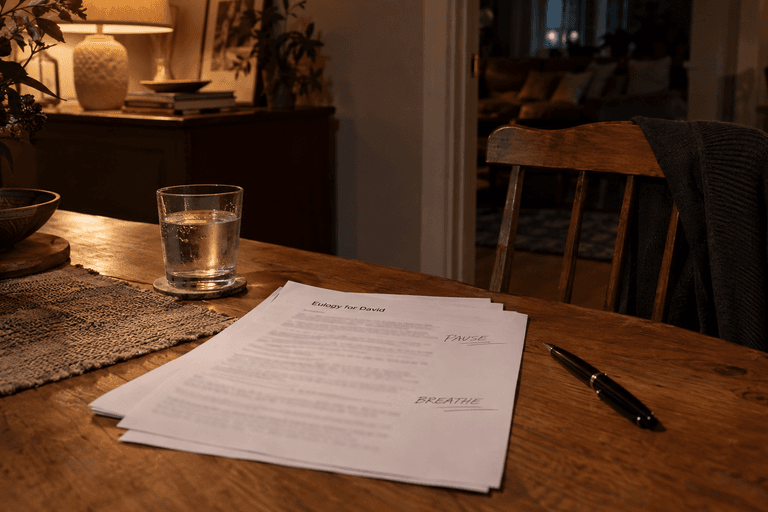
Give every speaker their slot and time limit in writing well before the service, and ask them to bring a printed copy of their words. A five-minute eulogy is roughly 650 to 750 words read aloud at a calm, unhurried pace. It also helps for the officiant to hold a backup copy of each tribute, in case a speaker is too overcome to finish.
Frequently Asked Questions About the Funeral Order of Service
A few questions come up again and again as families put the order together.
Is a funeral order of service the same as a funeral program?
Not quite. The order of service is the sequence of events, while the program is the printed booklet that displays that sequence for guests, often alongside a photo, the names of participants, and a short life summary.
Can we change the order of a Catholic Funeral Mass?
The overall structure is set by the rite and cannot be rearranged, but families still have real choices within it, including which readings are used, who serves as reader, what music is played, and whether a brief word of remembrance is offered before the Final Commendation. Your parish priest can walk you through the options.
How many readings are typical at a funeral?
Most Christian funerals include two or three readings, often alongside a psalm. A Catholic Funeral Mass generally includes a first reading, a responsorial psalm, an optional second reading, and a Gospel passage. Nonreligious services might include a poem or two in their place.
Can more than one person give a eulogy?
Usually yes, outside of a Catholic Funeral Mass, where remembrance is typically limited to one speaker for a few minutes. In most Protestant and nonreligious services, two or three speakers is common, though it helps to agree on a combined time limit in advance.
What order does a memorial service follow when there is no casket or urn?
It follows the same basic arc as a traditional funeral, with gathering, readings, a eulogy, and closing words, simply without a processional or a committal, since there is no body or urn present to carry in or lay to rest.
How many funeral programs should we print?
Print enough for your expected guest count, plus extras for unexpected arrivals and for family members who want to keep one as a keepsake. Your funeral director can help you settle on a final number once the guest count is clearer.
Shaping a Service That Feels Like Them
An order of service is a framework, not a test you can fail. Whether you follow a centuries-old rite or build a simple gathering around a few favorite songs, what matters is that the sequence gives everyone in the room a way to remember together and then to let go, gently and in their own time.
The stories shared in the eulogy and tributes don't have to end with the recessional, either. An online memorial gives family and friends a place to keep adding photos, memories, and messages long after the service.
Keep the Stories Going After the Service
Gather the tributes, photos, and memories from the day into one lasting online memorial.
Start Your MemorialSources
- Office of Liturgy of the Archdiocese of New York, Liturgical Guidelines for the Celebration of Funerals
- Archdiocese of Boston, Guidelines for Homilies and Words of Remembrance in the Order of Christian Funerals
- The Episcopal Church (Church Publishing Incorporated), The Book of Common Prayer
- Discipleship Ministries of The United Methodist Church, A Service of Death and Resurrection
- Presbyterian Church (U.S.A.), Book of Order 2025/2027
- U.S. Department of Veterans Affairs, National Cemetery Administration, Military Funeral Honors
- U.S. Department of Veterans Affairs, What to expect at a military funeral
- Funeral Consumers Alliance, State by State: Assigning an Agent to Control Disposition
Lovekept's guides are drafted with AI against briefs written by the Lovekept team. Abdullah Nabeel, the founder, is the blog's editor. Read how we produce and correct content at /editorial-standards.