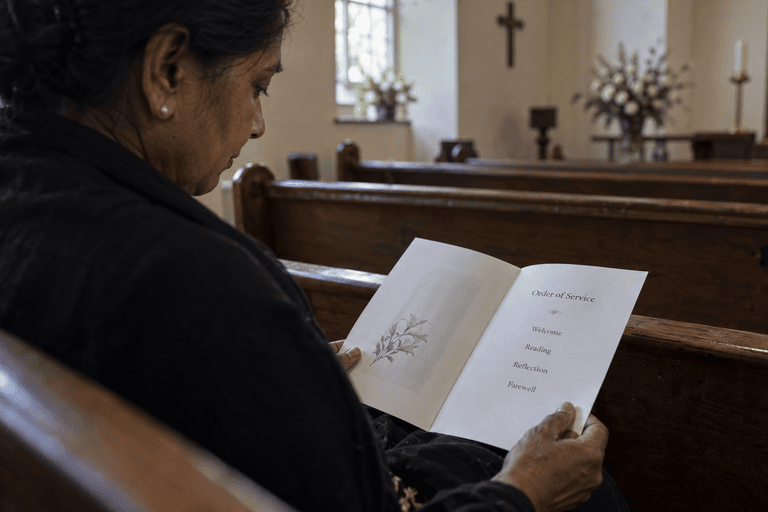
How to Write a Funeral Program: A Panel-by-Panel Guide
Learn how to write a funeral program: what goes on the cover, what to include inside, wording examples, how many to print, and where to print on short notice.
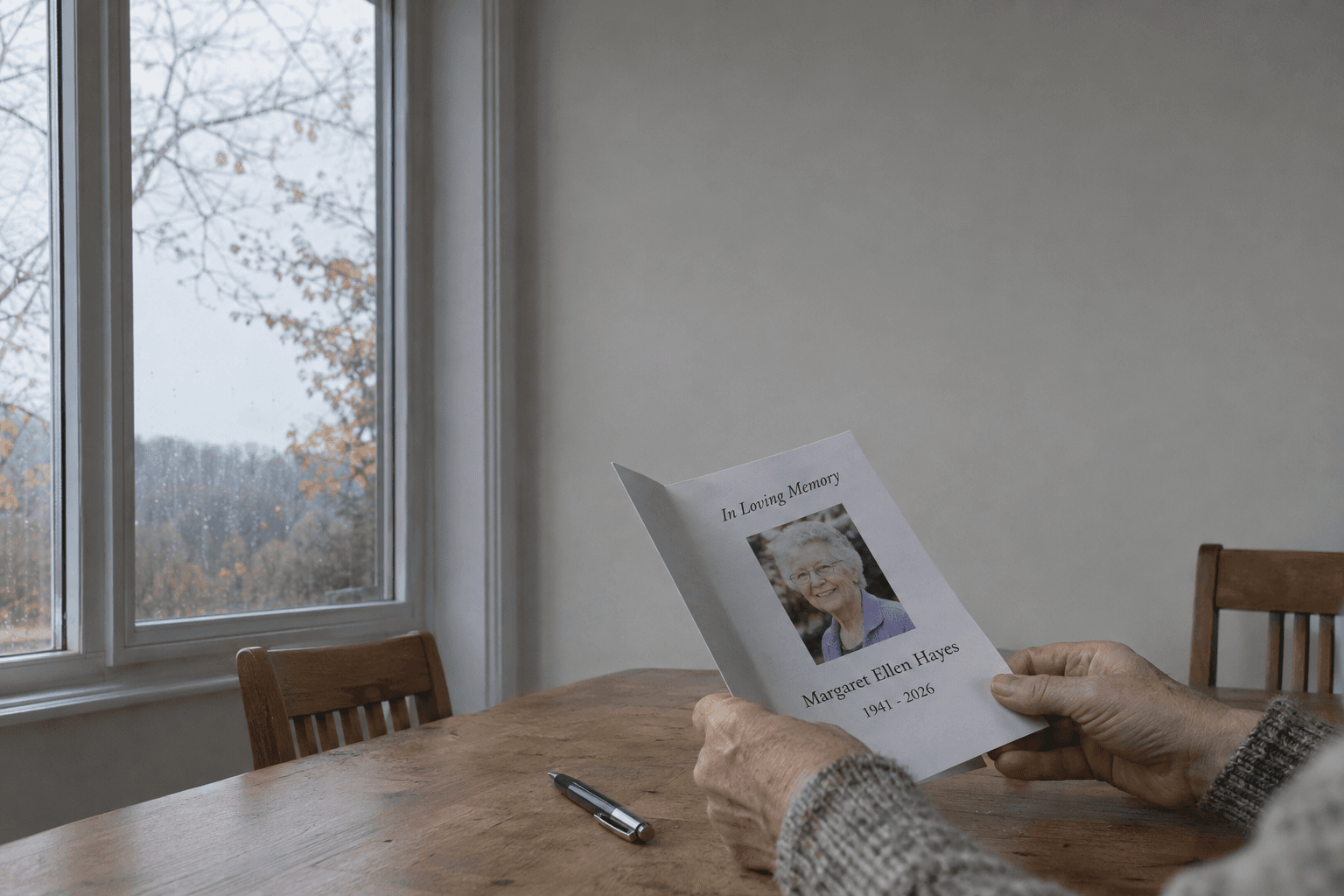
A funeral program is the first thing guests hold when they arrive, and often the one thing they carry home. Usually it is a single folded sheet or a short booklet. It holds your loved one's name and dates, a photo, the order of service, and a few words of tribute. Most families put it together in just a few days, while making many other decisions and with very little energy to spare.
The good news is that learning how to write a funeral program is easier than it looks, and you can finish one in an afternoon if you take it one panel at a time. This guide follows the program the way a guest reads it: the front cover, the inside pages, the order of service, survivors and pallbearers, and the back page. Then it covers the practical part: common mistakes, how many copies to print, adding a photo and a QR code, and where to print when time is short. Draft each section as you read, and by the end you will have a complete program that honors the person you love.
Key Takeaways
The cover needs the full name, birth and passing dates, a photo, and the service date and place.
The inside pages hold the order of service, a short life summary, survivors, and pallbearers.
The back page carries acknowledgments, a poem or verse, and reception or memorial donation details.
Lock the order of service first. Confirm it with the officiant before you design anything.
Print for households, not just guests. Add extras for keepsakes and for people who cannot attend.
Test any QR code on more than one phone before you print.
What Goes on the Front Cover of a Funeral Program
The front cover usually carries a heading phrase, the full name, birth and passing dates, one photo, and often the service date, time, and location. Include a nickname or maiden name if the family prefers it, such as Margaret "Peggy" Hayes. Keep the layout clean. The cover is the first thing people see, and it should read at a glance.
Cover wording examples
- In Loving Memory of
- Celebrating the Life of
- Forever in Our Hearts
- A Service of Remembrance for
- Going Home or Homegoing Celebration, for families whose faith traditions use these phrases
For the cover photo, choose the one that looks like the person everyone knew, which is not always the most formal one. A relaxed smile in good light often brings more comfort than a studio portrait, and guests will recognize them right away. Once the cover feels right, open the fold and turn to the pages inside.
What to Include Inside the Funeral Program
The inside pages are where the program does its work. Most of what goes there is a short list, and the one piece of real writing is the life summary. Use a shortened version of the published obituary rather than the full text. Our guide to how a full obituary is structured shows which parts to keep, and Lovekept's AI-assisted obituary writer can help you draft a brief life summary if you are starting from scratch. Here is everything the inside pages typically hold.
Inside Page Elements at a Glance
Order of service
The ceremony listed part by part, with names. One page is usually enough.
Life summary
A short story or obituary excerpt. Aim for one to three short paragraphs.
Survivors
Family listed from closest relationship outward, in one compact paragraph.
Pallbearers
Names listed one per line, with honorary pallbearers on a separate line.
Readings and verses
Scripture, poems, or favorite sayings. Pick one or two short pieces.
Photo collage
An optional small group of three to six photos that show different years.
Interment and reception
Where and when the family gathers next, with simple directions.
How to Word the Order of Service in the Program
The order of service is a simple list of each part of the ceremony, with the name of whoever leads it. Keep each line short. If you would like to understand what each part means and why it comes where it does, see our guide to the funeral order of service explained. The two examples below show how the wording looks on the page.
A religious service example
- Prelude
- Welcome and Prayer, Rev. Ana Lopez
- Reading, Psalm 23, read by David Kim
- Hymn, "Amazing Grace"
- Eulogy, Sarah Mitchell
- Closing Prayer and Benediction, Rev. Ana Lopez
- Recessional
A secular celebration of life example
- Music as Guests Gather
- Welcome, Daniel Hayes
- Remembrances from Family and Friends
- Poem, read by Priya Shah
- Open Sharing of Memories
- Closing Words and Invitation to the Reception
A few formatting habits help the page read smoothly. Right-align the names, put song titles in quotation marks, and add hymn numbers if the congregation uses hymnals. If a faith tradition has a set structure, follow it. Catholic funerals, for instance, follow three parts, according to the USCCB: the Vigil Service, the Funeral Liturgy, and the Rite of Committal.
For a veteran, list the military funeral honors as their own line. Military OneSource explains that a uniformed detail of at least two people carries out the core elements: the playing of Taps and the folding and presentation of the flag. A line such as "Military Honors, Taps and Presentation of the Flag" is enough.
How to List Survivors and Pallbearers in the Program
List survivors from the closest relationship outward: spouse or partner, children, grandchildren, parents, then siblings. A single compact paragraph usually works best, and a longer list can be broken into short grouped lines. Our guide on how to list survivors in an obituary goes deeper on tricky cases.
Every family looks different, and the wording can stay simple and kind:
- Blended family: "He is survived by his wife, Linda; his children, Mark, Anita, and Jordan; and his stepchildren, Chris and Dana."
- Partner: "She is survived by her partner of twenty years, Elena Ruiz."
- Chosen family: "She also leaves behind her chosen family and dear friends, including Tom and Ruth Alvarez."
For pallbearers, list the names one per line under the heading "Pallbearers." Add a separate "Honorary Pallbearers" line for people who are being honored but will not carry the casket. Before you print, confirm each name and spelling with the person, and ask whether they go by a nickname. It is a small step that prevents the most painful kind of typo.
What to Put on the Back Page of a Funeral Program
The back page is where the family speaks to guests directly. It usually holds a thank-you message, a poem, verse, or favorite saying, reception or repast details, the burial or interment location, and memorial donation information. A typical donation line reads: "In lieu of flowers, the family asks that gifts be made to the Hayes Family Scholarship Fund."
Here are three acknowledgment examples you can adapt. Our guide to funeral thank you card wording offers more.
- "The family is grateful for your love, your prayers, and your presence today."
- "Thank you for helping us celebrate a life that meant so much to so many."
- "Your kindness has carried us through these days. We will not forget it."
A quick note on permissions. Modern song lyrics and recent poems may need the rights holder's permission, so classic verses are the safer choice. In the United States, works from 1930 entered the public domain on January 1, 2026, according to Duke's Center for the Study of the Public Domain, so as of 2026, anything first published before 1931 is generally free to print. The nineteenth-century line below, which appears in Thomas Campbell's collected poetical works at Project Gutenberg, is a well-loved choice.
“To live in hearts we leave behind is not to die.”
A short line like this fits comfortably on a back page. If the family is also honoring their loved one with a living tribute, you can mention it beside the donation details. A line such as "A tree has been planted in their honor" works beautifully, and you can learn more about planting a tree in their honor on our tree planting page.
What Are Common Funeral Program Mistakes?
Many families start with the cover design. We suggest the opposite: lock the order of service with the officiant first. It is the part most likely to change, and a late change can force a reprint when you have the least time to spare.
These are the errors families most often catch after printing:
- Misspelled names, especially of relatives and pallbearers.
- Wrong dates, most often the year of birth.
- A missing or misspelled officiant or musician.
- A page count that does not fold correctly. Booklets need a multiple of four pages.
- Blurry photos pulled from social media.
- Text too small for older guests to read comfortably.
On photos, Utah Valley University's printing services advise that images should be 300 pixels per inch at final print size. A photo that looks fine on a screen can still print soft, because screens need far less resolution than paper does.
Finish with a two-person proofreading routine. Have one person read only the names aloud against a family list. Have a second person check only the dates and times. Two readers, each with one job, catch what a tired group skimming together will miss.
How Many Funeral Programs to Print
There is no single right number, but a simple method helps. Count households rather than individual guests, since couples and families usually share one program. If you are unsure how many people will come, ask the funeral director what attendance tends to look like for services in your community, and think about how wide your loved one's circles were: their congregation, workplace, clubs, and neighborhood.
Then add a cushion. Set aside copies for family keepsake boxes and scrapbooks, and for mailing to people who could not travel. Running short at the door is far more stressful than carrying a small box of leftovers home.
A Quick Way to Estimate
Start with the number of households you expect, then add extras for family keepsakes and copies to mail to those who could not attend. If you are torn between two numbers, choose the higher one. Leftover programs often become treasured keepsakes.
How to Add a Photo and a QR Code to the Program
Use one strong portrait on the cover and, if you like, a small collage inside. Scan old prints at high resolution, and crop every photo in the same style so the page feels calm. Keep faces well away from the fold.
A QR code on the back page can carry the tribute beyond the service. It can link guests to an online memorial, where they can read the full life story, see more photos, and leave messages in a guestbook. You can create an online memorial to link from the program, and Lovekept memorial pages generate a QR code for exactly this purpose.
A little background helps. DENSO WAVE states that "QR Code" is its registered trademark, and that no license or fee is needed to use one. The format was approved as an ISO international standard in 2000. For reliable scanning, print the code in black on white, leave a blank border around it, and make it large enough to scan easily. Add a short line such as "Scan to share a memory," and test it on at least two phones before you print.
Our free funeral program template has space for both the photo and the code, so you do not have to fit them in by hand.
Lay Out Your Program With Our Free Template
The template has ready-made spaces for the cover photo, name and dates, order of service, survivors, a back-page verse, and a QR code linking to the online memorial.
Use the Free Funeral Program TemplateWhere to Print Funeral Programs on Short Notice
When the service is only days away, you still have several realistic options:
- The funeral home, which often offers printed programs as part of its services.
- Local print shops and copy centers, which can often turn around a simple bifold quickly if you bring a print-ready PDF.
- Office supply stores with print counters.
- Online printers, which are usually too slow unless you pay for rush shipping.
- Home printing on heavier cardstock, which suits small services.
You are not locked into the funeral home's printing. Under the FTC's Funeral Rule, as of 2026, a funeral home must give you an itemized General Price List, and you can generally choose only the goods and services you want. If printing programs elsewhere costs less or is faster, the choice is yours.
Call ahead to confirm same-day capacity and paper stock. The standard format is letter-size paper folded in half. An 11 by 17 sheet folded in half makes a four-page letter-size booklet.
A Program Made With Care Is Enough
Writing a funeral program can feel like one more task in a week that already asks too much. Take it one panel at a time: a cover that looks like them, an order of service the officiant has confirmed, a list of the people who loved them, and a few words of thanks on the back.
Above all, remember that a simple, accurate program is enough. Guests will not remember the paper. They will remember the name, the photo, and the care you put into honoring someone they loved too.
Who usually writes the funeral program?
Usually a close family member drafts it, often with help from the funeral director or a friend who is good with words. Many funeral homes will format it for you if you supply the details. Sharing the work is perfectly fine.
How far before the service does the program need to be finished?
Aim to send the final file to the printer at least a day or two before the service, so you have time to proofread a printed copy and fix any mistakes. If you are printing at home, you can work closer to the day. Ask your printer about their turnaround before you commit to a plan.
Is a funeral program the same as an order of service?
Not quite. The order of service is the list of what happens during the ceremony. The funeral program is the whole printed piece, which includes the order of service along with the cover, a life summary, survivors, and a back page. People often use the terms loosely, though.
Can I include a Bible verse, and do modern translations need permission?
Yes, you can include a verse. Many modern translations are under copyright, and many publishers post their own quotation guidelines. Check the translation's permissions page, or choose an older public-domain translation to be safe.
Do you need a program for a small service or celebration of life?
You do not need one, but a single folded sheet can be a lovely touch even for a gathering of a dozen people. It gives guests something to hold and a keepsake to take home. A small program can be as simple as a photo, a name, and a short poem.
What size paper is a funeral program printed on?
The most common choice is letter-size paper folded in half, which makes a four-page bifold. For a longer program, an 11 by 17 sheet folded in half makes a four-page letter-size booklet. Heavier cardstock gives the program a sturdier, more keepsake feel.
What should we do with leftover programs?
Keep a few for the family's scrapbook or memory box. Mail copies to relatives and friends who could not attend, with a short note. Share the rest with anyone who asks, since many people treasure having one.
Sources
- United States Conference of Catholic Bishops, An Overview of Catholic Funeral Rites
- Military OneSource (U.S. Department of Defense), What to Expect During Military Funeral Honors
- Duke University School of Law, Center for the Study of the Public Domain, Public Domain Day 2026 - Center for the Study of the Public Domain
- Project Gutenberg, The Project Gutenberg eBook of The Poetical Works of Thomas Campbell
- Utah Valley University, Printing Services, How to Set Up Print Files Correctly: Bleeds, Resolution, and Color Space
- DENSO WAVE, FAQ | QRcode.com | DENSO WAVE
- DENSO WAVE, History of QR Code | QRcode.com | DENSO WAVE
- Federal Trade Commission, The FTC Funeral Rule
Lovekept's guides are drafted with AI against briefs written by the Lovekept team. Abdullah Nabeel, the founder, is the blog's editor. Read how we produce and correct content at /editorial-standards.