
Free eulogy writer
and funeral speech helper

Answer a few questions about them and get a eulogy you can read aloud, timed to the minutes you have been given. It is free, no account is needed to start, and every word is yours to change.

Free to useNo sign-up to startTimed for reading aloud

Who is the eulogy for?

Their name is enough to begin. The writer then asks who they were to you, the moments you remember, and how many minutes you have to speak.

Date of birth (optional)
Date of passing (optional)
Location (optional)

The town they called home. A eulogy rarely names it, so leave it blank if it does not matter.

Add a first and last name to begin.

What a eulogy is, and what it is not

A eulogy is spoken. One person stands up and says, in their own voice, what this person was to them. It is personal, and it is partial, and it is allowed to be: nobody expects one speaker to account for a whole life.

A eulogy

  • Spoken out loud, once, at the service
  • In the first person, by someone who knew them
  • Built from a few real memories, not a full biography
  • Three to five minutes, most of the time
  • Often shared between two or three speakers, each from their own angle

An obituary

  • Written to be read, in a newspaper or online
  • In the third person, for everyone including strangers
  • The facts: dates, family, work, and the service details
  • A hundred words, or several hundred online
  • One notice, published once, then archived

Most families end up needing both, and they are written differently. If it is the notice you are short of rather than the speech, the free obituary writer handles that one.

How to write a eulogy in three passes

Gather, shape, then speak. Most people try to do all three at once, in one sitting, at midnight, and that is what makes it feel impossible. The writer above handles the middle pass for you.

Gather before you write

Put down the raw material first, in fragments, with no sentences yet: two or three moments you actually remember, their exact words if you have them, what they loved, and the one thing you would not want left unsaid. Name the thing. A tin of butterscotch in the car door does more work than the word generous.

Give it a shape

Open by saying who you are to them and why you are the one standing there. Move through the memories one at a time, letting each have its own moment instead of stacking them into a list. Then say what you carry now. Close by speaking to them rather than about them.

Say it out loud

Stand up and read it at the speed you will really speak, which is slower than reading in your head. Time it. Cut whatever you stumble over twice, because you will stumble over it on the day. Anything you cannot say without stopping is a line to shorten, not a line to practise harder.

You do not have to write the whole thing to use the tool. Fragments are enough: the writer only builds from what you give it, and it never invents a memory.

How long should a eulogy be, in minutes

Three to five minutes. That is what most services plan for, and it is long enough to tell two or three things properly without asking a room to hold its breath.

Minutes matter more than word counts here, because the page and the lectern are not the same place. Reading silently, most people move at 200 to 250 words a minute. Reading aloud at a funeral, with a catch in your voice and a pause you did not plan, it comes down to about 130 to 150. Count on 140 and you will not be surprised.

Ask who else is speaking before you settle on a length. Families often have two or three people share the eulogies, and around thirty minutes tends to be set aside for all of them together. Five minutes is generous on your own and too long if there are four of you.

Time at the lecternOn the pageWhat fits in it
2 minutesabout 280 wordsOne memory, told properly
3 minutesabout 420 wordsOne memory and a close
4 minutesabout 560 wordsTwo memories, and who they were
5 minutesabout 700 wordsTwo or three memories, plus what they gave you
6 minutesabout 840 wordsThree memories, room to name people
7 minutesabout 980 wordsThe most a service will usually want from one speaker

You do not have to do this arithmetic. Tell the writer how long you have and it aims at that span, then shows the word count of the finished draft and how many minutes it takes to read aloud, so you can cut with something better than a guess.

Eulogy examples for four relationships

Each of these runs a little under 200 words, which is roughly a minute and a quarter spoken, so a full three to five minute eulogy is three or four passages of about this length. The people are invented. The specific detail is what to copy, not the words.

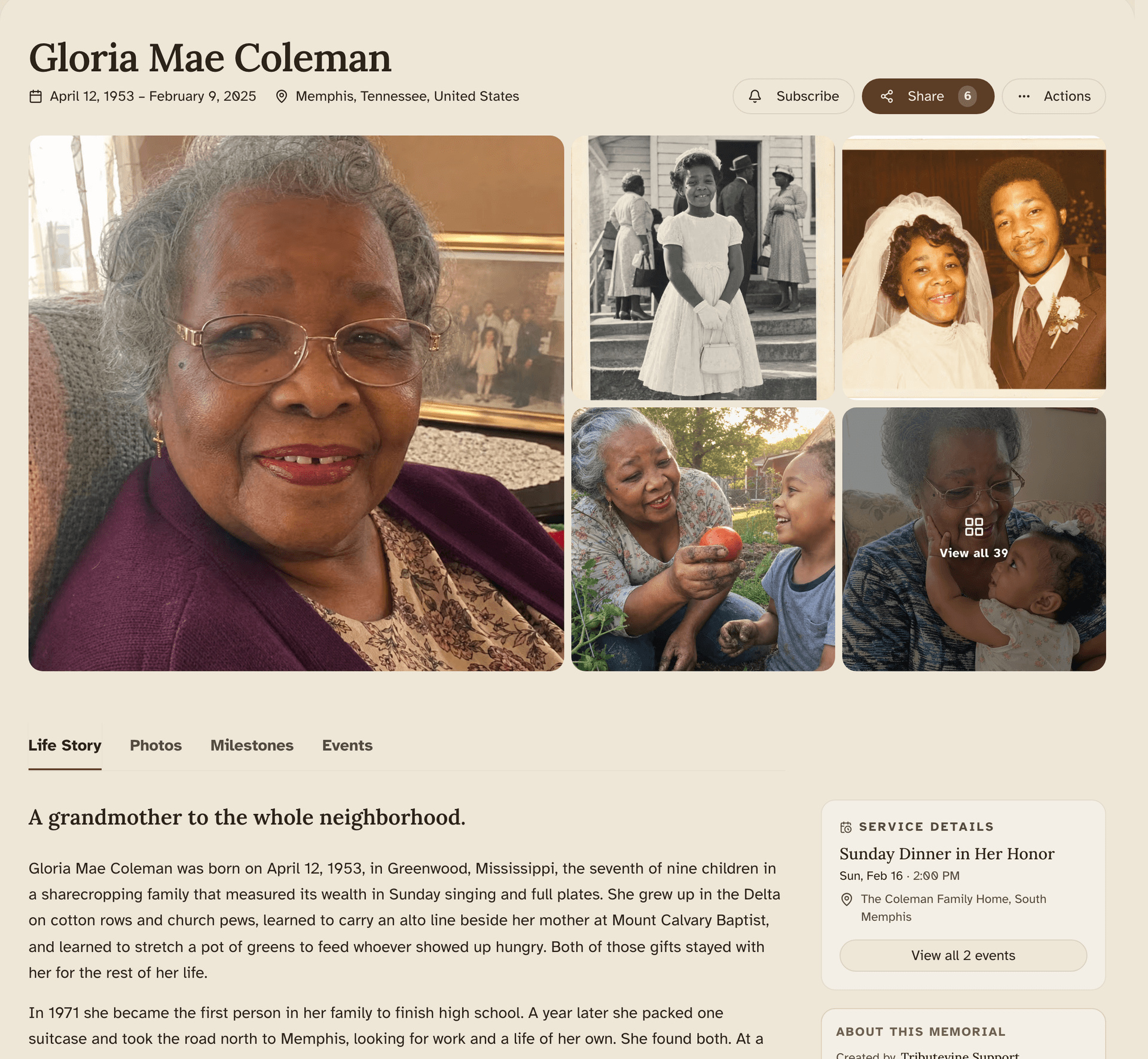
For a grandmother

Given by her granddaughter · about 175 words · just over a minute aloud

I am Vera's granddaughter. For eleven years, every Saturday, I was also her assistant.

She had a system. We left the house at eight, reached the bakery before the good rolls went, and were home with the radio on by half past nine. I was allowed to carry the eggs and nothing else, because I had dropped the eggs once, in 1998, and she was never going to let that go.

Nana kept a tin of butterscotch in the door of her car and a second tin in her handbag, in case of the first tin. She wrote the price of everything on the back of the receipt and then never looked at it again. When I failed my driving test she did not say one word about it. She handed me her keys in her own driveway and said, go round the block, I will be right here.

That was the whole of her. She stayed right there.

Nana, thank you for the Saturdays. I am keeping a tin in the car.
For a father

Given by his son · about 180 words · just over a minute aloud

My father was Owen, and if you ever needed something moved, you rang him and he was already in the truck.

He worked thirty-one years at the water plant and never once called it interesting. He called it necessary, which to him was the better word. He kept a notebook in his shirt pocket with three columns in it, and I could not tell you what any of the columns meant, but when the pipes froze on Aldridge Road in February it was Dad they rang, at eleven at night, and he went.

He was not a talker. He was a doer of small quiet things. He put petrol in my car for six years without mentioning it, and I only found out because I finally beat him to the station one morning and he seemed genuinely put out about it.

The last thing he said to me, and he said it about the dog, was, she is fine, do not fuss.

Dad, we are going to fuss a little. Just today. Then we will get back to work.

For a mother

Given by her daughter · about 165 words · just over a minute aloud

My mother was Ines, and she believed no problem on this earth survived a pot of soup and a phone call.

She raised four of us in a house with one bathroom and a screen door that never once shut quietly. She worked the early shift in the hospital laundry, came home, and cooked for six on the money for four. If a neighbour's child turned up at five o'clock there was somehow a plate. I have thought about that arithmetic my whole adult life and I still cannot make it work.

She was not soft. She corrected my grammar at my own wedding. But she wrote to every one of her grandchildren, on paper, in that small careful hand, and every letter finished the same way: eat something, ring your mother.

Mum, we ate. And the four of us are ringing each other more than we used to, which is you, still working.

So I will end where you always ended. Eat something. Ring your mother.

For a close friend

Given by a friend of twenty-two years · about 190 words · around a minute and a half aloud

Teddy and I met in a car park in 2003, arguing about whose dent it was. It was mine. He bought me a coffee anyway and we were friends for twenty-two years.

Teddy was the one who answered. Not the one who said the perfect thing, the one who answered, at any hour, and stayed on the line while you said nothing at all. When my marriage ended he arrived with a bag of frozen peas and no advice whatsoever, which was exactly right.

He was late to everything. Every single thing. He was late to his own surprise party, and I would like the record to show that I planned it. He would want you to know he had a reason. He always had a reason, and it was never the real reason.

I keep reaching for my phone. I have about forty things I still need to tell him and none of them matter, which is the entire point of a friend like that.

Ted, it was my dent. I have carried that for twenty-two years and I am putting it down now. Thank you for answering.

Yours will not sound like any of these, and it should not.

Write one for your person

How to open, and how to close

The first line and the last line are the two you will worry about, and they are the two the room remembers. Take any of these and put your own person in it.

Opening lines you can adapt

  • I am her youngest, and I have four minutes to tell you about a woman who talked for sixty years.

    Says who you are straight away, and gives the room permission to smile in the first ten seconds.

  • Most of you knew my father through his work. I knew him through his truck.

    Narrows a whole life down to one angle, which is all any single speaker needs to claim.

  • I asked my mother once why she kept doing all of it. She said, somebody has to.

    Starts inside a memory instead of a preamble, so the room is listening before it decides to.

  • There is no version of this where I get through it, so I am going to read.

    Tells the truth and takes the pressure off your own delivery, in one sentence.

Closing lines you can adapt

  • Nana, thank you for the Saturdays.

    Speaks to them rather than about them, and it is short enough to get out.

  • Eat something. Ring your mother.

    Ends on their own words, which is almost always the strongest line a speaker has.

  • I will keep the porch light on, Dad. Somebody should.

    Leaves the room holding one image instead of a summary of a life.

  • Thank you for answering.

    Four words. When your voice is going, short is not a compromise, it is the plan.

The writer has a field for each of these. Type the opening you want, or the last line you already know you need, and it builds the speech towards it.

What to leave out of a eulogy

A eulogy is said once, in front of everyone, and it cannot be taken back. Six things to keep out of it.

  • Family grievances, and anything still being argued about
  • Anything the person kept private while they were living
  • The cause of death, unless the family has chosen to share it
  • Inside jokes that only three people in the room can follow
  • Their resume read out in order: job titles are not a life
  • An apology for your own speaking, your nerves, or your writing

Delivering it on the day

Writing it is most of the work. The rest is a few practical things that make standing up considerably easier.

Print it large

Sixteen point or bigger, double spaced, on paper rather than a phone, with the pages numbered in case you put them down. Mark two or three places where you can stop and breathe.

Read it standing, once

Out loud, at the speed you will really speak, with a timer running. That single rehearsal finds the sentence you cannot say, which is the only sentence worth changing.

Have water, and have someone

A glass within reach, and one person told in advance that they may need to come up and finish reading. Knowing that is arranged is usually why you never need it.

It is fine to read every word

Nobody is grading your delivery. If you cry, you stop, you breathe, you carry on. Crying while you speak about someone you loved is not failing at this.

A LoveKept memorial page, with the tribute, photographs, and a guestbook

Keep the eulogy after the service.

You will say it once, to the people who could be there. Most of that room will want to read it again in a week, when they can take it in, and the people who could not travel never hear it at all. Publishing it on a free LoveKept memorial page fixes both: one permanent link, no ads, and family can add their photographs and their own memories underneath it.

One link, and everyone who missed it can read it

Send the page to anyone, in any city or time zone. They read the eulogy, sign the guestbook, and add a photograph of their own in a minute.

The pages of a speech go in a drawer

Online, the words you found stay findable. A grandchild can open them in twenty years and hear how their family talked about this person on the day.

What people ask us

You only have to find
the words once.

Tell us what you remember and how long you have. We will give you something you can stand up and read.

Free to useNo sign-up to startEdit every word