How Long Should a Eulogy Be?
How long should a eulogy be? Most run 3 to 5 minutes, or 360 to 750 words. Find your ideal length and learn how to trim your draft with care.
How Long Should a Eulogy Be?
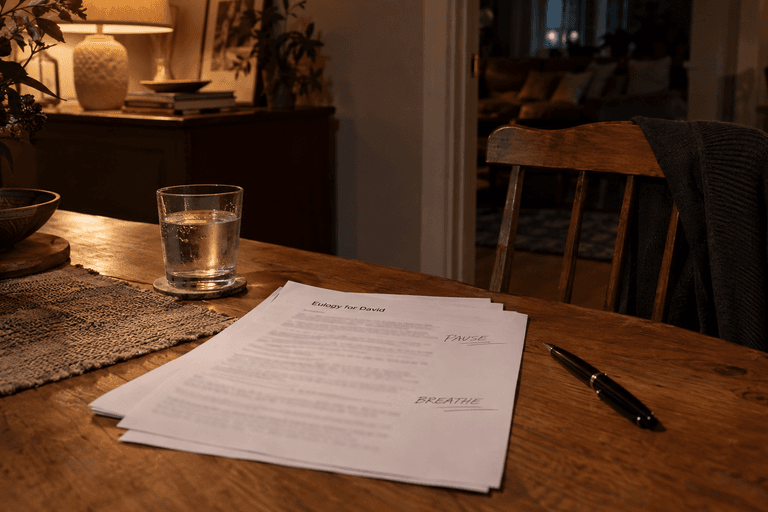
It is the night before the funeral, and you are sitting at the kitchen table with three pages in your hands, wondering how long a eulogy should be. A practical target is 3 to 5 minutes, which comes to roughly 360 to 750 words at a calm speaking pace.
The right length depends first on the time the service gives you. A single speaker may have five minutes, while several speakers may receive two or three minutes each. The setting matters too. A graveside tribute often benefits from being more concise than the main remembrance at a celebration of life.
The sections below turn that broad range into a practical number for your service, draft, and speaking style. You will find word counts by minute, venue considerations, a rehearsal method, and a clear order for making cuts when your tribute runs long.
This guide focuses specifically on length. If you also need help choosing memories, shaping the opening, or preparing to speak, begin with our complete guide to how to write and deliver a eulogy. For now, take a breath. A meaningful tribute does not need to contain every memory. It needs enough room for one true picture of the person you are honoring.
Key Takeaways
Aim for 3 to 5 minutes. That is roughly 360 to 750 words at a calm speaking pace.
Budget about 120 words per minute. Emotion, pauses, laughter, and looking up at the family can slow your delivery.
Shorten each tribute when several people speak. Two to three minutes per person helps preserve time for readings, music, and reflection.
Keep most graveside tributes concise. Plan on about two to three minutes, or approximately 250 to 400 words.
Confirm the actual limit. Ask the funeral director, celebrant, or officiant before treating any general range as your time slot.
Rehearse aloud at least twice. If you run long, remove a whole story or section instead of thinning every sentence.
How Many Words per Minute Do People Actually Speak at a Funeral?
Plan on about 120 to 130 words per minute when estimating the length of a eulogy. This deliberately leaves more room than a calculator that assumes a brisk, conversational delivery.
As of 2026, the University of Minnesota identifies 120 to 150 words per minute as a normal speaking rate and notes that speaking too quickly can make a message difficult to follow. At a funeral, clarity matters more than fitting the greatest possible number of words into the allotted time.
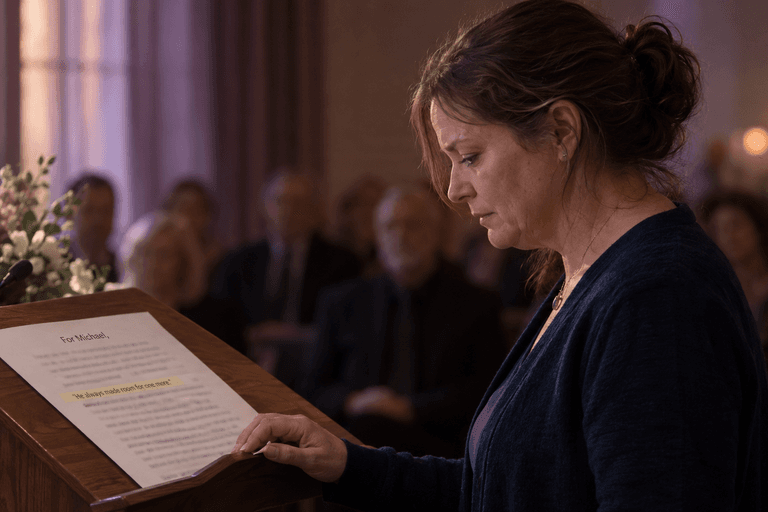
You may naturally slow down when a memory becomes real in the room. You might pause to steady your voice, wait for gentle laughter to settle, take a sip of water, or look toward the people who shared that memory. Those moments are part of the tribute, not wasted time.
A rehearsal alone in a quiet room may also run faster than the live delivery. At home, no one laughs, shifts in their chair, or meets your eyes. You know what every sentence says, so you may glide through words that listeners need a moment to absorb.
For that reason, divide your word count by 120 for a cautious first estimate. The small cushion gives your eulogy room to breathe, especially around the story or closing lines that matter most.
How Many Words Should a Eulogy Be?
A 3 to 5 minute eulogy is about 360 to 750 words. The following planning ranges use a slow emotional pace of 120 words per minute and a steadier pace of 150 words per minute. Page estimates assume about 250 double-spaced words per page.
- 2 minutes: 240 to 300 words, about 1 page. This fits a graveside tribute or one of several short remembrances.
- 3 minutes: 360 to 450 words, about 1.5 to 2 pages. This is a useful target when the order of service is full.
- 5 minutes: 600 to 750 words, about 2.5 to 3 pages. This is a practical default for one main eulogist.
- 7 minutes: 840 to 1,050 words, about 3.5 to 4 pages. Confirm that the service can accommodate this length.
- 10 minutes: 1,200 to 1,500 words, about 5 to 6 pages. Use this only when you are the sole speaker and the time has been confirmed.
- 15 minutes: 1,800 to 2,250 words, about 7 to 9 pages. This generally requires a service planned around one extended tribute.
Religious guidelines may use a different page estimate. As of 2026, the Diocese of Lansing equates three to five minutes with one typed page, which is a reminder to follow the venue's guidance rather than relying on page count alone.
A eulogy's length also works differently from an obituary's because listeners cannot pause or reread a spoken sentence. Our guide to the differences between a eulogy and an obituary explains how each form serves a separate purpose.
Is 15 Minutes Too Long for a Eulogy?
For most services, a 15-minute eulogy is likely to be too long. At a measured pace, it contains roughly 1,800 to 2,250 words and can occupy a large share of the service before music, readings, prayers, or other speakers are included.
A longer tribute can work when you are the only speaker, when the officiant has asked you to give the main remembrance, or when a celebration of life has been intentionally planned around one extended story. Even then, confirm the time first. As of 2026, the Funeral Consumers Alliance says five minutes are often enough and recommends no more than 15 minutes for maximum impact.
At a Catholic funeral liturgy, that length may not fit. As of 2026, the Archdiocese of Boston permits one speaker for no more than five minutes during the funeral liturgy.
A focused story is often easier for listeners to carry with them than another page of dates and details. Brevity does not lessen the person's life. It gives the central memory room to remain clear.
Gettysburg offers an enduring example. The Library of Congress records that Lincoln's address contained 272 words while Edward Everett spoke for two hours. Brevity did not make Lincoln's words small. It made their central idea unmistakable.
“I should be glad, if I could flatter myself that I came as near to the central idea of the occasion, in two hours, as you did in two minutes.”
Everett's comparison comes from his November 20, 1863, letter to Lincoln, preserved in the Library of Congress Abraham Lincoln papers.
How the Length Changes When Several People Are Speaking
When several people give tributes, each person should usually plan on 2 to 3 minutes. That keeps the combined speaking time close to what one 5 to 10 minute eulogy would require.
The arithmetic grows quickly. Four speakers at five minutes each require 20 minutes before the service includes a reading, song, homily, prayer, or quiet reflection. If everyone has been invited to speak, agree on the limit before drafting begins rather than asking people to cut their tributes at the venue.
Families generally have two workable options. One person can give the main eulogy while others offer brief remembrances, or everyone can receive an equal share of the available time. Whichever arrangement you choose, name one person to coordinate with the officiant and keep track of the total. As of 2026, the Funeral Consumers Alliance recommends having one person coordinate service details with the venue, officiant, and musicians.
It also helps to exchange drafts or story summaries beforehand. This is not about editing one another's grief. It simply prevents the same vacation story or childhood anecdote from being told three times while another important side of the person's life goes unmentioned.
Some religious settings permit only one speaker during the principal liturgy. As of 2026, the Archdiocese of Boston guidance cited above directs additional eulogies and stories to the vigil or the period after the cemetery committal. Moving extra tributes to a visitation or reception can give each memory more space without crowding the formal service.
Does a Graveside Eulogy Need to Be Shorter?
Usually, yes. A concise graveside tribute leaves room for the other parts of the committal and can be easier for guests to hear and follow outdoors. If the graveside gathering is the only service, however, the usual 3 to 5 minute range may still be appropriate.
Graveside Timing at a Glance
Plan on 2 to 3 minutes, or about 250 to 400 words. Mourners may be standing, sound may be difficult to carry without a microphone, and weather can affect the gathering. Confirm the available time with the funeral director or cemetery representative before finalizing your draft.
How Long the Funeral Home Will Actually Give You
The real limit is whatever the funeral director, celebrant, or officiant gives you. Ask before you finish the draft. A general online recommendation cannot account for another service, the procession, cemetery timing, or a scheduled livestream.
The same time pressure applies at a cemetery. As of 2026, the National Cemetery Administration says VA committal services generally last 20 minutes, including military honors, and are held in committal shelters for safety. A concise tribute respects the many elements that must fit inside that window.
Ask these questions when the service is being arranged:
- How long will the entire service run?
- How many people are speaking?
- Where does the eulogy fall in the order?
- Will there be a microphone, lectern, and printed program?
Religious venues may have more specific rules. As of 2026, the Catholic guidance cited in this article limits words of remembrance to about three to five minutes, commonly allows one speaker during the funeral liturgy, and may ask for the text in advance. Our guide to the funeral order of service can help you understand where the eulogy fits among the other elements.
How to Time Your Eulogy Before the Day
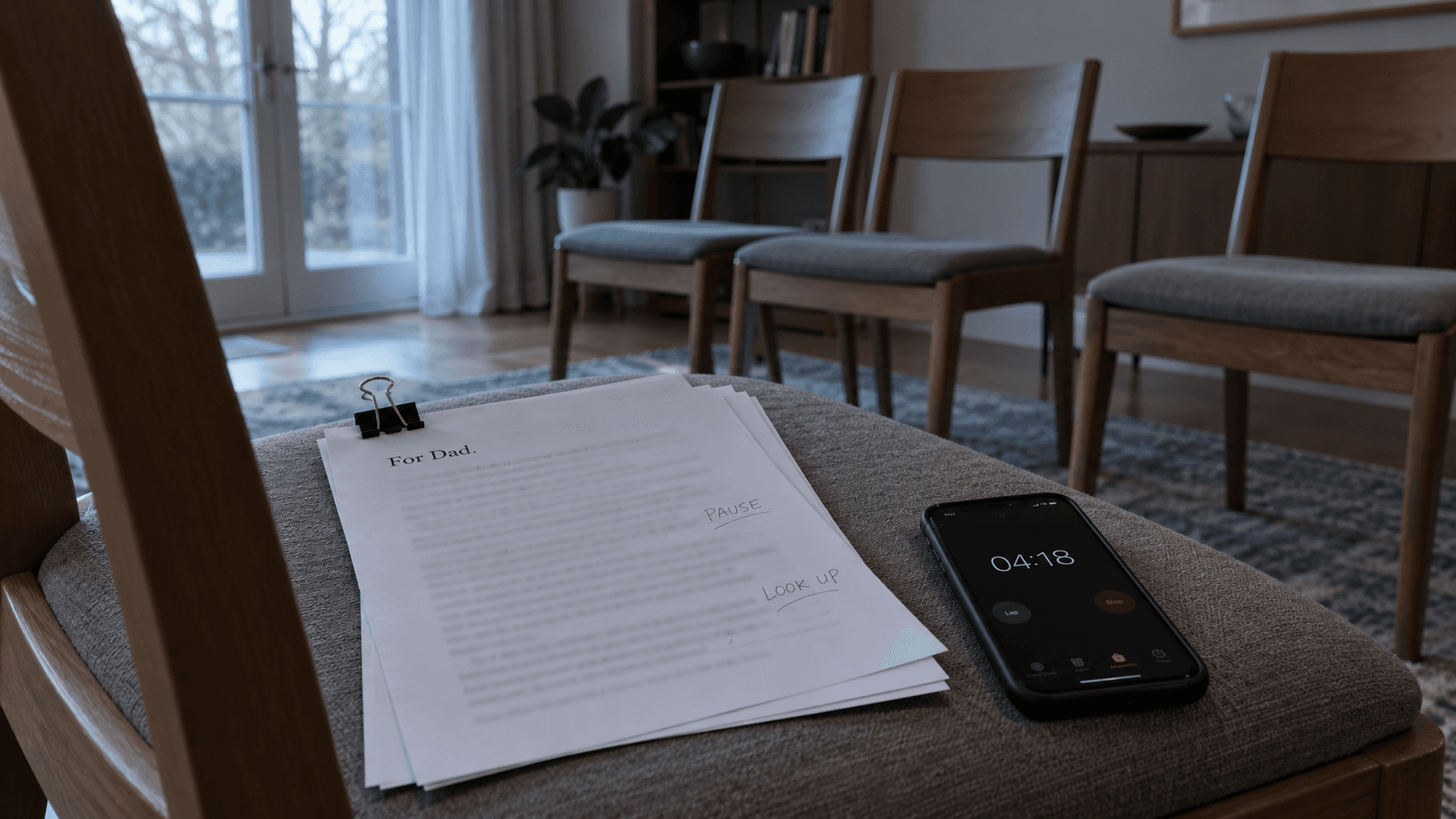
Your word count is only a starting point. A full rehearsal shows how the tribute sounds when you include pauses, look up from the page, and give important lines time to settle.
A Six-Step Rehearsal
Estimate the time
Divide your total word count by 120 to estimate the number of minutes you will need at a calm pace.
Print the real pages
Use the large font, spacing, and page breaks you intend to use at the service so the physical draft feels familiar.
Stand and read aloud
Face an imagined full room and time the complete eulogy with your phone. Do not rely on silent reading.
Mark natural pauses
Add visible reminders after a funny line, before a difficult sentence, and anywhere you want to look up.
Build in a cushion
Aim to finish rehearsal 30 to 60 seconds under your confirmed limit because live delivery may take longer.
Invite one listener
Do a final run for someone you trust and ask where their attention drifted or where a pause would help.
Speaking aloud is essential because the clock measures delivery, not silent reading speed. As of 2026, Lincoln Land Community College recommends rehearsing aloud with a timer multiple times and advises practicing nonverbal delivery, including looking up. Its guidance also recommends timing individual sections so you know which part is consuming the available minutes.
Treat the first timed reading as information, not a performance. If your voice catches or a pause feels longer than expected, leave it in the timing. You are discovering what the eulogy needs in a human voice, and that version matters more than the silent draft.
What to Cut When You Are Two Minutes Over
Two minutes is about 240 to 300 words at the planning rates used in this guide. The fastest way to lose that time is to remove one or two complete sections. Trimming a few words from every sentence usually makes the language stiff while saving less time than expected.
Cut in this order:
- Life chronology and résumé details already included in the obituary.
- Long lists of names or thank-yous that the officiant or printed program can cover.
- A second story that demonstrates the same quality as your strongest story.
- The backstory before an anecdote's meaningful or funny moment.
- A long introduction explaining who you are when one sentence will do.
- Borrowed poems or quotations that are not central to the tribute.
Protect your closing lines and the one story only you can tell. The purpose of editing is not to make the person seem smaller. It is to clear a path so listeners can carry one vivid memory home.
The stories you remove are not lost. You can preserve them with photographs and messages on an online memorial page, where family and friends have more time to read and contribute. If the draft has become tangled through repeated cutting, Lovekept's free eulogy writer can help you rebuild a focused first draft from your own memories.
Draft Your Eulogy With Lovekept's Free Eulogy Writer
If you are staring at a blank page or a draft that will not settle, begin with a first draft shaped from your own memories. Then use this guide to time it, refine it, and make room for the words that matter most.
Try the Free Eulogy WriterFrequently Asked Questions About Eulogy Length
A time limit can feel strangely practical when you are trying to honor a whole life. These brief answers can help you adjust the general guidance to your relationship, venue, and role in the service. When a parish, celebrant, or funeral director gives you a specific limit, follow that instruction even if it differs from the usual range.
Is a 2-minute eulogy too short?
No. A sincere tribute of about 240 to 300 words can feel complete, especially when several people are speaking or the remembrance is taking place at a graveside. Focus on one quality, one story, and one closing thought rather than trying to summarize an entire life.
How many pages is a 5-minute eulogy?
At roughly 600 to 750 words, a five-minute eulogy is often two to three double-spaced pages, depending on the font and margins. Page estimates vary, so time the speech aloud using the pages you intend to carry at the service.
Should a eulogy be longer for a parent or spouse?
Not necessarily. The closeness of the relationship does not change the service's time slot. Go deeper rather than longer by choosing a story that reveals the relationship clearly, then close with what you will carry forward from that person's love or example.
How long is a eulogy at a Catholic funeral Mass?
As of 2026, the Archdiocese of Boston guidance allows one speaker for no more than five minutes. Other dioceses and parishes may have different requirements, and the written text may need to be shared with the priest beforehand. Confirm the local practice before drafting.
What if I get emotional and run over?
Build a 30 to 60 second cushion into your rehearsal time. If emotion rises, stop, breathe, look at a supportive face, and continue when you are ready. A pause may feel long to you, but listeners will understand its meaning.
Is a eulogy longer than an obituary?
Length alone does not define the difference. An obituary records essential life information for readers, while a eulogy uses spoken memories to help listeners recognize the person. Our guide to choosing an appropriate obituary length offers separate guidance for the written announcement.
How long should a celebration of life speech be?
Three to five minutes is a useful planning target. A longer speech can work when the family has planned one main tribute rather than several remembrances. Ask how much time is available, then rehearse aloud so your closing lands comfortably before the limit.
Sources
- University of Minnesota Libraries Publishing, Chapter 16a: Nonverbal Communication
- Diocese of Lansing, Blessed Are Those Who Mourn: A Guideline for the Celebration of the Funeral Rites
- Funeral Consumers Alliance, How to Plan a Memorial Service
- Archdiocese of Boston, A Guide For Preparing Funeral Liturgies
- Library of Congress, Dedicated to the Great Task: Remembering and Studying Abraham Lincoln’s Gettysburg Address
- Library of Congress, Abraham Lincoln papers: Series 1. General Correspondence. 1833-1916: Edward Everett to Abraham Lincoln, Friday, November 20, 1863 (Lincoln's remarks at Gettysburg)
- U.S. Department of Veterans Affairs, National Cemetery Administration, Committal Service
- Lincoln Land Community College, Rehearsing Your Speech and The Importance of Timing
Lovekept's guides are drafted with AI against briefs written by the Lovekept team. Abdullah Nabeel, the founder, is the blog's editor. Read how we produce and correct content at /editorial-standards.