The First Thanksgiving Without Them
A gentle Thanksgiving grief guide for your first holiday without them: the empty seat, hosting, old roles, and what to say when the table goes quiet this year.
Why Thanksgiving Grief Hits So Hard the First Year
A week before your first Thanksgiving without her, someone in the family group text asks the question they ask every year: who's bringing the pumpkin pie? The answer was always Mom. Nobody says her name, and the question just sits there. This is Thanksgiving grief: the particular ache of a holiday that was never really about the turkey, but about who sat at the head of the table.
Thanksgiving is harder than an ordinary hard day because it is built around one table, one set of roles, and one moment when everyone says out loud what they are thankful for. Take away the person who filled a certain chair, carved the bird, or led the blessing, and the whole shape of the day changes at once. In 2026, Thanksgiving falls on Thursday, November 26, the fourth Thursday of the month, according to the federal holiday schedule published by the U.S. Office of Personnel Management. That date has probably been circled on a family calendar for months, which means the dread has had months to build, too.
And the dread is often the harder part. The Dougy Center's guidance on the holidays notes that the anxiety and anticipation leading up to the season can be more intense than the holidays themselves, and that planning ahead can help lower that anxiety, especially for children. If you're reading this the week before, or the month before, know that the getting ready is usually harder than the getting through. This guide walks through the day itself, chair by chair and job by job. For the dates beyond this one holiday, our ideas for marking anniversaries and remembrance messages offer more ways to get through the days that hurt.
Key Takeaways
The empty seat is your choice. Leave it empty on purpose, invite someone to fill it, or change the seating entirely. There is no wrong answer.
Hosting isn't mandatory. If hosting was their job, or you're the one grieving hardest, it's okay to pass it to someone else this year.
Decide each job on purpose. Carving, the blessing, the signature dish, the phone calls: keep it, hand it off, share it, or set it down for a year.
Tell the family early and plainly. Share changes well before the day, call them "this year" changes, and give people a specific way to help.
Skipping is allowed. Choosing not to observe Thanksgiving this year is a valid decision, not a failure, and it says nothing about next year.
How to Handle the Empty Seat at the Thanksgiving Table
There are three workable ways to handle the empty seat at your Thanksgiving table, and no family needs to apologize for whichever one they choose. You can leave the chair empty on purpose, invite someone else to sit in it, or change the seating (or the room) so the gap isn't staring back at everyone over the mashed potatoes.
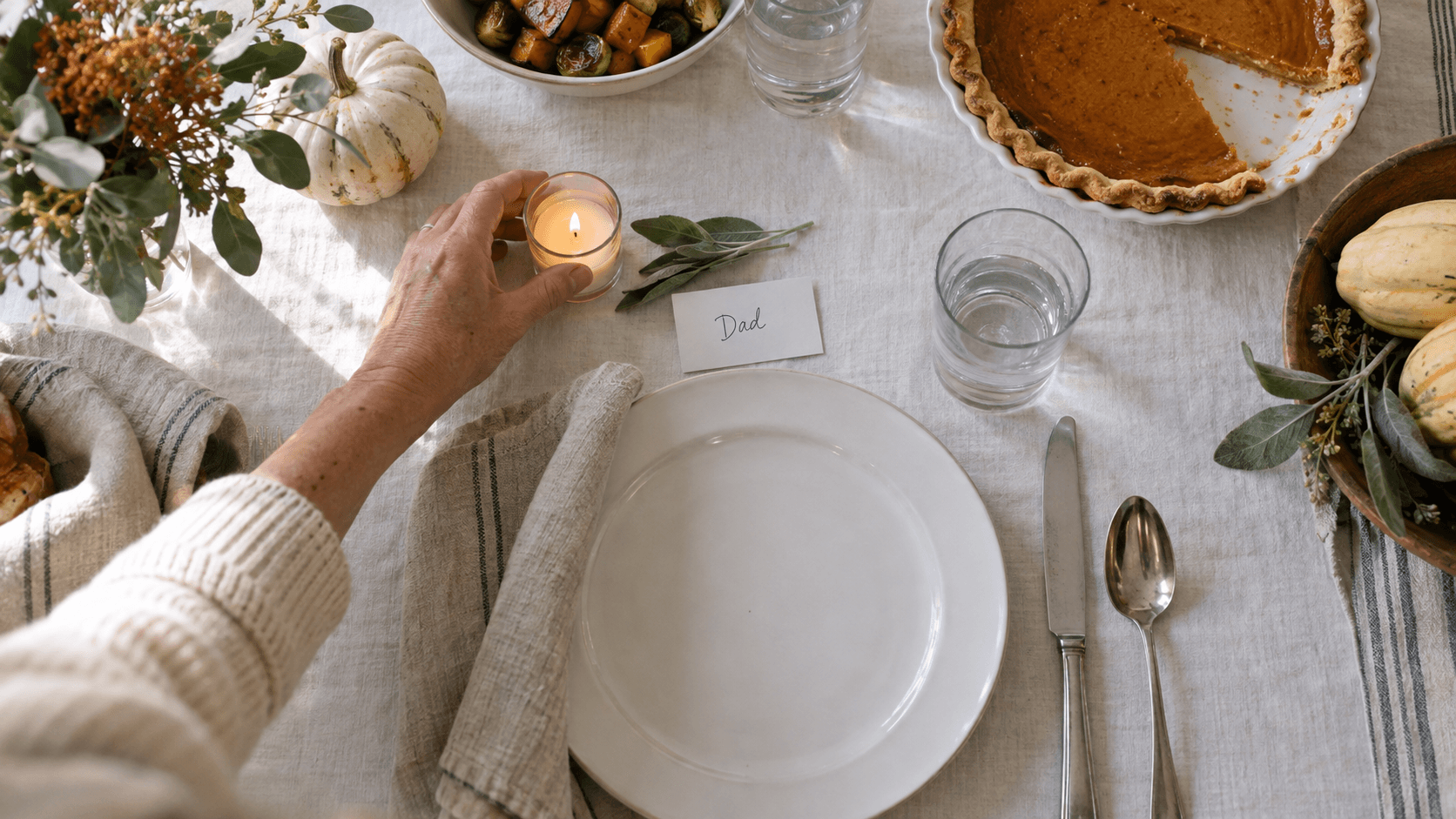
Leaving the chair empty works well when the family wants the absence acknowledged rather than smoothed over. A candle at the place setting, their photo propped against a glass, or a place card with their name written out turns an empty space into a deliberate tribute instead of an accident nobody mentions. The Hospice Foundation of America's advice on coping with holiday grief names lighting a candle, holding a moment of silence, or giving a toast as simple ways to acknowledge a loss on holidays and anniversaries.
Inviting someone else into the seat, such as a widowed neighbor, a friend without family nearby, or a college student who can't get home, gives the day a different kind of meaning without erasing anyone. And sometimes the kindest option is neither. Moving the meal to a different room, using a round table instead of the usual long one, or gathering somewhere new means there simply isn't a chair that used to be theirs for anyone to look at.
Whichever you choose, agree on it as a family before guests arrive, so no one is improvising in front of a full table. And if the empty chair still aches, that ache means something. Queen Elizabeth II put it plainly in her message to the people of New York, read at St. Thomas Church Fifth Avenue shortly after the September 11 attacks: grief is the price we pay for love. The chair hurts because the love it held was real.
“Grief is the price we pay for love.”
Should You Host Thanksgiving This Year, or Let Someone Else?
If hosting Thanksgiving was always their job, or if you're the family member grieving the hardest, it's entirely reasonable to hand the hosting to someone else this year. It's also fine to keep hosting, if the routine steadies you more than it drains you. Neither answer is more right than the other.
Three questions tend to make the decision clearer. Do you have the energy for a full day of guests, dishes, and small talk? Will being in their house, or standing at their stove, help you feel closer to them, or will it be too much? And if you host at home, will you have anywhere to step away for a few minutes when you need a break? Sit with your honest answers before you commit to anything.
There's plenty of room between hosting exactly like always and skipping it entirely. Co-hosting splits the work with a sibling or in-law. A potluck means no one cooks alone, which matters more than it sounds. A shorter meal can be plenty, and some families choose a restaurant that first year so no one has to stand where the cooking used to happen. The Dougy Center acknowledges that you may not be able to do all the things you've always done, and suggests scaling back or changing things rather than forcing the day to look the same. It also points out that when you let people help with concrete tasks, like cooking a dish, running to the store, or watching the kids, more often than not they are eager to.
What to Do About the Jobs They Always Did on Thanksgiving
Go through each job your loved one owned on Thanksgiving and decide, on purpose, whether to keep it, hand it off, share it, or set it down for this year. The deciding matters more than the choice itself. A role that quietly disappears feels like one more loss. A role the family consciously sets aside for now feels like a decision you made together.
Think through the usual list: carving the turkey, saying grace or leading the blessing, the signature dish that only ever tasted right from their hands, the phone calls to relatives who couldn't make the trip, setting the table just so. Each one can go a different direction. Maybe someone else carves this year, with everyone agreeing it's a this-year arrangement, not a permanent handoff. Maybe the blessing becomes shared, going around the table instead of one person leading it.
Most holiday advice centers on keeping traditions alive exactly as they were, and often that's good advice. What it tends to skip is the job nobody decided about: no one stepping up to carve, an awkward silence where the blessing used to be. That kind of drift can sting more than a change the family chose openly. The Hospice Foundation of America's Three Cs for coping with holiday grief start with exactly this idea: choose which activities you want to take part in and how you want to acknowledge the person you've lost. Choosing protects people, even when the choice is to skip something this time.
If someone wants to attempt the stuffing or pie from a handwritten recipe card, let them, and tell them in advance that it's fine if it doesn't taste quite the same. The gesture is the point, not a flawless replica. It can become one of the meaningful ways to honor a loved one who has passed away that your family keeps returning to, refined a little more each year.
How to Change the Plan Without Upsetting the Family
Changing Thanksgiving can feel like breaking a promise, especially to relatives who are holding tight to the old way because it's the last thing that still feels normal. The goal isn't to get everyone to agree. It's to make sure no one is blindsided.
The Hospice Foundation of America's Three Cs for holiday grief frame this as communicate and compromise: talk openly about your choices, because other people's grief may look different from yours, and leave room for those differences. The Dougy Center's advice is similarly direct: once you've decided what you can and can't do, share your decisions with friends and family. Here is one way to do that without starting a family argument.
Six Steps for Talking With Your Family
Know what you need first
Before telling anyone else, decide honestly what you can handle this year. It's much easier to explain a plan than to negotiate one from scratch.
Share the change well before the day
A text or call well ahead of Thanksgiving gives relatives time to adjust, instead of hearing about a change at the table itself.
Call it 'this year,' not 'from now on'
Framing a change as specific to this year, rather than a permanent new rule, makes it easier for relatives who love the old way to accept it.
Give people a specific role
Ask someone to bring a dish, pick up a relative, or run the kids' table. A concrete task gives people somewhere to put their own grief and worry.
Expect some pushback
Some people grieve by holding tighter to tradition. Offer a small compromise, like keeping one ritual exactly the same, rather than arguing about everything else.
Agree on an exit plan
Let everyone know beforehand that anyone can step outside or leave early if it gets to be too much, no explanation required.
What Do You Say When the Table Goes Quiet?
Say their name. When the table goes quiet, it's usually because everyone is afraid to be the one who brings them up, worried it will make things worse. More often, one person saying the name out loud releases the room instead.
A few lines work well when you need to break the silence yourself: "I keep thinking Mom would have complained about the gravy by now." "Can we each share one Thanksgiving memory before we eat?" Or simply, "I miss him today." None of these need to be eloquent. They just need to be honest.
The National Institute on Aging notes that people sometimes hesitate to mention the name of the person they've lost because they worry it will be hurtful, but that many people find it helpful to talk directly about their loss and share memories and stories. If the moment starts to feel too long, it's fine to move things along gently: "Let's eat while it's hot, and we can keep talking after."
Children at the table take many of their cues from the adults around them. The Dougy Center's guidance on helping a grieving child explains that bringing up the name of the person who has passed is one way to give a child permission to share their own feelings. A grandchild who hears the adults laugh about Grandma's famously lumpy cranberry sauce learns that it's safe to laugh, and safe to miss her, in the same breath.
Ways to Include Them in the Thanksgiving Meal
Small, concrete rituals tend to land better than a long speech, because everyone can take part without feeling put on the spot. Below are six ways families weave someone who is missing into the meal itself.
Many of these rituals stir up stories and recipes worth keeping. If you want one place to gather them, you can create a free online memorial page for the person you're missing, and the whole family, including relatives scattered across the country, can keep adding to it long after the dishes are done. Some families also plant a tree as a living companion to the day, something that will still be growing next Thanksgiving; our guide to memorial tree planting and living memorials covers how.
Six Ways to Remember Them at the Table
Cook Their Signature Dish
Make the dish from their handwritten recipe card, even if it doesn't come out exactly the same. The gesture matters more than a perfect match.
Set Out Their Photo or a Candle
A photo or a lit candle at their usual place gives everyone a quiet, visible way to include them without anyone needing to say a word.
Start a Memory Jar
Leave slips of paper and a jar by the door. Ask each guest to write down one memory to read aloud after the meal, or save for later.
Raise a Toast
A short toast before the meal, even just their name, gives the whole table one shared moment to acknowledge who's missing.
Play Their Favorite Songs
Build a playlist of the music they loved and let it run quietly in the background while everyone cooks, eats, and cleans up.
Open a Memorial Page at the Table
Pull up their memorial page on a tablet, or share a QR code, so relatives who couldn't travel can add a story or photo of their own that day.
Give Them a Place at the Table All Year
Create a free online memorial page for the person missing from your table this year. Invite the whole family to add Thanksgiving memories, recipes, and photos, before the meal or long after the dishes are done. Every published memorial on Lovekept includes a real tree planted in their honor.
Honor Your Loved OneHow to Handle Being Asked What You Are Thankful For
When the gratitude question comes around the table, you have three acceptable answers: an honest one, a small one, or a pass. All three are fine, and none of them requires an explanation.
A few replies help if you'd rather not improvise: "I'm thankful I had them for as long as I did." "I'm thankful for everyone who showed up for us this year." Or, if you need it: "Honestly, it's a hard year for me. Can I pass this time?" If you'd rather not be caught off guard at all, a quiet word beforehand with whoever is leading the round, asking to go last or to be skipped, is a completely reasonable thing to arrange.
Gratitude and grief are not opposites, and you don't owe the table a version of thankfulness that erases how hard this year has been. As the Hospice Foundation of America puts it in its holiday guidance, grief is deeply personal, and there is neither one right way to feel nor one correct way to grieve. Feeling grateful and heartbroken in the same five minutes isn't a contradiction. It's simply what this particular Thanksgiving is asking of you.
What to Do If You Would Rather Skip Thanksgiving Entirely
Skipping Thanksgiving altogether is a legitimate choice in the first year, not a failure of nerve or a sign that something is wrong with you. For some people, opting out is the only version of the day that feels bearable, and that's allowed.
Make it a plan rather than just a feeling. Tell family ahead of time, by text or call, so no one is left wondering or worrying. The Dougy Center encourages exactly that: decide what you can and can't do, then share that decision with friends and family. Then plan the day anyway, so it doesn't turn into empty hours that feel worse than a hard dinner would have: a long walk, a movie you've been meaning to watch, a shift at a food bank, a visit to their resting place, or a quiet meal with one friend who understands.
Decide ahead of time whether you want anyone checking in on you, a single text at noon or nothing at all, and tell someone which you'd prefer. And remember that skipping Thanksgiving this year says nothing about next year. You're allowed to change your mind in either direction, every year, for as long as you need.
If your loss happened very recently and you're still in the middle of arrangements, Thanksgiving may not be the most pressing thing on your plate, and that's understandable too. Our guide to what to do in the first 24 hours after a loss covers the practical steps that come first, before any holiday planning has to.
When Thanksgiving Grief Needs More Than a Plan
Most of this guide is about getting through one hard day. But sometimes a holiday surfaces something bigger than a day can hold. If grief a year or more after a loss still feels disabling rather than simply sad, it may be what the American Psychiatric Association recognized in its diagnostic manual in 2022 as prolonged grief disorder, a form of grief intense enough to disrupt everyday life. It's the kind of thing a grief counselor or therapist can genuinely help with, and not something you need to manage alone.
And if the day ever brings thoughts of self-harm, or a feeling that you can't go on, the 988 Suicide & Crisis Lifeline is free, confidential, and available around the clock, whether you're reaching out for yourself or for someone you're worried about.
You Don't Have to Carry This Alone
If Thanksgiving brings thoughts of self-harm or a feeling that you can't go on, call or text 988, the Suicide & Crisis Lifeline, any time of day or night. If grief still feels disabling a year or more after your loss, a grief counselor or therapist can help you find your footing again.
Thanksgiving Grief: Common Questions
Quick answers to the questions families ask most as they head into their first Thanksgiving without someone they love.
A Thanksgiving That Holds Both
Your first Thanksgiving without them will not look like the ones before, and it doesn't have to. Whether you keep every tradition, change half of them, or spend the day on a quiet walk, you are still honoring the person you love by choosing with care.
Next year may feel different again. Until then, be gentle with yourself and with the people around your table. And if you'd like a tribute that keeps growing alongside your family, Lovekept plants a real tree in honor of every published memorial, a living reminder that the love at the center of this holiday is still very much here.
Sources
- U.S. Office of Personnel Management, Federal Holidays
- Dougy Center: The National Grief Center for Children & Families, Getting Through the Holidays
- Hospice Foundation of America, Three Cs for Coping with Grief
- Saint Thomas Church Fifth Avenue, Grief is the price we pay for love
- National Institute on Aging, National Institutes of Health, Coping With Grief and Loss
- Dougy Center: The National Grief Center for Children & Families, How to Help a Child Who is Grieving
- Hospice Foundation of America, What will this holiday mean for me now?
- American Psychiatric Association, Prolonged Grief Disorder
- 988 Suicide & Crisis Lifeline, 988 Lifeline - If you need emotional support, reach out to the national mental health hotline: 988.
Lovekept's guides are drafted with AI against briefs written by the Lovekept team. Abdullah Nabeel, the founder, is the blog's editor. Read how we produce and correct content at /editorial-standards.