How to End a Eulogy: Closing Lines, Examples, and Gentle Guidance
Learn how to end a eulogy with heartfelt closing lines, real examples, and gentle guidance on quotes, last words, and what to do when the room is crying.
The final lines of a eulogy can feel harder than everything that came before them. You may have found the stories, named the qualities you cherish, and still find yourself staring at the last empty space on the page. That is completely normal. The ending carries a weight the rest of the speech does not: it is the moment you hand the memory back to the room.
Here is the good news. A strong ending does not need to be perfect or poetic. Its job is simple: gather the central feeling of your words, offer one last moment of connection, and leave the people gathered with a truthful picture of the person you are honoring. This guide walks you through how long that ending should be, closing lines you can adapt, when a poem or quote helps, and what to do if emotion rises in the final moments.
A eulogy is spoken for the people in the room, which makes it different from an obituary. Iliff School of Theology explains the distinction between a eulogy and an obituary, including the practical facts an obituary usually contains. If you are still deciding which piece you need to write, our guide to the difference between a eulogy and an obituary can help. And if you are starting from the very beginning, our complete guide on how to write and deliver a eulogy covers the whole speech, from first story to final word.
Key Takeaways
Keep the ending short and focused. A few spoken sentences built around one feeling, image, or farewell is enough.
You do not have to say goodbye. Gratitude, a promise to remember, or a wish for peace can close a eulogy just as well.
Make it sound like them, and like you. A phrase they used to say or plain, familiar language often lands more deeply than formal words.
Match the setting. Graveside endings are usually briefer; in a church, ask where your words fit in the order of service.
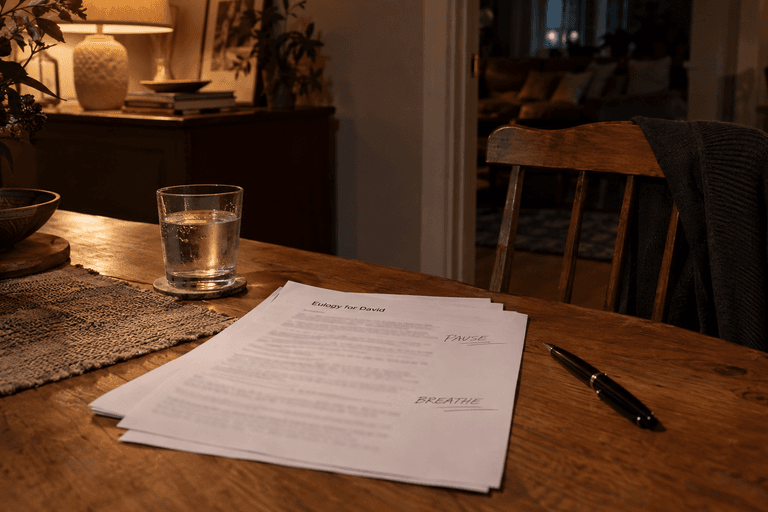
Plan for tears. Mark your last lines, pause when you need to, and ask someone you trust to stand ready to finish for you.
How Long the Ending of a Eulogy Should Be
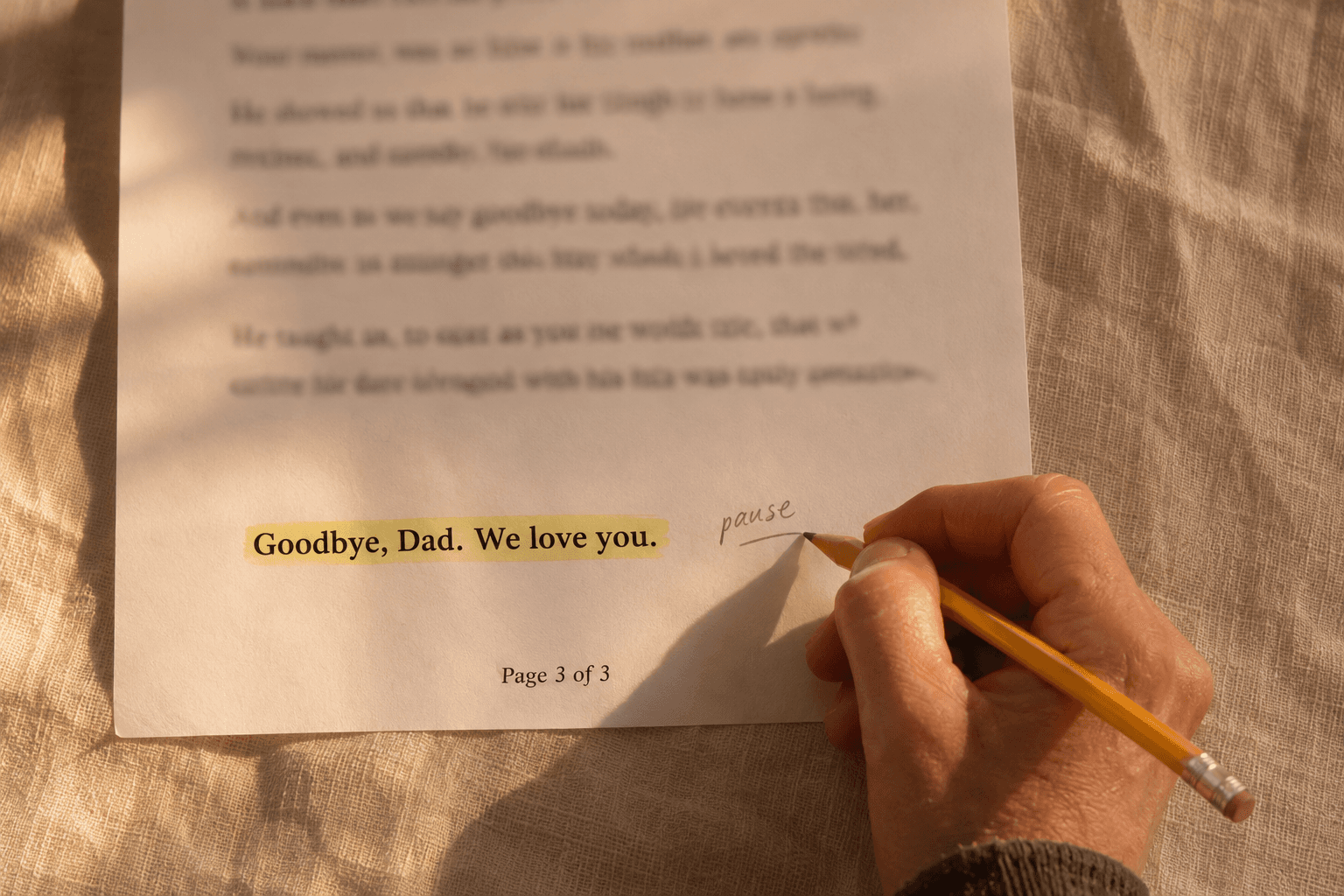
The ending should be only as long as it takes to complete your main thought. For most speakers, that means a short paragraph or three to five spoken sentences, not a second conclusion. Choose one image, one feeling, or one farewell, then give the final words room to settle before you step away.
Often the strongest close is the line you almost cut because it felt too simple. Rehearsing aloud, as Iliff's guidance on preparing a eulogy encourages, will show you where the speech naturally wants to stop. Mark a pause before your last sentence so you do not rush it. If you are working out the length of the whole tribute, not just the close, read our guide to how long a eulogy should be.
Closing Lines That Work When You Cannot Say Goodbye
You do not have to say goodbye to end a eulogy. For many people, that word feels too final, too formal, or simply untrue to the relationship. A closing can express gratitude, continuing connection, a promise to remember, or a wish for peace, without asking you to resolve feelings that are still raw.
- “We will carry your kindness into the days ahead.”
- “Thank you for the life you shared with us.”
- “You are part of who we are, and that does not end today.”
- “Until we meet again, we will keep your stories close.”
The most honest line is the one that names what feels possible to say today. A closing does not need to comfort everyone at once. It only needs to offer the room a truthful place to rest.
What Are Examples of Closing Words at a Funeral
The right closing words depend on your relationship and the tone of the service. Treat these original examples as starting points, and change the details until they sound like something you would truly say aloud.
- For a parent: “Your love made this family feel like home, and we will keep building that home for one another.”
- For a partner: “Thank you for the ordinary days that became a beautiful life with you.”
- For a friend: “We will keep telling your stories, laughing at your jokes, and saving you a place in every memory.”
- For a colleague: “Your generosity changed the people who worked beside you, and that influence will continue.”
- For a general audience: “May we honor this life by caring for one another with the same open heart.”
Notice that each example returns to one shared truth rather than trying to summarize an entire life. That is where a closing line finds its quiet strength. If you would like help shaping the rest of the speech around a line like these, you can draw on our eulogy examples or use Lovekept's free eulogy writer to turn your memories into a first draft you can revise in your own voice.
Should You End a Eulogy With a Poem or a Quote
A poem or quote can make a meaningful ending when it genuinely reflects the person or echoes a story you have already told. It works best as a final lens on your own words, not a substitute for them. Choose a short passage, name its author, and read it aloud during rehearsal to make sure its rhythm feels natural in your voice.
If a reading does not connect to a memory, a value, or something the person loved, a sentence of your own will usually serve the room better. The goal is not the most recognizable quotation. It is words that belong to this particular farewell. For someone who lived generously or creatively, for instance, a line like the one below can frame everything you have just shared.
“That the powerful play goes on, and you may contribute a verse.”
This is the closing line of Walt Whitman's poem “O Me! O Life!”, as published by the Academy of American Poets. It speaks to a life that added something lasting to the world, so use it only if that message fits the person you have described. Read the line, pause, and let it be your last word.
How to End With Something They Used to Say
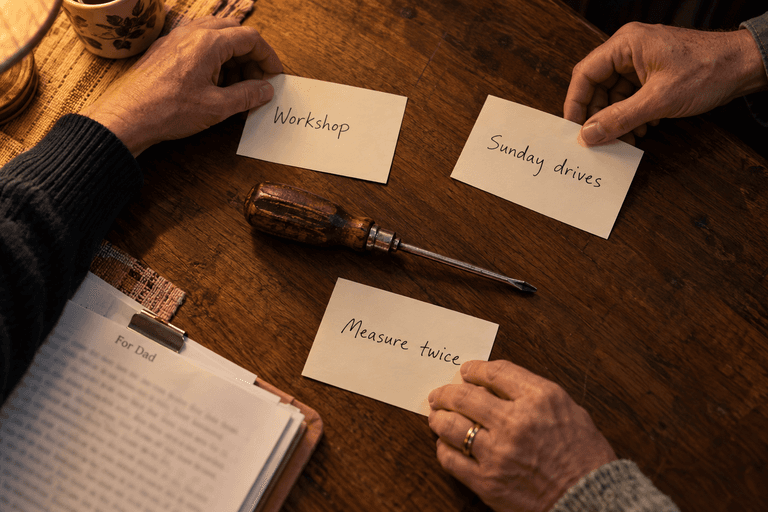
A familiar saying, nickname, joke, prayer, or family phrase can make a closing feel unmistakably personal. Give the phrase one sentence of context first, especially if some guests may not know it. Then let it stand alone as the final line.
For example: “Whenever a hard day came, Maria would smile and say, ‘We'll find a way through.’ Today, we will carry those words with us.” Or: “My grandfather ended every phone call with, ‘Take good care of yourself.’ So, Grandpa, we will.” The context lets the phrase land as a piece of their voice, rather than an inside reference only a few people understand.
How to Speak Directly to Them in the Last Line
Turning to speak directly to the person can create a moment of real intimacy, particularly if your eulogy has already shared personal stories. Begin with their name or what you called them, and keep the language specific and simple enough to say aloud. A direct address does not need to be dramatic to be deeply felt.
In a eulogy for your father, you might say, “Dad, thank you for showing us how to be steady when life is uncertain.” Or, “Aisha, we will miss your laugh, and we will keep making room for joy because you taught us how.” Practice the line at speaking volume before the service. If it feels too private to say in front of others, shift it gently toward the gathered family: “We will keep making room for joy because Aisha taught us how.”
How to End a Eulogy at a Graveside Versus in a Church
Where you speak shapes how you should close. The same final line can feel right in one setting and too long in another, so think about what happens immediately after you finish.
Graveside or committal setting
At a graveside, a brief ending is usually kindest. Weather, standing, and the ritual that follows can make a long close hard to hear and absorb. As of 2026, the U.S. Department of Veterans Affairs National Cemetery Administration notes that committal services at VA national cemeteries generally last about 20 minutes, including military honors, and may be held in a committal shelter rather than at the gravesite. In a window that short, one or two closing sentences let the moment breathe.
Church or faith-service setting
In a church, ask the officiant where a remembrance fits within the order of service and whether music or prayer follows it. Family traditions and the officiant's guidance come first. For example, the Catholic Diocese of Raleigh's funeral norms describe specific places for words of remembrance within Catholic funeral liturgies. An ending that leads naturally into the next part of the service, such as a hymn or a prayer, will feel calm and respectful.
How to End When the Room Is Crying
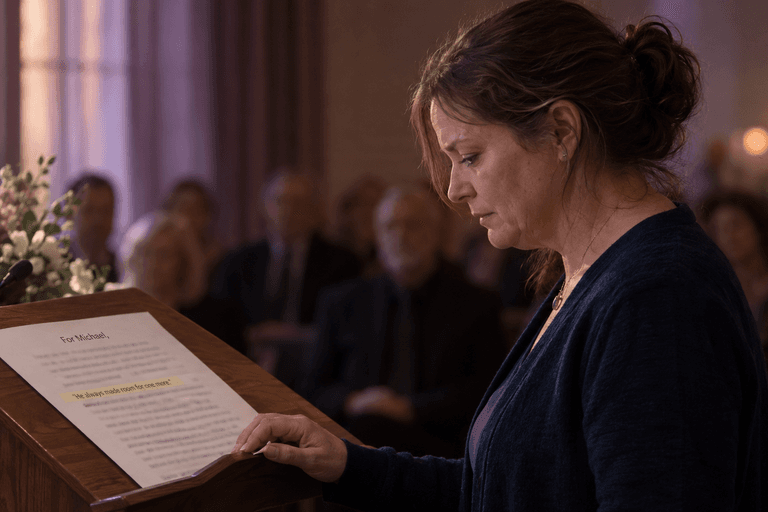
If the room is crying as you reach your final lines, pause. Take a breath, sip some water, look down at your notes, and continue only when you are ready. Grief affects everyone differently, and strong feelings can surface without warning, as the National Health Service's guidance on grief explains. Tears are not a mistake in a eulogy. They are evidence of love.
Make a simple plan before the service. Mark your final two sentences clearly, ask a trusted person to stand nearby, and give yourself permission to stop after the last thought. If you cannot continue, that person can read the closing lines for you. The silence before them may say as much as any extra explanation.
What Not to End a Eulogy With
Most weak endings come from trying to do too much in the final moment. As you revise, watch for these common missteps:
- A new, unrelated story. The ending should gather what you have said, not open a fresh thread.
- An apology. There is no need to say sorry for tears, for running long, or for not being a public speaker.
- Logistics. Directions to the reception or parking notes belong to the officiant or a family member, not your last line.
- Words that do not sound like you. Borrowed formality can create distance just when you want closeness.
- A trailing finish. Phrases like “I guess that's all” undercut the moment. Decide your final sentence in advance and stop there.
When the room is tender, one honest final thought is stronger than extra words.
A Gentle Reminder
Emotion is not a problem to repair. If your voice breaks on the last line, pause, breathe, and finish when you can. The people listening are with you.
Draft Your Closing With Gentle Guidance
Lovekept’s free eulogy writer can help you organize memories into a complete draft, then revise the closing until it sounds like your own voice.
Try the Free Eulogy WriterA Closing Line Is Enough
The best way to end a eulogy is not to find flawless words. It is to offer one honest expression of love, gratitude, or remembrance, and then let it rest. Practice your final lines once or twice, print them clearly, and trust the meaning they already carry.
The stories you gathered for this tribute do not have to end with the service. If you would like a place where family and friends can keep sharing photos, memories, and messages, you can create a lasting online memorial for the person you love, and keep adding to their story for years to come.
How should I end a eulogy if I do not want to say goodbye?
End with gratitude, a promise to remember, or a wish for peace instead. Lines like “Thank you for the life you shared with us” or “We will keep your stories close” close the tribute warmly without forcing a finality you may not feel yet.
How long should the final part of a eulogy be?
Usually a short paragraph, or three to five spoken sentences. The ending should complete one main thought, not summarize the whole speech again.
Is it okay to cry during the final line?
Yes. Pause, breathe, and look at your notes. Tears are a natural expression of love and loss, and you do not need to apologize for them. Most people in the room will understand completely.
Should I thank attendees at the end of a eulogy?
A brief thank-you can work, especially at an informal service. If an officiant or family member is handling announcements, let your eulogy end with the remembrance itself so the final words stay focused on the person you are honoring.
Can someone else read the ending if I cannot?
Yes. Ask a trusted family member, friend, or the officiant in advance, give them a clearly marked copy of your final lines, and agree on a simple signal if you need them to step in.
What should I do if I lose my place near the end?
Stop for a moment and find your marked closing lines. It is fine to skip ahead, read one final sentence, and finish there. No one in the room knows what you planned to say, only what you chose to share.
Sources
- Iliff School of Theology, How to Write a Eulogy (and Other Legacy Projects That Honor a Life)
- Academy of American Poets, O Me! O Life!
- U.S. Department of Veterans Affairs, National Cemetery Administration, Committal Service
- Catholic Diocese of Raleigh, General Norms for the Celebration of Roman Catholic Funerals
- National Health Service, Grief after bereavement or loss
Lovekept's guides are drafted with AI against briefs written by the Lovekept team. Abdullah Nabeel, the founder, is the blog's editor. Read how we produce and correct content at /editorial-standards.