What to Write on a Funeral Flower Card
What to write on a funeral flower card: short sympathy messages from one person, a family, coworkers, or a company, plus gentle verses and wording to avoid.
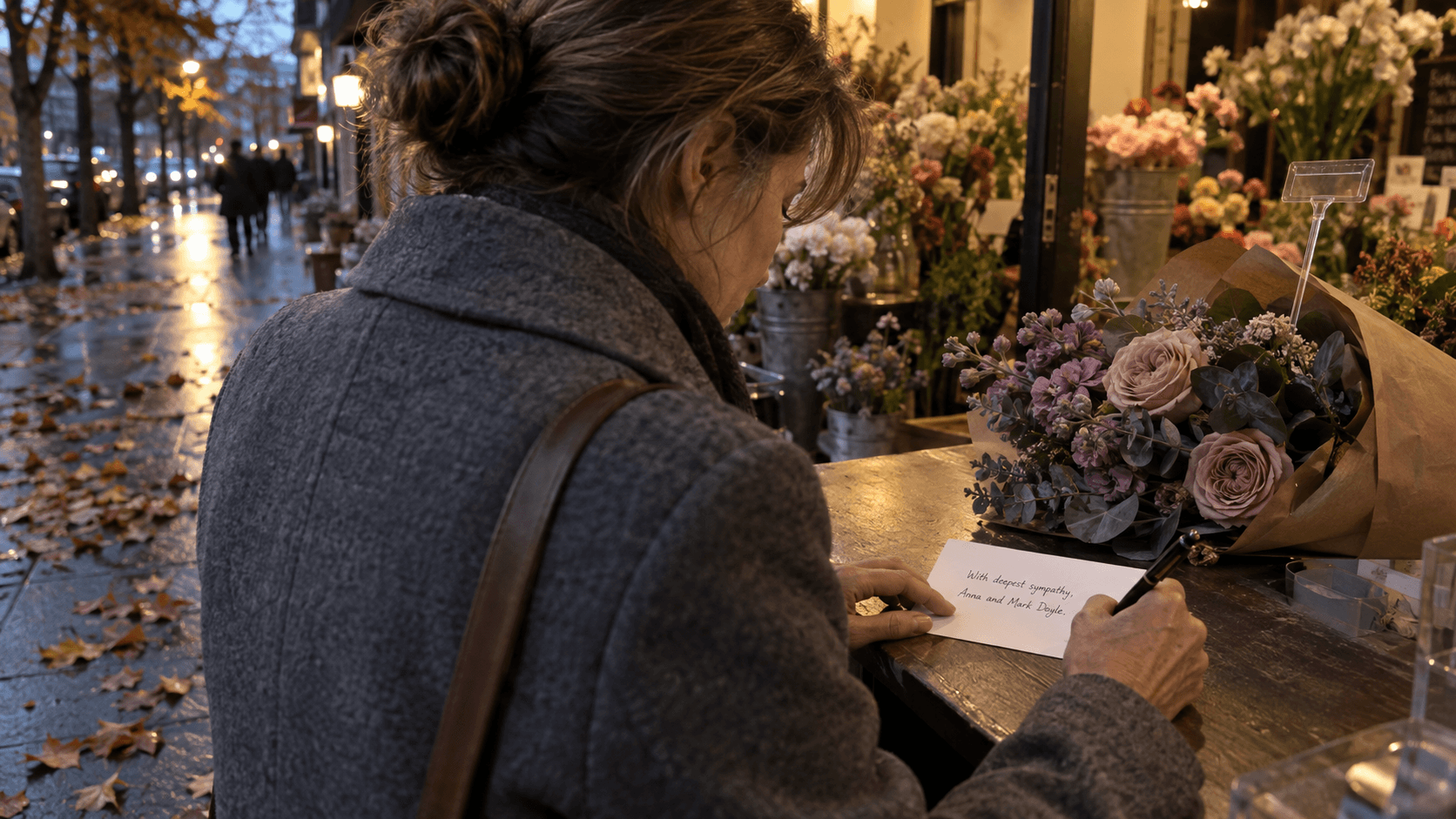
You've chosen the flowers. Then you reach the small blank line for the card message, and it can feel like the hardest part of the order. You might be at the florist counter or filling out a form online. Either way, you want words that honor the person you're remembering and comfort the family who will read them.
Here's the good news: a funeral flower card only needs three things. Write a short line of sympathy, sign your full name, and say how you knew the person or their family. You don't need poetry or perfect words. Many people may read the card at the visitation or service, and someone usually keeps a written record of who sent each arrangement so the family can send thank-you notes afterward. Being clear matters more than being eloquent.
If you need wording right now, try this: "With deepest sympathy and fond memories of Ruth. Daniel Okafor, her neighbor on Elm Street." Notice the structure: sentiment, name, relationship. Below you'll find examples for every situation, from a single friend to a whole company. When your line is ready, you can send sympathy flowers to the family and type that message straight into the card field at checkout.
Key Takeaways
Keep it short. Florist cards are small, so one or two lines plus your signature is plenty.
Sign your full name and relationship. Families use the cards afterward to know whom to thank.
Name the group. Coworkers and companies should say who's included, such as "The Accounts Team at Harlow Supply."
Match the family's beliefs. Use religious wording only when you know it fits, and stay neutral if you're unsure.
Leave out the extras. Skip the cause of death, advice, and any phrase that minimizes the loss.
How Many Words Fit on a Florist Card?
A standard florist enclosure card is small, usually just a few inches wide. It's made for a short message, not a full letter. As a rule of thumb, one or two sentences of about 10 to 25 words plus your signature will fit without crowding the card.
Online florists often set a character or word limit at checkout, and the limit varies by shop. Check the counter on the order form instead of assuming your message will fit. If space is tight, keep your name and relationship and shorten the sentiment. The family can guess at kind feelings, but they can't guess who "Sam" is.
The Emily Post Institute's advice on sympathy notes works just as well for flower cards: a single sincere line expressing the genuine feeling you had for the deceased is really all you need to write. And because the floral enclosure card should have room for several names, a group can use that space for everyone's names instead of fitting in a message from each person.
If you have more to say, put the longer message in a separate sympathy card mailed to the family's home. They can read it slowly there and keep it.
Funeral Flower Card Wording From One Person
When you send flowers on your own, a short line and a clear signature go a long way. The messages below are grouped by how you knew the person. Find the one closest to your situation and change the names.
If You Were a Close Friend of the Person Who Passed
- Remembering Ruth's kindness and her garden. With love, Daniel.
- Forever grateful for your friendship, Tom. Rest easy. Carla.
If You Were a Friend of the Family
- Thinking of you and your family. Priya Shah, Marcus's college roommate.
- Wrapping your whole family in love this week. The Bennetts.
If You Were a Neighbor
- With sympathy from next door. The Alvarez family, 214 Willow Court.
- So sorry for your loss. Your neighbor, Grace.
If You Didn't Know the Person Well
- With deepest sympathy. Jenna Wu, your coworker at Fairview Dental.
- Keeping you in my thoughts. Ben Carter, from the Tuesday running group.
One detail trips people up more than any other. Later, a grieving family may go through a whole stack of cards, and a first name alone rarely tells them who sent one. "Love, Sam" could be a dozen different people. So add a short phrase that shows who you are, like "from the Tuesday choir" or "your mom's former student." It's the single most useful thing you can write on the card.
What to Write on Funeral Flowers From a Family or From Grandchildren
When a whole household sends flowers, how you sign depends on whether people already know your family. "The Rivera Family" works when most guests will recognize the name. If they may not, list first names instead, such as "With love, Tom, Grace, Ella and Sam." This helps most with extended relatives and in-laws, who may not recognize a surname alone.
Close family often choose a more personal arrangement, too. Casket arrangements are typically provided by the immediate family. That arrangement rests closest to the person you're remembering, so its card can speak to them directly. "We love you, Nana" feels natural on a family card in a way it wouldn't on a card from a coworker.
Messages From the Family
- With all our love, always. The Chen Family.
- You gave us everything. We will carry you forward. With love, your family.
- Resting now, but never forgotten. The Delgado Family.
- Our hearts are full of you. With love, Mom, Dad, and the kids.
Messages From Grandchildren
- Forever in our hearts, Grandpa. Your grandchildren, Maya, Leo and June.
- Thank you for every story and every Sunday dinner. Love, your grandkids.
- We love you, Nana. Your grandchildren and great-grandchildren.
- With love from your grandchildren and step-grandchildren, who all called you Papa.
Short Verses and Quotes for Funeral Flower Cards
Sometimes a borrowed line says what you can't find the words for yourself. These short verses and phrases fit on a small card. Where a line has a source, we've included it so you can credit it if you like.
- Matthew 5:4, in the King James Version: "Blessed are they that mourn: for they shall be comforted."
- Psalm 23:1 (KJV): "The Lord is my shepherd; I shall not want."
- Ecclesiastes 3:1 (KJV), shortened: "To every thing there is a season."
- Emily Dickinson, in a note to her sister-in-law Susan: "Unable are the Loved to die, for Love is Immortality."
- The Society of American Florists suggests the simple line "With deepest sympathy."
- "In loving memory."
- "With heartfelt condolences."
- "Forever loved, forever missed."
- "Loved beyond words, missed beyond measure."
Whatever verse you choose, cut longer passages down to one line so they fit on the card. Then add your name and relationship underneath. The quote can carry the feeling, but only your signature tells the family who sent it.
“Unable are the Loved to die, for Love is Immortality.”
What to Write on Flowers for a Coworker's Parent
When a coworker loses a parent, they may be the only person at the funeral who knows your name. That makes a clear signature even more important than usual. Sign with your team and company, not just your own name, such as "From your friends on the Northside Clinic nursing team." Write the message to your coworker, not to the parent they lost.
If several of you are chipping in, it's normal for one person to order the arrangement under a group name. When the list of coworkers is long, the card can just name the group. This follows the Emily Post Institute's advice on signing pooled gifts as a group, such as a whole department, instead of squeezing a dozen names onto one small card.
These examples are warm without getting too personal:
- Holding you and your family in our thoughts as you remember your father. From your friends at Bright Path Marketing.
- So sorry for your loss, Maria. We're thinking of you. The Northside Clinic nursing team.
- Sending comfort and support during this difficult time. Your work family at Hollis and Reyes.
- Wishing you peace as you say goodbye to your mom. From all of us on the sales floor.
- We're here for you, however you need us. Your friends in Accounting.
- With deepest sympathy for your loss. The entire Fulton Street office.
What to Write on a Card for Funeral Flowers From a Company
A business might send flowers to an employee's family, a client's family, or the family of someone who retired years ago. In every case, the card should sound like it came from people, not a marketing department. Use the full company name. Leave off any logo, slogan, or promotional language. Name the person you're honoring directly: "In memory of Harold Brooks, a valued colleague for 22 years. With sympathy from everyone at Harlow Supply."
Put a real contact name on the order, too. A manager, an HR representative, or someone who knew the person is ideal, so the florist's system doesn't fill in a generic account name. The Society of American Florists advises including a contact name and address on the card so the family knows exactly whom to thank. That matters even more when the sender is an organization.
Examples for different situations:
- Employee's family: "In loving memory of James, husband to Wanda. With heartfelt sympathy from the entire team at Coleman Freight."
- Client's family: "Thinking of you and your family during this difficult time. With sympathy from your friends at Bellview Financial."
- Former employee: "Remembering Dorothy's 30 years of dedication and friendship. With sympathy from the Fairhaven Manufacturing family."
- General colleague: "In memory of a wonderful colleague and friend. With deepest sympathy, the leadership team at Prescott and Cole."
Religious vs. Non-Religious Wording for a Flower Card
Wording that matches the family's beliefs shows care, and you don't have to guess at theology to get it right. Here's how to choose:
- Religious wording fits best when you know the family shares your faith and would welcome it. Example: "May God comfort you and hold Ruth close."
- Spiritual or faith-neutral wording works when you're unsure of the family's beliefs but still want a gentle, hopeful tone. Example: "May peace be with you in the days ahead."
- Secular wording is the safest choice when you don't know the family's faith at all, or when you know they aren't religious. Example: "Remembering a life well lived."
Some families don't want flowers at all, whatever the card says. For example, many Jewish families follow a custom of not sending or bringing flowers to a funeral or cemetery, because flowers are traditionally tied to joyful celebrations, not mourning. Customs vary within every faith. If you're unsure, check the obituary or funeral notice for an "in lieu of flowers" request before you order.
If flowers aren't the right fit, or you'd like a living tribute as well, consider planting a tree in someone's honor. It suits families of any belief, and it keeps growing long after the service ends.
What Not to Write on a Funeral Flower Card
A caring message can still hurt if it says the wrong thing. The Hospice Foundation of America's guidance on supporting someone who's grieving warns against saying a loss was "for the best" or comparing it to a loss of your own. Both mistakes show up often on flower cards. Read your card over once before you send it, so the family isn't left rereading something that stings.
If the family hasn't shared how the person passed, don't mention it on the card. Our guide to how families decide whether to mention the cause of death goes deeper on that choice for the obituary. For a flower card, the answer is simple: leave it out.
Avoid These on a Funeral Flower Card
Cause of death or illness details: the card isn't the place to explain what happened, even briefly. Minimizing phrases like "everything happens for a reason" or "at least they're not suffering": these can feel dismissive, not comforting. Advice or instructions: this isn't the moment to tell the family how to grieve or what to do next. Inside jokes: a phrase that made sense between you and the person you've lost may confuse or upset a room full of mourners. Unsigned or first-name-only cards: the family can't thank someone they can't identify. Business promotion: a company arrangement should never carry a logo, slogan, or sales message.
What to Write When the Flowers Arrive After the Funeral
Sending flowers after the service isn't a mistake. It's often when a family needs them most. There are no firm rules about timing. The Society of American Florists notes that some people send flowers to the home right away while others wait a week or more, and neither is wrong. In fact, close friends often send flowers to the home over the course of several months to show they still care. Visitors thin out once the funeral is over, and the house can grow very quiet.
Because the service is over, send late flowers to the family's home, not the funeral home. You can mention the timing gently without apologizing for it. "Still thinking of you and remembering Carol" and "We know the weeks after are hard. With love, the Nguyens" both work well, and neither dwells on why the flowers are late.
The one-month mark and the first anniversary are also good times to send flowers. By then, most support has faded, but the grief is still there. For wording you can use on those later dates, see our guide to anniversary remembrance ideas and messages, written for that time after a loss.
If the family has an online memorial with a shared guestbook, you can leave a longer message there than a florist card allows. A few sentences in the guestbook stay with the family's memories for good. A card usually gets set aside once the flowers fade.
Send Sympathy Flowers to the Family
Your wording is ready. Choose an arrangement the family will remember, and write your card message using the examples in this guide.
Send Sympathy FlowersFuneral Flower Card FAQs
People ask the same few questions when they sit down to write a flower card. Here are short answers to the most common ones.
Do you address the card to the person who passed or to the family?
Usually, address the family, since they're the ones reading it before and after the service. Close family members often speak to the person directly instead, as in "We love you, Nana." For friends, coworkers, and acquaintances, it's safer to write to the family or simply sign your sympathy.
Is it okay to write only "With deepest sympathy"?
Yes. "With deepest sympathy" is one of the most common and appropriate card messages. Add your full name and your relationship, and the card has everything the family needs.
Should you sign with your first name only?
It's best not to. Among dozens of cards, a grieving family may not know who a first name belongs to. Add your last name and a short phrase about how you knew them.
What if the family asked for donations in lieu of flowers?
Follow their request. Give an amount comparable to what a floral arrangement would have cost. Include a note saying whom the donation honors, along with your address, so the organization can let the family know.
Do you still need a separate sympathy card?
Not necessarily, but it's a kind addition. The flower card covers the moment. A separate note mailed to the home lets you say more once you've had time to think. For other ways to show support, see our guide to meaningful ways to honor a loved one who has passed away.
Is "Rest in peace" appropriate for any faith?
It suits many Christian and secular families, but it has religious meaning that doesn't fit every tradition. If you're unsure of the family's beliefs, a neutral line like "Remembering a life well lived" is safer.
A Few Honest Words Are Enough
No card can hold everything you feel, and it doesn't have to. A short, sincere line with a clear signature tells the family that someone remembered, cared, and showed up. That's what they'll hold on to.
So pick the example closest to your situation and make it your own. Send it with warmth. Your kindness can keep comforting the family long after the flowers are gone.
Sources
- The Emily Post Institute, Sympathy Flowers Etiquette
- The Emily Post Institute, Sympathy Notes and Letters
- Society of American Florists (About Flowers), Sympathy - About Flowers
- Bible Gateway, Matthew 5:4;Psalm 23:1;Ecclesiastes 3:1 KJV - Blessed are they that mourn: for they - Bible Gateway
- Dickinson Electronic Archives, Emily Dickinson's Correspondences: Correspondence with Susan Dickinson (H B18)
- Chabad.org, Basic Laws of a Jewish Funeral
- Hospice Foundation of America, Supporting a friend or loved one
- The Emily Post Institute, Funeral Etiquette: Donations In Lieu of Flowers
Lovekept's guides are drafted with AI against briefs written by the Lovekept team. Abdullah Nabeel, the founder, is the blog's editor. Read how we produce and correct content at /editorial-standards.