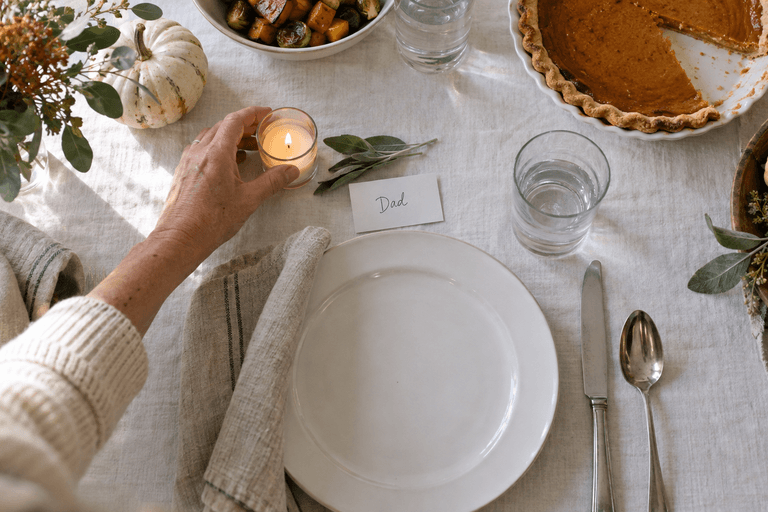
The First Christmas Without Them: A Gentle Guide
Facing your first Christmas without a loved one? Gentle help with traditions, the tree, their stocking, gifts, and what to say when people wish you well.

Facing the First Christmas Without a Loved One
You lift the lid off the ornament box, and there it is: the ornament they always hung first, every year, before anyone else touched a single string of lights. Maybe it was a chipped glass angel, a felt Santa from a school craft table decades ago, or a plain wooden star that only mattered because their hands chose it every December. You did not expect it to undo you like this, sitting on the floor with a half-unpacked box and a whole holiday still ahead of you.
Christmas without a loved one is hard in a way other days are not, because Christmas is built almost entirely on repetition. The same songs, the same recipes, the same order of unwrapping gifts, the same seat at the table. Every one of those small rituals was shaped, without anyone meaning to, around them being there. This year, each one becomes a place where their absence shows up all over again, whether this is your first Christmas without your mom, your first Christmas without your dad, or the first one without a partner, a child, or someone else who made the day what it was.
This guide will not tell you to simply find the joy. It answers the specific questions people actually lie awake with: whether to put up the tree, what to do with their stocking, what to say when a cashier wishes you a merry Christmas. And it starts with something worth knowing before December arrives. The National Center for PTSD's guidance on anniversary reactions explains that as a hard date approaches, you may dread it and worry in advance that you will struggle, and that most people feel better within a week or two after the date passes. If the weeks leading up to Christmas feel heavier than you expected, you are not doing anything wrong. The waiting is often part of the weight.
Key Takeaways
Take it tradition by tradition. You can keep, change, or pause each one individually, and nothing you decide this year is permanent.
Their stocking and chair can stay, change, or be put away. Leaving things as they were, turning them into something new, or setting them aside this year are all reasonable choices.
Gifts can wait. Presents they bought for you, or gifts you bought for them, do not have to be opened, given, or returned in December.
A short, ready answer helps. Having a simple reply prepared makes it easier to hear "Merry Christmas" from someone who does not know.
Say their name on purpose. Including them through a story, a candle, or a shared memorial page often eases the day more than avoiding the subject.
How to Decide Which Christmas Traditions to Keep This Year
Instead of facing Christmas as one enormous question, sort your traditions one at a time. Some will feel impossible this year. Others, surprisingly, might be the very thing that helps most. The only way to know is to look at each one on its own and ask a few honest questions:
- Does this tradition comfort me, or do I dread it?
- Was this tradition theirs, or was it truly ours, something the whole family built together?
- Who else depends on it, like a child who still believes in the magic, or an aging parent who looks forward to it all year?
Most advice on this topic lands on one of two extremes: keep every tradition exactly as it was, or start over with something completely new. For many families, a middle path works better. Keep the shape of a tradition, but change who carries it out or where it happens. If your mother always made the stuffing, someone else can make it in her kitchen, or you can make it in yours. Treat this year as a trial run rather than a lifelong decision, and give yourself a Plan B for the moments that turn out harder than expected.
Kenneth Doka of the Hospice Foundation of America frames these decisions around what he calls the three Cs for coping with holiday grief: choose, communicate, and compromise. Choosing means deciding in advance which activities you actually want to be part of and who you want beside you. Communicating means telling family your choices before the day arrives, so no one is caught off guard. Compromising leaves room for the fact that not everyone in your family grieves the same way, or on the same timeline.
If you have already come through Thanksgiving this season, you have a head start. Whatever helped you get through that table, and whatever you learned from our guide to getting through the first Thanksgiving without them, can usually be adapted for Christmas too.
Should You Put Up the Tree and the Stockings?
You do not have to put up a tree this year, and a smaller version is a completely legitimate middle ground. A tabletop tree, a single strand of lights across the mantel, or a bare branch holding only the ornaments that matter most can give you the feeling of Christmas without the full weight of the ritual.
If there are children in the house, consider their need for continuity separately from your own. A tree, even a small one, can be one of the few things that still feels normal to them this year. You are allowed to want less of the holiday than they do, and to let someone else supply the parts you cannot.
Let another family member carry the boxes down and start the unpacking if that first sight of the ornaments feels like too much to face alone. Or decorate in stages over several evenings instead of one long, emotional night: lights one evening, ornaments the next, the tree topper whenever you are ready.
Sometimes it is not the tree itself that is hard. It is the box, their handwriting on a masking-tape label, or an ornament they picked out on a trip you took together. If that is true for you, it is fine to set that particular box aside and decorate with what you can manage. A half-decorated tree is still a tree, and it can still hold a little light in a dark season.
The stockings follow the same logic. You can hang the whole row as usual, hang only a few, or skip the mantel this year. The hardest one, of course, is theirs, and it deserves its own decision.
What to Do With Their Stocking or the Empty Chair
There is no single right answer here, only three honest options. You can leave the stocking hung and the chair exactly where it always sat. You can turn them into something new, filling a memory stocking with notes each family member writes about them, or setting a candle or photograph where they used to sit. Or you can put both away this year, without guilt, and bring them back whenever it feels right, if it ever does.
Talk it through with the people who will be at the table before the day arrives. One person may find comfort in seeing the stocking hung, while another cannot bear to look at it. A quick conversation in advance, even a text, can spare everyone a painful surprise on Christmas morning and lets you find a version that works for the whole household.
Whatever you choose, the chair is only the most visible sign of an absence that touches every part of the day: the recipes, the songs, the quiet in between. C.S. Lewis put that feeling into words after losing his wife, in a line that still rings true for anyone missing someone at Christmas:
“Her absence is like the sky, spread over everything.”
How to Handle Gifts They Bought, or Gifts You Already Bought for Them
None of these decisions has to be made in December. Gifts your loved one bought and never got to give, and gifts you bought for them, can wait until you are ready to think clearly about them.
Gifts They Bought for You or Others
If your loved one already bought or wrapped gifts, you get to decide when to open them. Some people open them on Christmas morning as planned. Others save one, unopened, for a birthday or another date later in the year, so the moment does not have to compete with everything else happening in December. If you find a gift half-wrapped, tape still out, ribbon not yet tied, treat it gently. In its own way it is a final message, and it is worth keeping just as it was found until you are ready.
Gifts You Bought for Them
For gifts you bought for your loved one, there is no deadline pressuring you either. You can give the item to someone who would genuinely use it, donate it in their name to a cause they cared about, keep it as a keepsake, or return it. Store return windows vary widely, so check each retailer's policy before assuming a deadline has passed.
Gift cards deserve the same patience. Under the Consumer Financial Protection Bureau's rule on gift card expiration, most gift cards and store gift cards cannot expire within five years of the date they were issued or the date money was last loaded onto them, as of 2026. That means there is rarely any rush to spend a gift card they left behind, or one they bought for someone else before the holidays.
Should You Spend Christmas Somewhere New?
A change of place can genuinely help, because it removes some of the reminders that live inside your own home: the chair, the ornament box, the kitchen where they always stood. But it is worth being honest about the limits of that relief. The absence travels with you, so choose a new place because it offers you rest, not because you hope to outrun grief entirely.
Consider the realistic options in front of you. A relative's house might offer company without the memories built into every room. A short trip or a rented cabin can create a clean slate, with no old traditions to measure the day against. Staying home but changing one thing, a different meal, a different time for dinner, a different room for opening gifts, can also loosen the grip of a routine that otherwise runs on autopilot.
Weigh the practical tradeoffs, too. Travel adds fatigue at a time when you may already be running on very little reserve. Children often have their own expectations about where Christmas happens and who is there. And other relatives may still need the familiar gathering, even if you need something different this year.
A compromise many families land on is joining for only part of the holiday. The Hospice Foundation of America's guide to the first holidays after a loss describes a widow who flew to her late husband's family for the holiday, then left early while her children stayed through the weekend. She had the privacy she needed, and her children kept their connection with relatives. You might try something similar: join for Christmas Eve, then head home, or arrive Christmas morning for just a few hours. Whatever you choose this year is an experiment, not a precedent. Next year, you get to choose again.
What Do You Say When People Wish You a Merry Christmas?
Most people who say "Merry Christmas" to you this year mean it kindly, and they have no way of knowing what those two words cost you to hear. You do not owe anyone a long explanation. A short reply, decided on before you need it, can carry you through nearly every version of this moment. Here are a few to borrow:
Ready Replies for Every Situation
A Cashier or Acquaintance
"Thank you, you too." A brief, warm reply is complete on its own. You never have to add anything more.
A Coworker Who Knows
"Thank you. It's a hard one this year, so I appreciate that." This names the truth without asking them to fix it.
A Close Friend
"Honestly, it's rough. Can I tell you about Dad's Christmas tradition?" Let someone who has room for it hear more.
A Card From Someone Who Has Not Heard
A short line works well: "Thank you for thinking of us. I wanted you to know we lost Mom this year, so it's a quieter Christmas."
When You Want to Change the Subject
"Thanks so much. How is your family doing this year?" Turning the question back is a graceful, easy exit.
How to Tell Family You Cannot Host This Year
If you have always been the one who hosts, stepping back can feel like letting everyone down. It is not. Tell your family early, keep the message brief, and offer something they can do instead of the thing you cannot. Early notice matters most, because other relatives may need time to rearrange their plans, book travel, or step in to host in your place.
It often helps to tell one trusted relative first and ask them to help share the news or take on the gathering. Saying no to hosting does not mean saying no to Christmas. You can still bring a dish, come for dessert, or join by phone for the part of the day that feels manageable.
A Message You Can Send As Is
"I love you all, and I can't host Christmas this year. It was always Mom's day, and I'm not ready. Could we do it at [name]'s, or keep it small?" Offer one alternative if you can: a potluck at someone else's home, a shorter visit, or a video call for anyone who cannot travel. You do not owe anyone a longer explanation than this.
Ways to Include Them on Christmas Day
Saying their name on purpose, out loud, at the table, often makes the day feel lighter rather than heavier. Researchers call this kind of ongoing connection a continuing bond. A 2023 study of 170 men grieving a loved one describes continuing bonds as a normal part of the grief process, one that centers on the ongoing relationship with the person who has passed, expressed through memories, longing, and small acts of remembrance.
There are many low-effort ways to build that connection into the day itself. Consider:
- Cooking their signature recipe and telling the story behind it while it's in the oven
- Setting out a memory jar where everyone writes one line about them before dinner
- Lighting a candle at the table, or wearing something that belonged to them
- Playing their favorite Christmas carol during dinner or gift opening
- Going around the table and asking everyone to share one favorite memory of them
If you are grieving a child, sibling, or grandchild, The Compassionate Friends' Worldwide Candle Lighting takes place each year on the second Sunday of December at 7 p.m. local time, which falls on December 13, 2026. Families around the world light candles for one hour in honor of a young person gone too soon. It can be a meaningful ritual to observe in the weeks before Christmas, alone or with others who understand.
Many families also find it easier to gather scattered stories and photos in one place that relatives can add to from wherever they are, rather than trying to remember everything in the moment. You can create a free online memorial for the person you are missing this Christmas, where cousins, old friends, and neighbors can add their own holiday memories and photos all season long. Every published Lovekept memorial also includes a real tree planted in their honor, a living tribute that keeps growing long after the decorations come down.
And if another difficult date is coming up on your calendar, our guide to getting through their first birthday in heaven walks through many of the same ideas for the next hard day you will face.
Give Their Stories a Place to Live
Invite family near and far to share holiday memories, photos, and guestbook messages on one memorial page, whenever they have a quiet moment this season.
Honor Your Loved OneFirst Christmas Without a Loved One: Common Questions
A few questions come up again and again during this first holiday season. Here are honest, direct answers to the ones we hear most.
Getting Through This Christmas, One Moment at a Time
You do not have to get this first Christmas right. You only have to get through it, in whatever way is kind to you and the people you love. Keep what comforts you, set aside what does not, and leave room for the moments that surprise you, both the hard ones and the unexpectedly sweet ones.
The ache will not vanish on a schedule, but for most people it does soften, quietly and in its own time. Some December ahead, you will likely find yourself lifting the lid off that same ornament box, a little more ready to hold what is inside.
Sources
- U.S. Department of Veterans Affairs, National Center for PTSD, Trauma Reminders: Anniversaries
- Hospice Foundation of America, Three Cs for Coping with Grief
- Consumer Financial Protection Bureau, § 1005.20 Requirements for gift cards and gift certificates.
- Hospice Foundation of America, What will this holiday mean for me now?
- Revista Latino-Americana de Enfermagem (via National Library of Medicine, PubMed Central), Continuing bonds in men grieving a loved one
- The Compassionate Friends, WCL - Compassionate Friends
- National Cancer Institute, Grief, Bereavement, and Loss (PDQ®)–Patient Version
- National Institute of Mental Health, My Mental Health: Do I Need Help?
Lovekept's guides are drafted with AI against briefs written by the Lovekept team. Abdullah Nabeel, the founder, is the blog's editor. Read how we produce and correct content at /editorial-standards.