How to Announce a Death: In Person, by Text, and on Facebook
Learn how to announce a death with care: who needs a phone call, what to say, when a text is okay, and how to share the news on Facebook when you're ready.
How to Announce a Death Without Adding to the Hurt
When you have to announce a death, the hardest part is rarely finding the words. It's the list: the sister who needs a call before she leaves for work, the cousin who lives three time zones away, the neighbor who mowed the lawn every week, and the quiet fear that someone who mattered will scroll past the news on Facebook before you've had the chance to tell them yourself.
A simple order protects the people closest to the loss. Call the inner circle first (spouses, children, parents, and siblings), in person if you can manage it. Once they know, send texts to the wider circle of relatives and friends. Only after that should anyone post publicly. Being told privately, before the rest of the world finds out, is a small courtesy the closest people have earned, and it's easy to overlook when you're exhausted and grieving yourself.
This guide walks through who gets a call and who can get a text, what to say in that first phone call, how much to share about the cause, what to do when not everyone can be reached, and how to post on Facebook when you're ready. If you haven't yet worked out the very first calls, such as the funeral home or the family member who needs to know before anyone else, our guide to what to do in the first 24 hours after a death covers that broader order first.
Key Takeaways
Call the closest people first. Tell them in person when you can. Never let a spouse, child, or parent learn the news by text or a public post.
Use plain, clear words. Say 'died' so nobody misunderstands what happened, especially children.
You never owe anyone the cause of death. Simple lines like 'suddenly' or 'after a long illness' are enough for most people.
Wait to post on Facebook. Hold off until every close relative has been told, and agree on one person to post first.
Keep public posts brief and give people one point of contact. Leave out the home address and personal details, and name one person for questions so the family's phones can stay quiet.
Who Needs a Phone Call and Who Can Get a Text?
Spouses or partners, children, parents, siblings, and anyone who saw the person almost every day need a phone call or an in-person visit, never a text and never a public post. Extended family, the households of close friends, and the person's employer can usually be reached with a personal call or a one-on-one text. Everyone else (wider friends, neighbors, and acquaintances) can hear through a text, a group message, or the eventual public post.
- Spouse, children, parents, and siblings: a phone call or an in-person visit, from whichever close family member can manage it, as soon as possible.
- Grandparents and elderly or frail relatives: a phone call, ideally with someone nearby when they hear, within the first few hours.
- Extended family and close friends' households: a phone call or a personal text, from any family member who has their contact information, within the first day.
- The person's employer or close coworkers: a call from a family member or a trusted coworker, once the immediate family already knows.
- Wider friends, neighbors, and acquaintances: a text, a group message, or the public post, once the inner circle has been told.
A few situations call for extra care. Children should hear the news in person from a parent or another trusted adult, never over the phone or in a group setting. Elderly or frail relatives shouldn't be told while they're alone, so try to have someone with them or arrange a visit soon after the call. If a relative is overseas and hard to reach quickly, our guide on what to do when someone dies abroad walks through the added steps when distance is involved.
No one person should have to make every call alone. Split the list across two or three family members so each person only calls people they already know well. For the fuller sequence, including the funeral home and legal next of kin, see our guide on who to call first and in what order.
What to Say in the First Phone Call About a Death
The first phone call needs three things: a warning that hard news is coming, the plain fact of the death, and a pause that gives the other person room to react. Rushing past any of these can make the moment feel more jarring, not less.
Training built for professionals who deliver this news for a living breaks it down in much the same way. A death notification guide from the FBI and Penn State University describes four stages: planning, preparation, delivery, and follow up. It recommends asking the person to sit down, offering a short sentence that prepares them, such as 'I'm sorry to have to share this,' and only then delivering the news itself.
Scripts for the first call
- A parent calling an adult child: 'Hi sweetheart, are you sitting down? I have to tell you something hard. Dad died this morning. I'm so sorry.'
- A sibling calling a sibling: 'I need to tell you something, and I wish I didn't have to. Mom died about an hour ago. Are you somewhere you can sit down?'
- A call to someone who might be driving or at work: 'Are you somewhere you can sit down right now? I have some very hard news.' Wait for them to confirm before you say anything else.
Most advice about breaking bad news tells you to soften your language, but notification specialists recommend the opposite. The same FBI and Penn State guide tells notifiers to use clear words such as died, death, or dead, and to avoid phrases like passed on, lost, or expired, because softer language can be misheard in the moment it matters most. Children's Hospital of Philadelphia offers similar guidance for children: phrases like 'passed away' or 'we lost her' can leave a child confused about what actually happened, while 'died' and 'dead' make the news impossible to misunderstand.
A text should never carry this news to someone in the inner circle. If you can't reach them by phone right away, a message like 'Can you call me when you're somewhere private?' is enough to prompt a call without revealing anything before you can actually speak.
The call people remember years later is usually the one that was honest and unhurried, not the one that tried hardest to cushion the blow.
How Much Detail to Share About How They Died
You owe no one the cause of death, and how much you share can shrink as the circle widens. Close family may want and deserve the full picture, friends usually only need a general sense of what happened, and acquaintances need nothing more than the fact that the person died.
For friends and extended family, a line like 'It was sudden, and we're still learning what happened' or 'She died peacefully after a long illness' says enough without requiring you to relive details on every call. For anyone who doesn't need specifics at all, 'We're not sharing details right now' is a complete answer on its own.
When a death involves suicide or an overdose, or its cause is still being determined, resist the urge to speculate before the facts are confirmed. It's fine to say 'The cause isn't confirmed yet' or 'We're still waiting for answers' and leave it there until you have accurate information worth sharing.
If someone pushes for more than you're ready to give, a gentle redirect works better than an explanation: 'I know you care, and I promise I'll share more when I'm able to talk about it.'
If you're also writing something for print, our guides on how to word the cause of death, or leave it out entirely and writing an obituary after a sudden or unexpected death cover the exact phrasing for those situations in more depth.
How to Announce a Death Before All the Close Family Knows
Sometimes you can't reach everyone in the inner circle before word starts to travel. A brother is on a long flight, a daughter is overseas, or a relative has been estranged for years and nobody is sure of the right number. If at all possible, hold off on any public or group announcement until every close relative has been told.
While you keep trying, ask everyone who already knows to stay off social media and give them a clear time when the family plans to share the news. Leave a voicemail that asks the person to call back urgently without stating the news itself, something like 'Please call me as soon as you get this, it's important.' If you know someone near that person, ask them to check in so they aren't alone when the call finally comes through.
If Someone Has Already Posted
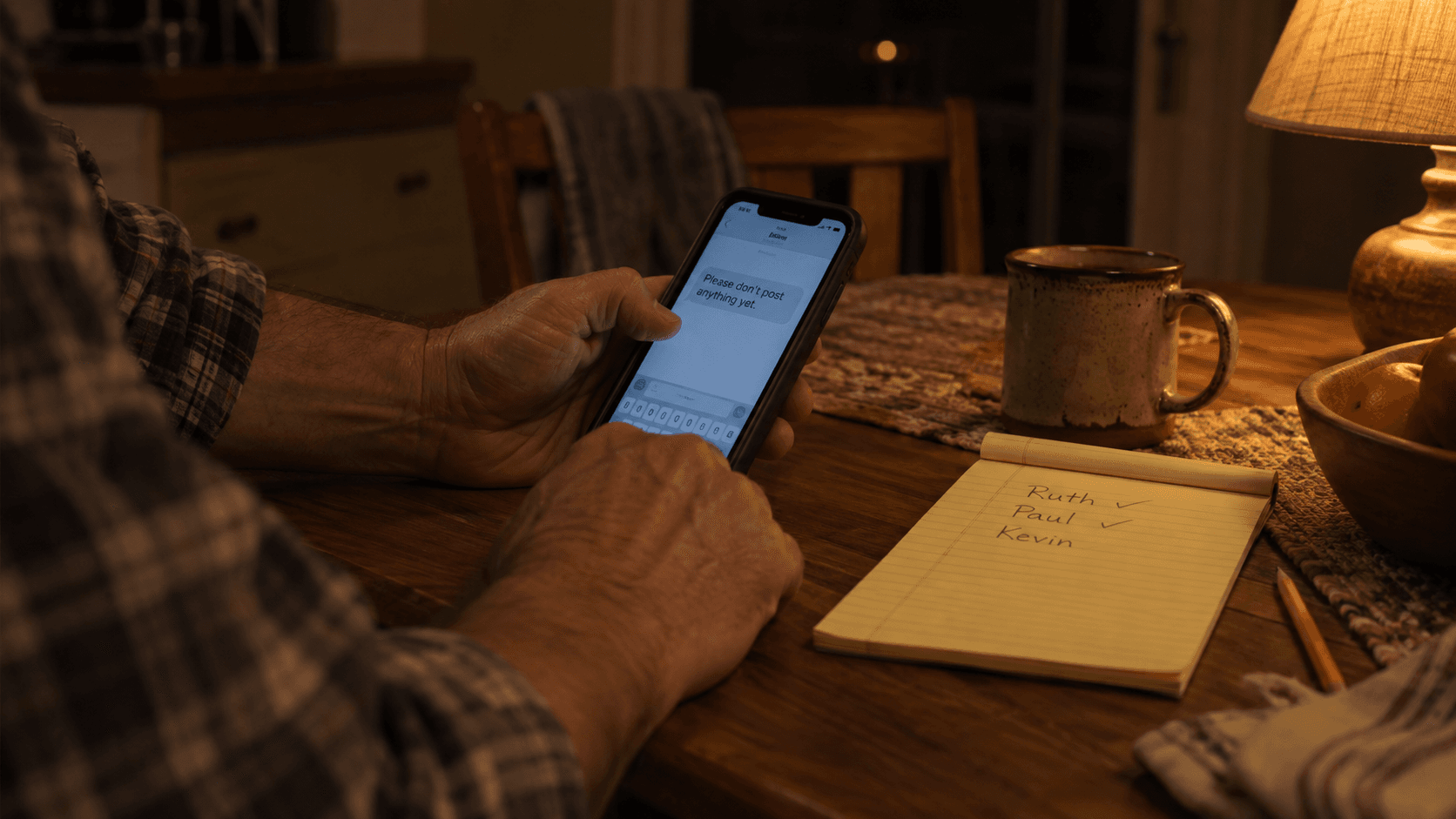
Reach out privately and ask them to take the post down until the family has finished telling the people closest to the loss. Keep it short and kind: 'Please don't post anything yet. We are still reaching [Name]'s brother.' Most people will remove it right away once they understand.
How to Announce a Death on Social Media
Once the inner circle knows, a single, well-written post can spare you dozens of individual conversations. The goal is one clear source of truth that friends can share, rather than a scatter of partial versions that raise more questions than they answer. These steps apply to Facebook but work just as well on most other platforms.
Posting the News on Facebook, Step by Step
Confirm the inner circle knows
Before writing anything public, make sure every close relative (spouses, children, parents, and siblings) has already heard the news directly from a person, not from social media.
Agree on one person to post first
Pick one family member to publish the announcement. Ask everyone else to share or comment on that post instead of writing their own version, which can create confusing, conflicting accounts.
Write a short, clear post
Include the full name, that they died, the date, a line about who they were, and 'details to follow' if arrangements aren't set yet. For example: 'We're sad to share that our mother, Linda Marsh, died peacefully on September 24. Details about a service will follow soon.'
Choose your audience carefully
Set the post to Friends rather than Public if you're not ready for wide sharing, and hold off tagging the person who died until the family feels ready for that.
Update the same post with service details
Once arrangements are confirmed, edit the original post or add a comment with the details, rather than creating a new post that some people might miss entirely.
Decide what happens to their account
Facebook offers options for memorializing the account of someone who has died. Those settings and requirements can change, so check Facebook's current help resources before you decide, and there is no rush to settle this in the first days.
How to Include Funeral Details in a Death Announcement
Funeral details usually belong in a second message or an updated post, not the first announcement, since arrangements are rarely confirmed within the first hour or two. Many families also choose to create a free online memorial page so the details have a permanent home: a Facebook post can get buried in a feed, while a memorial page stays put and holds everything in one place.
Once you're ready to share arrangements, include the service type (visitation, funeral, memorial service, or celebration of life), the date and start time, the venue name, whether it's open to everyone or private to family, a livestream link if there is one, and where to send flowers or make a donation in the person's memory.
Keep public posts lean, though. In 2019, Patch reported a warning from the Westchester County District Attorney's Office after a woman faced 22 charges for allegedly using obituaries to learn when homes would be empty during funeral services. The advice was to ask a friend or relative to house-sit during the service and make it obvious someone is home. It's also wise to leave the family's home address out of anything public and share exact details directly with the people who need them.
There's a financial risk to oversharing, too. In June 2026, New York's Division of Consumer Protection warned that personal details in obituaries can fuel identity theft, naming addresses, birth dates, maiden names, and family members' full names as information scammers look for. Its advice is to keep the notice brief.
If you're preparing something more formal for print, our free death notice template has ready-to-use wording, and our AI obituary writer can turn the same details into a complete tribute without starting from a blank page.
How to Ask People to Hold Off on Calling the Family
Once the news is out, a wave of calls and messages usually follows. It comes from a good place. In her message to the people of New York, read at a memorial service at St. Thomas Church Fifth Avenue after September 11, 2001, Queen Elizabeth II put it in words many families have held onto since:
“Grief is the price we pay for love.”
All of that concern is love that suddenly has nowhere to go. You can honor it and still protect your family's quiet by adding one kind sentence to your announcement and giving people somewhere else to send their care.
- To limit calls: 'The family isn't taking calls right now. Please text or leave a message on her memorial page instead.'
- To route questions: 'For questions about the service, please contact [point person] at [number].'
- To reassure people: 'We'll share details here as soon as we have them.'
Naming one point person and one place for updates (a pinned post or a memorial page) gives people somewhere to check before they pick up the phone. It also means the family only has to share information once instead of repeating it to everyone who reaches out individually.
At work, a short message to a manager or HR, such as 'I need bereavement leave starting today, I'll follow up with details when I can,' is enough. You don't owe an employer a long explanation. And if a call comes in before you're ready to talk, it's fine to say, 'I can't talk right now, but thank you for thinking of us,' and follow up when you have the energy.
Give Everyone One Place to Share Their Love
Instead of answering the same questions on dozens of calls and texts, create a free online memorial page that holds service details, photos, and a guestbook where friends and family can leave their own messages. Share the link in your texts and Facebook post, and every update lives in one place.
Create a Free MemorialHow soon after a death should you announce it?
There's no fixed deadline. Announce it once every member of the inner circle (spouses, children, parents, and siblings) has been told directly, whether that takes a few hours or stretches into the next day. It's better to wait a little longer than to have someone learn the news from social media before you've had the chance to call them.
Is it okay to announce a death by text?
Yes, but only for the wider circle: extended family, friends, coworkers, and neighbors. The closest family should hear it by phone or in person first. A text is also fine as a way to ask someone to call you back privately, as long as it doesn't reveal the news itself.
How do you announce a death on Facebook?
Wait until every close relative knows, then agree on one person to post first so others can share it instead of posting separate versions. Include the full name, that they died, the date, a short line about who they were, and 'details to follow' if arrangements aren't confirmed yet.
Should you tag the person who died in the post?
Not right away. Wait until the immediate family feels ready, since tagging puts the news in front of the person's own friends and connections before everyone has had time to process it. There's no rush, and you can always tag them later.
Who announces a death when there is no close family?
A close friend, neighbor, coworker, or the executor of the estate can take on this role. The same order still helps: tell whoever was closest to the person first, then widen out from there. Our guide on writing an obituary for someone with no surviving family covers this in more detail.
Do you have to share the cause of death?
No. You can say as much or as little as you're comfortable with, and phrases like 'suddenly' or 'after a long illness' are complete answers on their own. The section above on how much detail to share has ready-made lines you can use.
What should you leave out of a public death announcement?
Keep public posts brief. Leave out the family's home address and personal details like a full birth date or maiden name, which consumer protection officials warn can be used for identity theft. Share exact logistics directly with the people who need them.
You Don't Have to Get Every Word Right
There is no perfect script for telling people someone has died. What matters most is the order: the closest people hear it first, privately and plainly, and everyone else hears it from a single clear source once the family is ready.
Lean on others to share the load, give yourself permission to keep some details private, and let one post or one memorial page do the repeating for you. The people who love your family will understand, and in time, the stories they share back with you can become part of how you remember.
Sources
- Federal Bureau of Investigation and Penn State University (guide hosted by the Oregon Department of Justice), We Regret to Inform You... Guide for professionals delivering death notifications with professionalism, dignity, and compassion
- Children's Hospital of Philadelphia, Explaining Death to a Child
- Patch (reporting a warning from the Westchester County District Attorney's Office), DA: Protect Your Home From Burglars Who Target Funerals
- New York Department of State, Division of Consumer Protection, CONSUMER ALERT: New York Department of State's Division of Consumer Protection Provides Tips for Consumers to Avoid Funeral Fraud and End-of-Life Identity Theft
- Saint Thomas Church Fifth Avenue, Grief is the price we pay for love.
Lovekept's guides are drafted with AI against briefs written by the Lovekept team. Abdullah Nabeel, the founder, is the blog's editor. Read how we produce and correct content at /editorial-standards.